View semester dates
MBiochem (Hons) Biochemistry
Prepare to be a biochemist by reaching new frontiers - understand how chemical compounds form living organisms, and grasp the fundamental, physical nature of life itself.
Year of entry: 2027/28
Show year of entry: 2026/27
View semester dates
2nd in the Russell Group for 'Teaching On my Course'
12th in the UK for Biology
Biochemistry sits at the boundary between the physical and life sciences. It concerns the molecular basis of health and disease, contributing to the discovery of new medicines, the growth of biotechnology, and the feeding of a growing population.
Explore how the intersection of the molecular sciences explains life: Within our Biochemistry degree you’ll explore how biochemical understanding is central to addressing global challenges, from developing new drugs for combatting disease to supporting a growing population. As your interests develop across the course, you can tailor your degree with a wide range of option modules drawing upon expertise in both Biology and Chemistry to specialise as you progress through your degree.
Master the methods of a working scientist through training customised to your degree: In Years 1 and 2, bespoke Becoming a Bioscientist modules embed core scientific skills in experimental design, research, communication, and project management into every semester. Hands-on practicals will give you the confidence to undertake your guided, independent research project in Year 3.
Connecting different areas of study: Taught by the Departments of Biology and the Chemistry, this degree draws on outstanding biochemical research expertise. You'll benefit from research-led teaching across microbiology, biological and medicinal chemistry and biotechnology giving you a multidisciplinary perspective on how we are able to understand life at a molecular level.
Study in modern facilities within a vibrant, supportive community: You'll learn in custom-built teaching laboratories, a dedicated computing suite, collaborative workshop spaces, and a student study lounge. Guided by your personal supervisor, academic tutors, and project directors, you’ll discover your strengths, build career-ready skills, and receive tailored support throughout your degree and beyond.
Enjoy the flexibility to add a Year in Industry or Year Abroad, graduating with a MBiochem in Biochemistry (with a Year in Industry) or a MBiochem in Biochemistry (with Study Abroad): Whether you want to gain professional experience in biotech, pharmaceuticals, or research institutes, or spend a year studying overseas, our dedicated Placements Manager will support you from day one.
Develop your research expertise: Designed for aspiring researchers, our Integrated Master's embeds you within one of the UK's leading bioscience departments. You'll work alongside world-class scientists, master specialised techniques, and gain hands-on experience in laboratories driving pioneering discoveries. In Year 4, advanced Master's-level modules and practical training will deepen your scientific knowledge and technical skill set.
Accreditation
This undergraduate course is accredited by the Royal Society of Biology. As a graduate, you will meet in-part the academic and experience requirement for membership and chartered biologist (CBiol).
The Department of Biology provides excellent facilities, and having access to such high-quality resources truly enhances my learning. From modern teaching labs to dedicated study spaces and the impressive Technology Facility, I was in awe of what we had access to during research projects along our university experience.
Course content
This is a flexible and modular course which offers you choices in what you can study. There is the option to spend an additional year in industry or a year abroad as part of this course. If you do not go away for a year, you will continue to progress through your studies within the University.
Year 1
Stage 1 (the first year) consists of core modules which are designed to give you an excellent basis on which to build your future studies and develop your interests.
Core modules
- Becoming a Bioscientist: Core Skills
- Molecular Biology and Biochemistry
- Fundamentals of Chemistry for Biochemists 1
- Becoming a Bioscientist: Biochemical Skills
- Genetics
- Cells to Organisms
Academic integrity module
In addition to the above you will also need to complete our online Academic Integrity module.
Year 2
Core modules
- Becoming a Bioscientist: Experimental Design & Communication
- Becoming a Bioscientist: Research in Action
- Biochemical Reactions & Interactions
- Chemical and Structural Biology
Option modules
You will study two option modules. Examples can be found below. Some option module combinations may not be possible. The options available to you will be confirmed after you begin your course.
- Gene Expression in Action
- Cell Biology
- Molecular Microbiology
- The Immune System
- Neuroscience
- Pharmacology
- Molecular Biotechnology
- Introduction to Bioenterprise
- Medical Genetics
Elective modules
You may be able to replace one option module with an elective module, studying a complementary subject, a language or an interdisciplinary topic.
Year 3
Core modules
Option modules
You will study four option modules. Examples can be found below.
You must choose at least two of the following modules:
- Molecular Machinery in Action
- Advanced Topics in Biotechnology
- Chemistry and Disease
- Molecular Recognition
- Advanced Topics in Gene Expression
You can also choose up to two of the following modules:
- Cancer, Cell and Molecular Biology
- Pathogens
- Ageing and Regenerative Medicine
- Genomics
- Advanced Topics in Neuroscience
- Haematology and Immunology in Health and Disease
- Trends in Microbiology
Some option module combinations may not be possible. The options available to you will be confirmed after you begin your course.
Elective modules
You may be able to replace one option module with an elective module, studying a complementary subject, a language or an interdisciplinary topic.
Our modules may change to reflect the latest academic thinking and expertise of our staff, and in line with Department/School academic planning.
Learning outcomes
Every course at York has been designed to provide clear and ambitious learning outcomes. These learning outcomes give you an understanding of what you will be able to do at the end of the course. We develop each course by designing modules that grow your abilities towards the learning outcomes and help you to explain what you can offer to employers. Find out more about our approach to teaching and learning.
Learning outcomes for this course
- Provide systematic explanations that demonstrate a deep understanding of the principles, concepts and theories on the structure, function, and distribution of the chemical building blocks of life, the macromolecular constituents of living organisms, and the chemical reactions that drive biological processes in cells and organisms, through critical evaluations of the scientific literature at the forefront of Biochemical research.
- Formulate hypotheses, design and execute experiments for the collection, analysis and modelling of biochemical data, that tests the current understanding of biochemical molecules and reactions, and produce figures, graphs and tables explained in comprehensive research reports.
- Identify and critically evaluate state-of-the-art experimental, analytical and quantitative techniques and methodologies, by engaging with practical experience and training in laboratories, demonstrating a deep understanding of the application of cutting-edge research in tackling the major interdisciplinary challenges in Biochemistry of the 21st century.
- Work effectively as an individual, a team member or leader in collaborative groups, by applying logical and critical thinking and reflection to develop creative and innovative solutions to complex problems in biochemical research, and proactively develop and implement safe, ethical, sustainable and socially responsible solutions that would benefit humankind.
- Communicate and interpret complex information with confidence, clarity and precision through written and oral critical review, questioning dogma and thoroughly evaluating the impact of biochemical research in real-world and global issues, to expert, professional, business, industrial and lay audiences.
- Demonstrating self-direction, originality, creativity, and a critical understanding of cutting-edge practice and technology in biochemical research, and apply numerical, quantitative, and computer-based transferable skills to a range of academic and non-academic working environments.
- Specialise in research topics through in-depth critique of the literature, acquisition of advanced data analysis skills, sustained independent investigation of a research question, developing research proposals to solve interdisciplinary challenges and reflecting on their own and other's research processes and approaches.
Fees and funding
The fees and funding information here is for students starting in the 2026/27 academic year.
If you take a year abroad or year in industry you'll pay a reduced rate of fees for that year.
Annual tuition fees
| UK (home) | International and EU |
|---|---|
| £10,050 | £33,500 |
The UK government has announced its intention to increase tuition fees from £9,790 to £10,050 for the 2027/8 academic year. We expect this to apply to new UK (home) undergraduate students starting their studies in September 2027.
UK (home) or international fees?
The level of fee that you will be asked to pay depends on whether you're classed as a UK (home) or international student. Check your fee status.
Fees for subsequent years
- UK (home) fees may increase within the government fee cap in subsequent academic years. We will notify you of any increase as soon as we can.
- International fees are subject to increase in subsequent years in line with the prevailing Consumer Price Index (CPI) inflation rate (up to a maximum of 10%).
More information
For more information about tuition fees, any reduced fees for study abroad and work placement years, scholarships, tuition fee loans, maintenance loans and living costs see undergraduate fees and funding.
Additional costs
Text books and course books are all available in the library or online. We do recommend books you might find useful, reading lists are provided to you when you start your modules, but it is not compulsory for you to buy the books.
Costs for students going abroad or into industry will vary depending on what sort of placement it is and what sort of financial assistance is available.
Funding
We'll confirm more funding opportunities for students joining us in 2026/27 throughout the year.
York, Oxford, Cambridge, Imperial
Just four UK universities are rated Gold for teaching and top ten for research* in the latest national assessment exercises.
* Awarded joint 10th in the Times Higher Education ranking of the Research Excellence Framework 2021.
Teaching and assessment
You’ll study and learn with academics who are active researchers, experts in their field and have a passion for their subjects. Our approach to teaching will provide you with the knowledge, opportunities, and support you need to grow and succeed in a global workplace. Find out more about our approach to teaching and learning.
Teaching format
Teaching is delivered by academic scientists with additional contributions from clinical researchers. Throughout your course there will be strong links between your studies, scientific research and clinical applications. Our approach to teaching will provide you with the knowledge, opportunities, and support you need to grow and succeed in a global workplace. You may be taught by the following methods:
Small-group teaching
Cutting-edge research informs all our teaching activities and our friendly, approachable, and accessible staff are experts in their respective fields. Small-group teaching is an important part of our courses, in tutorials, skills-based and research project modules and in taught modules with group work elements. This approach helps develop your scientific writing, problem solving and communication skills, as well as being a great opportunity to have informal scientific discussions with members of staff about topical issues.
Lectures
You will attend lectures where we will deliver stimulating and thought-provoking perspectives on the major global challenges in biosciences of the 21st century.
Practicals
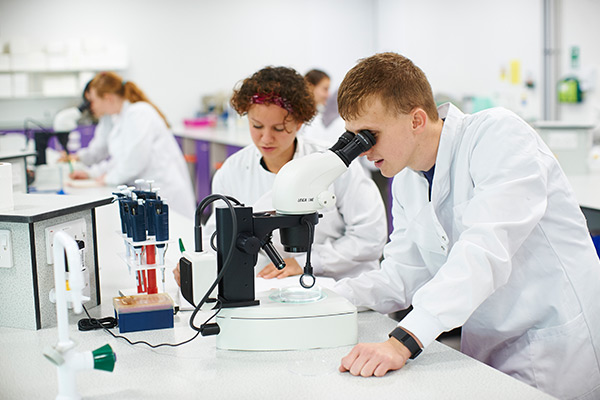
Practicals are designed to help you to develop laboratory skills and to become familiar with a wide range of practical techniques, training you to use methods precisely and encouraging you to objectively assess the reliability of your results.
Workshops
Workshops are also an important feature of our programme and they provide an additional dimension to most modules. You will often collaborate in small groups in problem solving and other learning activities in our flexible learning workshops. You will design your own experiments and work together on the findings from the latest research papers, or investigate the application of new technologies to the global challenges in the biosciences.
Skills and group work
Each semester during the first two years, students take modules designed to develop more generic scientific and transferable skills. Some modules focus on specific scientific techniques, while others develop skills in problem solving, experimental design and data analysis.
We encourage you to develop important communication skills, including working in groups to plan and carry out experiments that investigate a scientific problem, and you will present your work as an oral presentation or poster.
What the integrated Masters year looks like
The final year of an integrated Masters focuses on research. Much of the time, about four days of the week, is spent on your own research project. The rest of the week is spent hearing about research in seminars and journal clubs, writing about research and working in groups on research grant applications.
Timetabled activities
In your first year, you can expect:
| Lectures | 6-8 hours per week |
|---|---|
| Workshops | 2-3 hours per week |
| Practicals | 3-6 hours per week |
| Small-group teaching | 5 hours per semester |
These figures are representative of a typical week. Your contact hours will vary throughout the year due to your module choices, non-compulsory classes, exam periods and changes to scheduled activities.
Outside your timetabled hours, you'll study independently. This may include preparation for classes, follow-up work, wider reading, practice completion of assessment tasks, or revision.
In the UK, full-time students are expected to spend 1,200 hours a year learning. That's about 40 hours of classes and independent study each week during semesters. Everyone learns at a different rate, so the number of hours you spend on independent study will be different to other students on your course.
Facilities
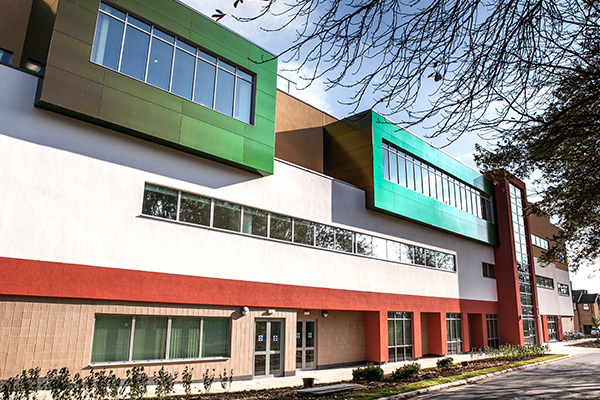
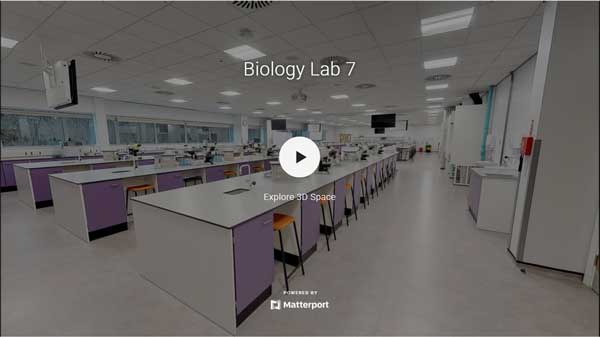
Teaching and learning in the Department of Biology is based in a £23m state-of-the-art facility, which is equipped with laboratories, a flexible workspace and creative learning lounge, computer rooms, specialist tissue culture and fluorescence microscopy suites.
Our teaching labs are equipped with a range of biological techniques that you could engage with while studying your degree including polymerase chain reaction, gel electrophoresis, immunofluorescence microscopy, cell culture and flow cytometry.
Facilities also span York's research centres, such as the York Biomedical Research Institute and Centre for Novel Agricultural Products. The Eleanor and Guy Dodson Building houses a cryo-electron microscope, as well as facilities for protein crystallography and high-field NMR spectroscopy.
Teaching location
This course is based in the Departments of Biology and Chemistry which are on Campus West. The majority of teaching takes place within Biology, with some additional teaching taking place at other locations on Campus West.
About our campus
Our beautiful green campus offers a student-friendly setting in which to live and study, within easy reach of the action in the city centre. It's easy to get around - everything is within walking or pedalling distance, or you can use the fast and frequent bus service. Take a campus tour.
Assessment and feedback
You will be assessed via a mixture of closed exams, online open exams, and continuous assessment. Although you must perform to a satisfactory level, Stage 1 (which is your first year) does not count towards the final degree. Your degree classification is determined by work in Stage 2 (25%), Stage 3 (37.5%) and Stage 4 (37.5%). If you undertake a year abroad or in industry this is marked by pass/fail.
Throughout your course we will provide you with feedback on your work and assignments, which will give you an indication of the progress you are making in your studies.
Careers and skills
A degree in biochemistry provides an excellent basis for science or health-related careers, and for a wide range of other occupations and professions from management and finance, to journalism and teaching.
Studying biochemistry will develop your critical thinking and research skills, and prepare you to be competitive for entry into relevant postgraduate degree programmes.
Employment opportunities are diverse, ranging from biochemical research and development, to careers in science communication, the health service, forensic science and environmental health. Our graduates are not confined to science-related careers, and a significant number enter jobs within finance, public and private sector management, social and health service work, the media and law.
Career opportunities
- Experimental officer
- Research analyst
- Graduate purchaser
- Business development executive
- Accountancy
- Laboratory technician
- Clinic coordinator
- Data manager
- Postgraduate study
- PhD
Transferable skills
- Problem solving
- Communication skills
- Teamworking skills
- Critical and analytical thinking
- Data interpretation and presentation
- Independent study skills
- Logical and critical thinking
- Creativity and innovation
- IT literacy
- Research skills
Entry requirements
| Qualification | Typical offer |
|---|---|
| A levels | AAA including grade A in Chemistry, plus a second science We accept the following subjects as a second science: Biology, Further Mathematics, Geology, Mathematics, Physical Education, Physics or Statistics. |
| Access to Higher Education Diploma | 39 credits at Distinction and 6 credits at Merit or higher. Must include Level 3 modules in Chemistry and a second science. Please contact us for information on the units we accept. |
| BTEC National Extended Diploma | DDD We consider BTEC Level 3 Extended Diploma in Applied Science (2016 syllabus) with all 7 mandatory units plus all 5 Chemistry units: 10,13,14,18, and 19. We consider BTEC Level 3 Extended Diploma in Applied Science (2010 syllabus), please contact us for information on the units we accept. |
| European Baccalaureate | 85% overall, including 8.5 in Chemistry and 8 in a second science. |
| International Baccalaureate | 36 points including 6 in Higher Level Chemistry plus either 5 in another Higher Level science or mathematics subject, or 5 in two Standard Level science or mathematics subjects.We accept the following IB subjects as a second science: Biology, Computer Science, Mathematics (A&A or A&I), Physics |
| T levels | We are currently not accepting T Levels for this course unless additional A Levels (or equivalent qualifications) in Chemistry and a second science or mathematics subject have been taken. |
| Scottish Highers / Advanced Highers | Advanced Highers - AB in Chemistry and a second Science plus Scottish Highers - AB We may also be able to consider three Advanced Highers or a combination of Highers and Advanced Highers, where an applicant does not meet the grade requirement through Highers alone. Please contact us to discuss your qualifications. |
| International foundation programme | Foundation Certificate from our International Pathway College or an appropriate alternative. |
| Other qualifications | To secure a place as a mature student on this course you will need recent qualifications in Chemistry and a second science Biology, Further Mathematics, Geology, Mathematics, Physical Education, Physics or Statistics) at a sufficiently advanced level to cope with the course, together with evidence of some of the key skills needed for studying at degree level. |
| Other international qualifications | Equivalent qualifications from your country |
Alternative offers
Meeting the following additional criteria may qualify you for an alternative offer.
| Criteria | Adjustment |
|---|---|
| Widening participation | BBB including Chemistry and a second science. This is conditional upon successful completion of the WP programme including the YorJourney module (Black Access Programme, Next Step York) or successful completion of Realising Opportunities More about widening participation. |
| Contextual offer | ABB including Chemistry and a second science. |
| EPQ | If you achieve B or higher in the EPQ, you may be eligible for an alternative offer up to one A level grade (or equivalent) below our typical offer. |
| Core Maths | If you achieve B or higher in Core Maths, you may be eligible for an alternative offer up to one A level grade (or equivalent) below our typical offer. |
| MOOCs | If you successfully complete one of our online courses, either Bugs, brains and beasts or Exploring Everyday Chemistry, you may be eligible for an alternative offer up to one A level grade (or equivalent) below our typical offer. Details about how to evidence completion of the MOOC will be sent in your offer letter. Please note: you do not need to pay for the certificate. More about MOOCs. |
English language
If English isn't your first language you may need to provide evidence of your English language ability. We accept the following qualifications:
| Qualification | Minimum requirement |
|---|---|
| IELTS (Academic) | 6.5, with a minimum of 6.0 in each component |
| Other English language qualifications | To see what other language tests we can accept and the scores required, visit our IELTS equivalences webpage and click on the IELTS requirement for your chosen course. We also accept various school-leaving certificates to meet our English Language requirements. Please visit our country-specific information for further details. |
For more information see our undergraduate English language requirements.
If you haven't met our English language requirements
You may be eligible for one of our pre-sessional English language courses. These courses will provide you with the level of English needed to meet the conditions of your offer.
The length of course you need to take depends on your current English language test scores and how much you need to improve to reach our English language requirements.
After you've accepted your offer to study at York, we'll confirm which pre-sessional course you should apply to via You@York.
Next steps
Contact us
Get in touch if you have any questions
Discover York