Skip to content Accessibility statement

BSc (Hons) Interactive Media with Games

Build a future in games design and development, from mobile experiences to sprawling 3D virtual ecosystems and Extended Reality.

Year of entry: 2027/28

UCAS code
WG25
Institution code
Y50
Start date
September 2027
View semester dates
Length
3 years full-time
Typical offer

Apply for this course

BSc Interactive Media with Games merges immersive world design with critical explorations of AI, empowering creators to define the next generation of digital play.

Why study Interactive Media with Games at York?

Develop the technical mastery and creative vision to build a career in gaming. You'll combine applied computer programming with 3D asset creation, UX/UI design and real-time engine architecture. Create content for virtual and augmented reality, mobile, interactive installations and more. Critically analyse the ethical, economic, and cultural implications of artificial intelligence. By understanding the factors that shape global gaming culture, you’ll learn to create responsible, inclusive innovations that welcome all players.

You don't need a background in coding or digital design. Whether you are a complete beginner or an experienced programmer, our structured pathways ensure you build the exact technical foundation you need. You'll learn to develop projects from concept to completion, combining programming, design principles, and media theory.

Gain industry connections and prepare for your career. Our project-based assessments mean you'll graduate with a portfolio that showcases your skills and creativity. We have regular masterclasses with people working in the industry and our annual Interactive Media Showcase displays students’ projects to visiting professionals. You’ll also have access to careers support from our in-house employability team and could choose a year in industry. You'll graduate as a well-rounded professional capable of navigating the complex landscape of the digital economy, from UX/UI design to AAA game studios.

Computer programming: tailored to you

We offer two distinct routes in your first year to match your prior experience with computer programming. If you already have programming experience (like a Computer Science A-level or equivalent), you’ll study our applied route by taking the Creative Coding module. If you have limited previous experience with coding, you'll take the foundational route instead with the Programming for Digital Media module, designed to get you up to speed by teaching the basic principles of coding from scratch.

I took a summer internship with CoSTAR Live Lab. It exposed me to current research in immersive technologies, helped boost my knowledge, gain industry experience and try new things like marketing. I even worked with professionals designing meta humans in Unreal Engine. Not only have I gained skills for my career, I’ve met so many people and can apply what I’ve learned in the final year of my degree.
Emily, BSc Interactive Media. Read Emily's blog post.
Motion capture studio, audio and edit suites, postproduction and interactive media rooms
Create your own portfolio to show to prospective employers. Our annual Creative Technologies Showcase promotes student work to visitors from across the industry.

Course content

We offer two distinct routes in your first year to match your prior experience with computer programming. If you already have programming experience (like a Computer Science A-level or equivalent), you’ll study our applied route by taking the Creative Coding module. If you have limited previous experience with coding, you'll take the foundational route instead with the Programming for Digital Media module, designed to get you up to speed by teaching the basic principles of coding from scratch.

  • Year 1 - six core modules
  • Year 2 - five core modules and one option module
  • Year 3 - one core module, three option modules and a Games-Specialism Individual Project

Year 1

You'll learn how to create audio and visual assets for games and interactive media, the nature of interactive storytelling and how to use coding to create games and interactive media artefacts.

Develop your digital media programming and production skills, solve problems with computers using algorithmic abstractions and computational models, and turn your ideas into prototypes. You'll take on a creative project idea of your choice, and advance your ability to critically analyse games and interactive media systems.

Core Modules

You will study six core modules. All students will take the following five modules:

If you have studied computer programming before (at A-level, or equivalent), you'll take the applied coding route which includes the additional core module Creative Coding

If you have limited or no prior computer programming experience, you'll take the foundational coding route which includes the additional core module Programming for Digital Media

Academic integrity module

In addition to the above you will also need to complete our online Academic Integrity module.

This module covers some of the essential skills and knowledge which will help you to study independently and produce work of a high academic standard which is vital for success at York.

This module will:

  • define academic integrity and academic misconduct
  • explain why and when you should reference source material and other people's work
  • provide interactive exercises to help you to assess whether you've understood the concepts
  • provide answers to FAQs and links to useful resources.

Year 2

In Year 2, your focus on games will really develop through learning how to make production quality virtual environments in real-time engines and advancing your 3D modelling skills. You'll continue to enhance your programming, media production, design and critical analysis skills and learn to combine them to create games and complex 3D virtual environments. You will also learn user-experience design techniques for understanding how users interact with games and interactive media. Your group project will develop essential team working skills, and you'll complete the entire process of game design and development from concept creation to evaluation. At the end of the academic year, we'll support you in finding games and interactive media industry placements and prepare you for your final year project. 

Core modules

Option modules

You will study one option. You can choose either an Interactive Media option and or an option from the School's other subject areas. Some option module combinations may not be possible. The options available to you will be confirmed after you begin your course.

From the School of Arts and Creative Technologies

Elective modules

You may be able to replace one option module with an elective module, studying a complementary subject, a language or an interdisciplinary topic.

Year 3

A major part of your third year is devoted to your final project, which allows you to develop a games-related idea in depth and demonstrate all the skills and knowledge you've gathered during the course. 

Core Modules

Option Modules

You will study three option modules. Examples can be found below. Some option module combinations may not be possible. The options available to you will be confirmed after you begin your course.

Elective modules

You may be able to replace one option module with an elective module, studying a complementary subject, a language or an interdisciplinary topic.

Our modules may change to reflect the latest academic thinking and expertise of our staff, and in line with Department/School academic planning.

Learning outcomes

Every course at York has been designed to provide clear and ambitious learning outcomes. These learning outcomes give you an understanding of what you will be able to do at the end of the course. We develop each course by designing modules that grow your abilities towards the learning outcomes and help you to explain what you can offer to employers. Find out more about our approach to teaching and learning.

Learning outcomes for this course
  • Ideate, initiate, plan, design and execute interactive media and games projects, both individually and collaboratively, by synthesising creative, artistic, analytic, and technical skills from concept to deployment.
  • Identify needs for mediated expression, communication and interaction and devise, model, evaluate and communicate meaningful interactive media concepts and artefacts that address them through the application of user experience design methodologies.
  • Create high quality interactive media and games assets, including graphics, pictures, 3D models, video, sound and virtual environments through the application of aesthetic principles, understanding of human perception and application of dedicated authoring tools and contemporary games engines.
  • Select, devise and apply appropriate algorithmic abstractions to model behaviour of games and interactive media artefacts and express such models in computer programming languages.
  • Adhere to established norms of professional conduct that operate in relation to interactive media and games.
  • Theorise interactions between games, media, technology and culture, and critique the social, political and cultural implications of such interactions employing relevant theoretical frameworks
  • Mediate conversations between people of various specialities involved in the process of interactive media and games development, including designers, art and content creators, software developers, business operators, and media analysts.
  • Apply creative problem-solving and analytical rigour to complex professional, real-world scenarios, communicate ideas with clarity and persuasiveness.
York is a UNESCO city of Media Arts
Also a member of the Creative Cities network. From digital innovation to media arts, York is a meeting point for creativity and ideas.
Create and innovate
Learn to create 3D virtual worlds, tell stories, create experiences

Fees and funding

The fees and funding information here is for students starting in the 2026/27 academic year.

If you take a year abroad or year in industry you'll pay a reduced rate of fees for that year.

The UK government has announced its intention to increase tuition fees from £9,790 to £10,050 for the 2027/8 academic year. We expect this to apply to new UK (home) undergraduate students starting their studies in September 2027.

UK (home) or international fees?

The level of fee that you will be asked to pay depends on whether you're classed as a UK (home) or international student. Check your fee status.

Fees for subsequent years

  • UK (home) fees may increase within the government fee cap in subsequent academic years. We will notify you of any increase as soon as we can.
  • International fees are subject to increase in subsequent years in line with the prevailing Consumer Price Index (CPI) inflation rate (up to a maximum of 10%).

More information

For more information about tuition fees, any reduced fees for study abroad and work placement years, scholarships, tuition fee loans, maintenance loans and living costs see undergraduate fees and funding.

Funding

We'll confirm more funding opportunities for students joining us in 2026/27 throughout the year.

York, Oxford, Cambridge, Imperial

Just four UK universities are rated Gold for teaching and top ten for research* in the latest national assessment exercises.

* Awarded joint 10th in the Times Higher Education ranking of the Research Excellence Framework 2021.

Teaching and assessment

You’ll study and learn with academics who are active researchers, experts in their field and have a passion for their subjects. Our approach to teaching will provide you with the knowledge, opportunities, and support you need to grow and succeed in a global workplace. Find out more about our approach to teaching and learning.

Teaching format

York's BSc in Interactive Media with Games is taught by academics at the forefront of research that also have hands-on industry experience. You'll learn through a mixture of lectures, small-group seminars, practicals, one-to-one tutorials and masterclasses with visiting industry leaders.

  • Our £35m arts and media complex houses exceptional facilities and equipment to support professional production and is central to our teaching.
  • You'll learn in bespoke computer labs, with access to a wide range of interactive media, a dedicated studio for immersive technologies and VR productions, TV and theatre equipment for specialist projects.

Explore our facilities

Timetabled activities

In your first year, you can expect:

Lectures 4-5 hours per week
Seminars 1 hour per week
Practicals 6-8 hours per week
Play sessions 0-4 hours per week

These figures are representative of a typical week. Your contact hours will vary throughout the year due to your module choices, non-compulsory classes, exam periods and changes to scheduled activities.

Outside your timetabled hours, you'll study independently. This may include preparation for classes, follow-up work, wider reading, practice completion of assessment tasks, or revision.

In the UK, full-time students are expected to spend 1,200 hours a year learning. That's about 40 hours of classes and independent study each week during semesters. Everyone learns at a different rate, so the number of hours you spend on independent study will be different to other students on your course.

Teaching location

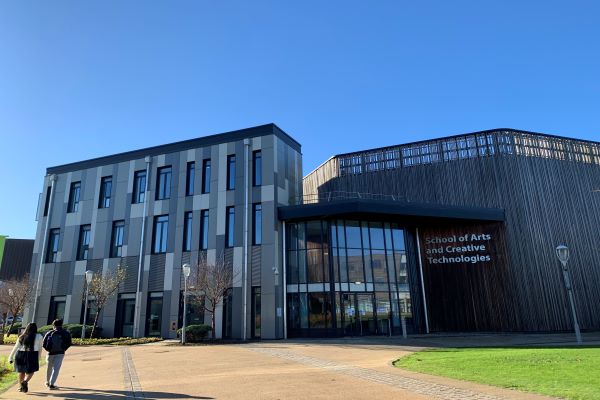
You will be based in the School of Arts & Creative Technologies on Campus East.

Most of your contact hours will be in the School. Some elective module teaching may also take place on Campus West.

About our campus

Our beautiful green campus offers a student-friendly setting in which to live and study, within easy reach of the action in the city centre. It's easy to get around - everything is within walking or pedalling distance, or you can use the fast and frequent bus service. Take a campus tour.

Assessment and feedback

You'll complete a variety of written and practical assignments, including: interactive prototypes, computer programs, group project, written essays, technical reports and exams.

  • For project work, you can choose themes that suit your interests, with the opportunity to develop a theme throughout the three years, moving from prototypes to research and development of a fully functioning system.
  • You'll receive feedback on all summative and formative assignments, mostly in the form of written comments.
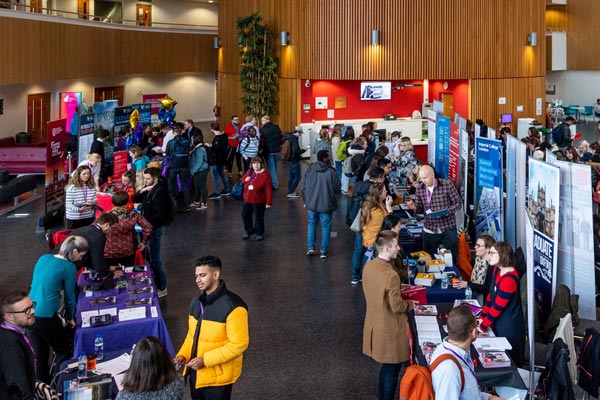
Every year, the School holds the Creative Technologies Showcase to display the works of BSc Interactive Media students. The event showcases our projects, like virtual reality games, humanities projects, web designs, mobile apps, and more. It's a great opportunity for our work to be recognised by other students, staff, and visiting industry professionals. It's a great way to build professional connections!
Pak-Yin, BSc Interactive Media. Read Pak-Yin's blog post.

Careers and skills

You'll graduate as a well-rounded professional capable of navigating the complex landscape of the digital economy. Whether your path leads to AAA game studios, indie development, UI/UX design, or virtual production, you will possess the agility, technical skill, and critical insight to make your mark on the future of the games and interactive media industries.

Career opportunities

  • Web/AR/VR software developer 
  • Digital content producer 
  • Game​​ developer/designer/programmer 
  • Game QA Tester / Analyst 
  • Technical Artist 
  • Asset Designer / 3D modeler
  • Front end web developer/designer
  • Web designer 
  • User experience (UX) designer 
  • User interface (UI) designer 
  • Digital marketer ​ 
  • Project manager 
  • Engagement manager 
  • Social media manager 
  • Digital communications manager​
  • Storytelling/script writing for interactive and immersive production
  • Metaverse developer

Transferable skills

  • Creative systems design
  • Critical thinking
  • Computer programming
  • Digital media production
  • Independent research skills
  • Teamwork
  • Leadership
  • Planning
  • Communication: oral presentations and digital media techniques
  • Time management
  • Writing: technical reports and critical essays

Entry requirements

Qualification Typical offer
A levels

ABB

Access to Higher Education Diploma 30 credits at Distinction and 15 credits at Merit or higher
BTEC National Extended Diploma DDM

We consider a range of BTEC qualifications equivalent to 3 A Levels, or in combination with A Levels or other qualifications. For example:

Distinction, Distinction in BTEC Level 3 National Diploma plus B at A Level

Distinction in BTEC Level 3 National Extended Certificate plus AB at A level

Distinction, Distinction in 2 BTEC Level 3 National Extended Certificates plus B at A level
European Baccalaureate 75% overall
International Baccalaureate 34 points
T levels Distinction overall
T Level subjects in Accounting; Design and Development for Engineering and Manufacturing; Design, Surveying and Planning for Construction; Digital Business Services; Digital Production, Design and Development; Digital Support and Services; Engineering, Manufacturing, Processing and Control; Finance; Health; Healthcare Science; Legal Services; Maintenance, Installation and Repair for Engineering and Manufacturing; Management and Administration; Marketing; Science

Distinction overall including grade A in the Core in T Level in Media, Broadcast and Production
Scottish Highers / Advanced Highers Scottish Highers - ABBBB

Advanced Highers - not required for entry

We may also be able to consider three Advanced Highers or a combination of Highers and Advanced Highers, where an applicant does not meet the grade requirement through Highers alone. Please contact us to discuss your qualifications.
International foundation programme Foundation Certificate from our International Pathway College or an appropriate alternative.
Other international qualifications Equivalent qualifications from your country

Additional requirements

If you have Computer Science A Level (or acceptable equivalent) you will be assigned to our Applied coding route.

If you don't have Computer Science (or acceptable equivalent) you will be assigned to the Foundation coding route. If you don't have Computer Science A Level (or acceptable equivalent) but can evidence strong programming foundation skills in other ways, e.g. through providing examples of your own work, we may be able to assign you to the Applied Coding route. Please contact the Admissions Tutor by emailing act-im-admissions@york.ac.uk to discuss this further.

Alternative offers

Meeting the following additional criteria may qualify you for an alternative offer.

Criteria Adjustment
Widening participation BBC
This is conditional upon successful completion of the WP programme including the YorJourney module (Black Access Programme, Next Step York) or successful completion of Realising Opportunities More about widening participation.
Contextual offer BBB
EPQ If you achieve C or higher in the EPQ, you may be eligible for an alternative offer up to one A level grade (or equivalent) below our typical offer.
Core Maths If you achieve B or higher in Core Maths, you may be eligible for an alternative offer up to one A level grade (or equivalent) below our typical offer.
MOOCs If you successfully complete our online course Fundamentals of Creative Technologies and Interactive Media , you may be eligible for an alternative offer up to one A level grade (or equivalent) below our typical offer. Details about how to evidence completion of the MOOC will be sent in your offer letter. Please note: you do not need to pay for the certificate. More about MOOCs.

English language

If English isn't your first language you may need to provide evidence of your English language ability. We accept the following qualifications:

Qualification Minimum requirement
IELTS (Academic) 6.5, with a minimum of 6.0 in each component
IB English A score of 4 in English A or 5 in English B (Higher Level or Standard Level)
Cambridge CEFR 176, with a minimum of 169 in each component
Oxford ELLT 7, with a minimum of 6 in each component
Oxford Test of English Advanced 136, with a minimum of 126 in each component
Duolingo Integrated subscores: 120 overall, with a minimum of 105 in each component
GCSE/IGCSE/O level English Language (as a first or second language) Grade C / Grade 4
LanguageCert SELT B2 with a minimum score of 33/50 in each component
LanguageCert Academic B2 with a minimum score of 33/50 in each component
Kaplan Test of English Language 478 Main Flight score with 444 in each component
Skills for English B2: Merit overall, with Pass with Merit in each component
PTE Academic 61, with a minimum of 55 in each component
TOEFL 87 overall, with a minimum of 21 in each component (taken before January 2026)
4.5 with 5 in Listening and 4.5 in each other component (taken after January 2026)
Other English language qualifications We also accept other English Language qualifications, including various school-leaving certificates.

For more information see our undergraduate English language requirements.

If you haven't met our English language requirements

You may be eligible for one of our pre-sessional English language courses. These courses will provide you with the level of English needed to meet the conditions of your offer.

The length of course you need to take depends on your current English language test scores and how much you need to improve to reach our English language requirements.

After you've accepted your offer to study at York, we'll confirm which pre-sessional course you should apply to via You@York.

Discover York

We offer a range of campus accommodation to suit you and your budget, from economy to premium.
Explore campus and city life and hear what our current students have to say about living here.
Lively, full of culture and beautiful, York is regularly voted one of the best places to live and visit in the UK.
Find out more about York. Chat to staff and students and take the tour, on campus or online.