View semester dates
BA (Hons) History/Philosophy
Experience culture, uncover the past and understand the world in a degree that explores the fundamentals of human nature.
Year of entry: 2026/27
View semester dates
8th in the UK for history
3rd in the UK for the impact of our research in history
Why study history and philosophy at York?
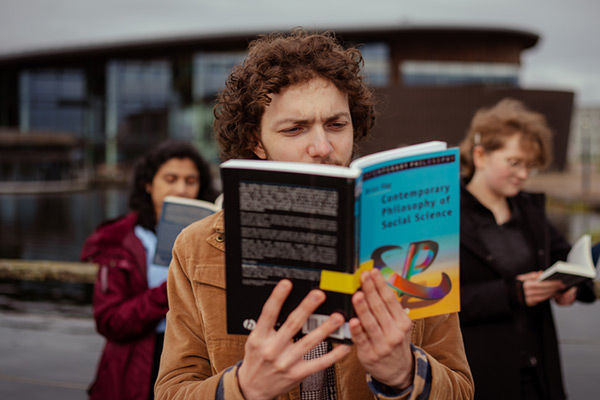
Take an interdisciplinary view. Combining history and philosophy allows you to explore enduring questions that have shaped past societies and cultures, and analyse the processes of at the heart of historical change.
Explore an extensive range of history modules. From the Middle Ages to the present day, our world-leading historians offer a wide range of modules spanning geographic, cultural and thematic boundaries. You'll hone your skills in critical reading, constructing arguments, and how to effectively use evidence.
Philosophy teaching is informed by groundbreaking research. We collaborate across disciplines and make significant contributions to contemporary debates. Our modules span historical and cultural boundaries, from classical through to current issues. You'll hone your skills in critical reading, research and constructing nuanced arguments. Apply philosophical reasoning to the history and origins of society.
Studying both History and Philosophy allows you to gain such a well-rounded understanding of the world, especially with the range of topics and modules available to study at York. I’ve enjoyed developing many different interests with experts in their field to guide you.
Millie, History and Philosophy student.
Course content
You can choose to focus your studies on specific periods and geographical areas, different types of history (social, political, cultural or intellectual), or different branches of philosophy (from logic and metaphysics, to philosophy of mind, to moral or political philosophy).
You'll take a balance of modules in history and half in philosophy.
In between your second and third year, you'll get the opportunity to study abroad. You'll be able to pursue opportunities that match your academic interests and we'll support you with learning a language where necessary.
Year 1
Your first year develops your basic knowledge of argument, reason and ethics. You'll also dive into popular and important periods throughout history.
Core modules
- Philosophical Analysis
- Knowledge and Perception
- Knowledge and Beliefs in World History
- Evidence and Methods
Optional modules
You will study two option modules. Examples can be found below. Some option module combinations may not be possible. The options available to you will be confirmed after you begin your course.
- Political Communities in World History
- Societies and Economies in World History
- Logic
- Ethics
- Free Will
Academic integrity module
In addition to the above you will also need to complete our online Academic Integrity module.
Year 2
You'll spend your second year exploring history through the context of the past and present. In semester 1, you'll study one history Explorations option module, and two philosophy option modules. In semester two, you'll study the core module Historical Thinking. You'll also choose one philosophy option module and either one History Explorations module or an elective.
Core module
Option modules
You will study five option modules. Examples can be found below. Some option module combinations may not be possible. The options available to you will be confirmed after you begin your course.
Philosophy
- Aesthetics
- Applied Ethics
- Being and Reason: Spinoza's Metaphysics
- Knowledge and the Social Sciences
- Religious Ethics
- Politics and Freedom: Anarchism and Conservatism
- Metaphysics
- Logic and Paradox
- Love, Law, and Solidarity: Recognition from Rousseau to Honneth
- Philosophy of Mind
- Philosophy of Language
- Philosophy of Science
- The Limits of Reason: Kant's Theoretical and Practical Philosophy
History Explorations
- Empire and Cultural Exchange in Asia 1500-1700
- Black Radicalism
- Ancien Régime France, 1610-1789
- Before the Mongols: Nomadic Empires of Central Eurasia, 900-1200
- Using and Abusing the Past in Britain, 1835-2018
- Gender, Enlightenment and Revolution in Eighteenth-Century Europe
- From the Global Shadows: Africa and the World since the 1950s
- Health for all? International Health from Colonial Medicine to Covid Vaccine
- Powerful Impressions: Culture and Politics in the Post-1945 United States
- Heterosexual Africa? Sexuality, Power, and Politics in Africa since 1900
- Persecution and Toleration in Early Modern Britain
- Catherine the Great
- Social Science and Modern Britain, c1880-c1970
- Crime and Society in Britain and Ireland since 1750
- Bankers, Merchants, and Poets: Florence and the Roots of the Renaissance
- Communist Europe: Crisis, Transformation & Memory after the Second World War
- Historical Fictions and Frictions: Fictionalising the Past
- Chivalry, Identity and Love 1350-1450
- Vikings and Historians: Historiographical Dialogues through the Ages
- The Scientific Revolution, 1500-1700
- Containing Multitudes: Inequality and the City in Britain and its Empire post-1800
Elective modules
You may be able to replace one option module with an elective module, studying a complementary subject, a language or an interdisciplinary topic.
Year 3
In your final year of the History and Philosophy degree, you'll have the option of writing a dissertation or taking on a research project, as well as taking multiple in-depth courses in philosophy and history.
All students take one History Special Subject option (taken in two parts, one per semester) and two Philosophy options. They then take:
- History Dissertation, or
- Philosophy Short Dissertation, plus either:
- a Philosophy option module
- a Comparative History option module
- an elective module.
Option modules
You will study three option modules. Examples can be found below. Some option module combinations may not be possible. The options available to you will be confirmed after you begin your course.
Philosophy
- Action and Agency
- Buddhism as Philosophy
- Causation and Laws
- Cognitive Anomalies, Decision-Making and Democracy
- Consciousness
- Contemporary Issues in Bioethics
- Experimental Philosophy: The Philosophy of Psychology
- Foundations of Mathematics
- German Idealism: Moral, Legal & Political Philosophy
- Mind and Morality
- Nine Art Works, Nine Philosophical Problems
- Philosophy of Christianity
- Philosophy of Physics
- Property and Self-ownership
- Theories of Social Justice: Rawls and Beyond
- The Nature of Time
- Topics in Feminist Philosophy
- World and Mind
Comparative History
History Special Subjects
- The First Islamic Empire
- From Colonial to Post-Colonial States? The Twentieth-Century Caribbean
- Imperial Japan, 1890-1950
- Popular Politics? The History of British Political Culture since 1945
- The French Wars of Religion
- Race, Place and Health in Britain and its Empire, 1880-1960
- Hong Kong: Decolonisation and Development, 1945-97
- Thomas More: Learning, Politics and Religion in England, 1500-35
- Ploughing the Sea? The Spanish American Wars of Independence, 1750-1830
- Rome Reborn: Culture and Society c.1575-c.1655
- Prussia and the Unification of Germany, 1815-1918
- Mao and Maoism
- Reading and Writing in Medieval England
- Exiled Lives: English Nuns in Catholic Europe, 1600-1800
- Poverty and the Welfare State in Post-War Britain
- Joan of Arc
- Revolution in the Streets: Faith, Poverty, & Religious Ferment, c.1200
- Francis Bacon: Myth, Magic and Morals
- Black British History and Decolonisation
Elective modules
You may be able to replace one option module with an elective module, studying a complementary subject, a language or an interdisciplinary topic.
Our modules may change to reflect the latest academic thinking and expertise of our staff, and in line with Department/School academic planning.
Learning outcomes
Every course at York has been designed to provide clear and ambitious learning outcomes. These learning outcomes give you an understanding of what you will be able to do at the end of the course. We develop each course by designing modules that grow your abilities towards the learning outcomes and help you to explain what you can offer to employers. Find out more about our approach to teaching and learning.
Learning outcomes for this course
- Communicate in-depth understandings of historical scholarship and a sophisticated appreciation of the use of analytical frameworks and concepts derived from philosophy in interpreting the past.
- Understand and explain key problems, issues, and debates across a range of areas of philosophy and its history—including some at the forefront of contemporary work – and apply this understanding to the resolution of new problems.
- Develop and articulate solutions to problems and puzzles, make an evaluation of the merits of different potential solutions and make a measured judgement about what is the best solution in each case, supporting that judgement with a sustained line of argument.
- Demonstrate versatility in their ability to interpret, evaluate and deploy a variety of information types, including digital resources, material culture, visual imagery, texts, databases and statistical information.
- Engage critically and constructively with the arguments and ideas of others, with an awareness of historical and cultural context, and make effective use of feedback and self-evaluation to extend their own skills and improve performance.
- Convey ideas with clarity and precision and make sustained, original and persuasive arguments that utilise evidence and methodologies from history and philosophy.
- Work effectively and productively as thinkers and learners, individually and in collaboration with others—planning and scheduling, seeking help where appropriate, initiating and pursuing projects, and working with others in the pursuit of knowledge and understanding.
- Engage as informed citizens with the political, cultural, social and ethical aspects of contemporary debates and issues by using insights gained through the study of past societies and ideas, theories and analytical methods from philosophy.
Fees and funding
The fees and funding information here is for students starting in the 2026/27 academic year.
If you take a year abroad or year in industry you'll pay a reduced rate of fees for that year.
Annual tuition fees
| UK (home) | International and EU |
|---|---|
| £9,535 (TBC) | £26,900 |
The UK government has announced its intention to increase tuition fees from £9,535 to £9,790 for the 2026/27 academic year. We expect this to apply to new UK (home) undergraduate students starting their studies in September 2026.
UK (home) or international fees?
The level of fee that you will be asked to pay depends on whether you're classed as a UK (home) or international student. Check your fee status.
Fees for subsequent years
- UK (home) fees may increase within the government fee cap in subsequent academic years. We will notify you of any increase as soon as we can.
- International fees are subject to increase in subsequent years in line with the prevailing Consumer Price Index (CPI) inflation rate (up to a maximum of 10%).
More information
For more information about tuition fees, any reduced fees for study abroad and work placement years, scholarships, tuition fee loans, maintenance loans and living costs see undergraduate fees and funding.
Additional costs
You will have to pay for the cost of printing some assignments for submission as assessed work in Years 2 and 3.
Funding
We'll confirm more funding opportunities for students joining us in 2026/27 throughout the year.
- UK government loans
- UK scholarships and bursaries
- International scholarships
- Country-specific funding
- US loans
Department funding
York, Oxford, Cambridge, Imperial
Just four UK universities are rated Gold for teaching and top ten for research* in the latest national assessment exercises.
* Awarded joint 10th in the Times Higher Education ranking of the Research Excellence Framework 2021.
Teaching and assessment
You’ll study and learn with academics who are active researchers, experts in their field and have a passion for their subjects. Our approach to teaching will provide you with the knowledge, opportunities, and support you need to grow and succeed in a global workplace. Find out more about our approach to teaching and learning.
Teaching format
Research-led teaching here at York makes learning interactive and engaging. This includes lecturers, seminars, discussion groups, specialist workshops and field trips.
You'll be taught in small, interactive seminars of 10-20 students, in which you'll engage with the module content and explore any questions.
Timetabled activities
In your first year, you can expect:
| Lectures | 6 hours per week |
|---|---|
| Seminars | 5-6 hours per week |
These figures are representative of a typical week. Your contact hours will vary throughout the year due to your module choices, non-compulsory classes, exam periods and changes to scheduled activities.
Outside your timetabled hours, you'll study independently. This may include preparation for classes, follow-up work, wider reading, practice completion of assessment tasks, or revision.
In the UK, full-time students are expected to spend 1,200 hours a year learning. That's about 40 hours of classes and independent study each week during semesters. Everyone learns at a different rate, so the number of hours you spend on independent study will be different to other students on your course.
Facilities
We are home to the Borthwick Institute for Archives, a major archive repository in Britain. It holds the records of the Archbishopric of York from the early thirteenth century onwards, and specialises in the study of ecclesiastic institutions.
There are several other important archives housed at York, including the JB Morrell Library and the Raymond Burton Library for Humanities Research. These contain collections covering subjects such as the British Civil Wars, French Revolution and Modern Asian history. Find out more about our libraries.
Teaching location
You will be based in both the Department of History and the Department of Philosophy which are situated on Campus West.
Nearly half of your teaching will take place in the Spring Lane building. The rest of your contact hours will take place in other locations on Campus West.
About our campus
Our beautiful green campus offers a student-friendly setting in which to live and study, within easy reach of the action in the city centre. It's easy to get around - everything is within walking or pedalling distance, or you can use the fast and frequent bus service. Take a campus tour.
Assessment and feedback
Your first-year work doesn't contribute toward your final marks. We recognise that students are only beginning to develop over the course of their degree.
From Year 2 onward, formal assessments contribute toward your degree. Most History modules will let you write a practice essay before assessment.
You'll be assessed using a range of methods, including essays, research projects, written exams, group projects and presentations.
Careers and skills
The analytical and communication skills you learn with a History and Philosophy degree are the first steps to your successful career. You'll be able to tackle complex problems with confidence and intellectual independence, as well as communicate your ideas clearly and make persuasive arguments.
Career opportunities
Our graduates have gone on to work in sectors such as:
- Law
- Social work
- Marketing and communications
- Politics, diplomacy and government
- Broadcasting and journalism
- Teaching
- Publishing
Transferable skills
You'll graduate with invaluable transferable skills such as:
- Critical and analytical thinking
- Logic building
- Problem-solving
- Excellent communication skills
- Time management
- Ability to analyse a variety of media
York is a beautiful city. It’s quite a privilege to spend your days encountering that history, stumbling around incredibly long cobbled streets! I really miss it as a place. That’s why I’ve loved coming back for the past nine years to give talks – it feels like coming full circle.
Public Historian & Podcast Host
Entry requirements
| Qualification | Typical offer |
|---|---|
| A levels | AAB including an A in either History or Classical Civilisation |
| Access to Higher Education Diploma | Obtain Access to HE Diploma with 36 credits at Distinction including at least 9 credits in History-related units and 9 credits at Merit or higher |
| BTEC National Extended Diploma | DDD with an additional A Level or equivalent qualification in History or Classical Civilisation at grade A |
| European Baccalaureate | 80% overall, including 85% in History |
| International Baccalaureate | 35 points, including 6 in History at Higher Level |
| T levels | We are currently not accepting T Levels for this course unless an additional A Level (or equivalent qualification) in History has been taken. |
| Scottish Highers / Advanced Highers | Advanced Highers - B in History plus Scottish Highers - BBBB We may also be able to consider three Advanced Highers or a combination of Highers and Advanced Highers, where an applicant does not meet the grade requirement through Highers alone. Please contact us to discuss your qualifications. |
| International foundation programme | Foundation Certificate from our International Pathway College or an appropriate alternative. |
| Other international qualifications | Equivalent qualifications from your country |
Alternative offers
Meeting the following additional criteria may qualify you for an alternative offer.
| Criteria | Adjustment |
|---|---|
| Widening participation | BBC including B in either History or Classical Civilisation This is conditional upon successful completion of the WP programme including the YorJourney module (Black Access Programme, Next Step York) or successful completion of Realising Opportunities More about widening participation. |
| Contextual offer | ABC including an A in either History or Classical Civilisation |
| EPQ | If you achieve A or higher in the EPQ, you may be eligible for an alternative offer up to one A level grade (or equivalent) below our typical offer. |
| MOOCs | If you successfully complete our online course Logic: the language of truth, you may be eligible for an alternative offer up to one A level grade (or equivalent) below our typical offer. Details about how to evidence completion of the MOOC will be sent in your offer letter. Please note: you do not need to pay for the certificate. More about MOOCs. |
English language
If English isn't your first language you may need to provide evidence of your English language ability. We accept the following qualifications:
| Qualification | Minimum requirement |
|---|---|
| IELTS (Academic) | 6.5, with a minimum of 6.0 in each component |
| IB English | A score of 4 in English A or 5 in English B (Higher Level or Standard Level) |
| Cambridge CEFR | 176, with a minimum of 169 in each component |
| Oxford ELLT | 7, with a minimum of 6 in each component |
| Oxford Test of English Advanced | 136, with a minimum of 126 in each component |
| Duolingo | Integrated subscores: 120 overall, with a minimum of 105 in each component |
| GCSE/IGCSE/O level English Language (as a first or second language) | Grade C / Grade 4 |
| LanguageCert SELT | B2 with a minimum score of 33/50 in each component |
| LanguageCert Academic | B2 with a minimum score of 33/50 in each component |
| Kaplan Test of English Language | 478 Main Flight score with 444 in each component |
| Skills for English | B2: Merit overall, with Pass with Merit in each component |
| PTE Academic | 61, with a minimum of 55 in each component |
| TOEFL | 87 overall, with a minimum of 21 in each component |
| Trinity ISE III | Merit in all components |
| Other English language qualifications | We also accept other English Language qualifications, including various school-leaving certificates. |
For more information see our undergraduate English language requirements.
If you haven't met our English language requirements
You may be eligible for one of our pre-sessional English language courses. These courses will provide you with the level of English needed to meet the conditions of your offer.
The length of course you need to take depends on your current English language test scores and how much you need to improve to reach our English language requirements.
After you've accepted your offer to study at York, we'll confirm which pre-sessional course you should apply to via You@York.
Next steps
Contact us
Get in touch if you have any questions
History Undergraduate Admissions
Discover York