View semester dates
LLB (Hons) International Human Rights Law
Apply the law to advance the struggle for human rights around the world
Year of entry: 2026/27
View semester dates
Human rights lawyers fight against injustice and ensure the oppressed know that they're not alone.
Applications for this course are closed to applicants for 2026/27. Applications for 2027/28 will open in September.
The York Law School's LLB in International Human Rights provides you with the skills and experience to confidently contribute to the struggle for social justice in the UK and around the world. You will develop as a problem solver and creative, critical thinker through a problem-based learning (PBL) approach working collaboratively to analyse real-world human rights violations and pursue remedies.
This innovative degree combines academic rigour with global, applied and interdisciplinary perspectives on human rights ensuring you develop an understanding of human rights law in all its contexts. As part of your degree, you will meet human rights defenders, be taught by expert staff with experience around the world on human rights issues and work alongside human rights practitioners on real human rights problems and cases.
Professional Qualification
This degree meets requirements that can enable you to progress to the next stages of professional qualification as a barrister or solicitor in England and Wales. You will be able to progress to the next stages of becoming a human rights lawyer or any other type of lawyer. In addition, it may also contribute to the entry requirements of qualification in other jurisdictions.
One of the best things at York Law School is seeing a lecturer passionately talk about their module. Quite often it makes me forget I’m studying a degree because they make you feel as though you are their intellectual equals. They ask for your opinion on legal matters and take your responses into genuine consideration.
Fees and funding
The fees and funding information here is for students starting in the 2026/27 academic year.
If you take a year abroad or year in industry you'll pay a reduced rate of fees for that year.
Annual tuition fees
| UK (home) | International and EU |
|---|---|
| £9,535 (TBC) | £27,500 |
The UK government has announced its intention to increase tuition fees from £9,535 to £9,790 for the 2026/27 academic year. We expect this to apply to new UK (home) undergraduate students starting their studies in September 2026.
UK (home) or international fees?
The level of fee that you will be asked to pay depends on whether you're classed as a UK (home) or international student. Check your fee status.
Fees for subsequent years
- UK (home) fees may increase within the government fee cap in subsequent academic years. We will notify you of any increase as soon as we can.
- International fees are subject to increase in subsequent years in line with the prevailing Consumer Price Index (CPI) inflation rate (up to a maximum of 10%).
More information
For more information about tuition fees, any reduced fees for study abroad and work placement years, scholarships, tuition fee loans, maintenance loans and living costs see undergraduate fees and funding.
Additional costs
Although students may decide to purchase some textbooks or other resources, we have an extensive physical and electronic library, so that there is no requirement to do so.
Funding
We'll confirm more funding opportunities for students joining us in 2026/27 throughout the year.
- UK government loans
- UK scholarships and bursaries
- International scholarships
- Country-specific funding
- US loans
We offer a number of scholarships to help cover the cost of tuition fees and living costs:
York, Oxford, Cambridge, Imperial
Just four UK universities are rated Gold for teaching and top ten for research* in the latest national assessment exercises.
* Awarded joint 10th in the Times Higher Education ranking of the Research Excellence Framework 2021.
Teaching and assessment
You'll study and learn with academics who are active researchers, experts in their field, engaged in human rights advocacy and litigation, and have a passion for their subjects. Our approach to teaching will provide you with the knowledge, opportunities, and support you need to grow and succeed in a global workplace.
Teaching format
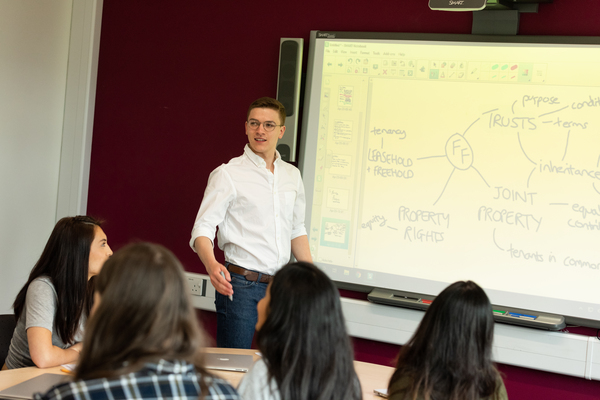
Our LLB is taught mainly through problem-based learning. This method will simulate the practice of human rights law and develop your skills of analysis, reasoning and judgement. Through this approach you'll also develop communication and project management skills that will enhance your effectiveness in the world of work.
You will be part of a student law firm during your studies. Your firm will be faced with complex legal issues as part of each of your modules; you will decide how you want to operate as a firm, build relationships within your team, and collectively approach these problems in a realistic way. Your firm may be working alongside or in opposition to other firms.
You will learn to identify the key legal principles, and establish what you know as well as what you need to ascertain. Through this process, you will reflect on deeper social and theoretical issues, such as questions of justice, fairness and human rights. Tutor-facilitators will guide you through particular points and issues, helping you maximise your time of study.
You'll also learn through a range of other resources including: plenary lectures, written subject guides, and a variety of relevant material in our virtual learning environment.
In the UK, full-time students are expected to spend 1,200 hours a year learning. That's about 40 hours of classes and independent study each week during semesters. Everyone learns at a different rate, so the number of hours you spend on independent study will be different to other students on your course.
Facilities
York Law School has a dedicated Problem Based Learning Suite and mock up court room for our students. You can use these during your contact hours and for independent studying. Our Baroness Hale Legal Clinic provides a hub for our legal activism and an opportunity to pursue human rights advocacy and work on live cases. The Centre for Applied Human Rights, affiliated with the Law School and the Department of Politics and International Relations, is an interdisciplinary research and teaching platform for academics, activists, policymakers and others to discuss shared challenges and co-produce solutions.
Teaching location
York Law School is located on Campus East. Nearly all of your teaching will take place within the Law and Sociology building or nearby on Campus East.
About our campus
Our beautiful green campus offers a student-friendly setting in which to live and study, within easy reach of the action in the city centre. It's easy to get around - everything is within walking or pedalling distance, or you can use the fast and frequent bus service. Take a campus tour.
Assessment and feedback
York Law School uses two main forms of assessment, formative and summative.
- Formative assessment provides feedback on coursework tasks and your general contribution in PBL and Skills sessions. This does not count towards your final module grades.
- Summative assessment consists of formal skills-based coursework tasks, examinations and formal assessment of individual contribution in PBL and Skills sessions as part of some modules. These assessments will count towards your final module grades.
You will sit all examinations (and assignments generally) as an individual. They have, however, been specially designed to reflect the PBL learning process and so facilitate group work as a means of preparation.
In addition, many modules, including all Foundation Stream modules, will assess your performance using coursework, including focused essays and more general reflective assignment.
The transition into university life was made much smoother by the exceptional student support at York. When I first arrived in York, I was feeling a variety of emotions – excited, worried, anxious, just to name a few. However, in my opinion, from the orientation programmes to the approachable academic staff, the support network here has been invaluable.
Careers and skills
Our pioneering Careers and Development programme will help to ensure you are ready to pursue your chosen career path. Created through collaboration with leading local, national and international firms and key vocational providers, the programme includes professional skills workshops, personal development, mentoring schemes and link days.
We also have a dedicated full-time Employability Tutor, who can give you advice on a wide range of matters, from CV and assessment centre techniques to general career planning.
We have established a wide range of professional links and partnering arrangements. Through these you benefit from 'real world' lawyers as part of the teaching team and gain access to practical, work-based learning opportunities that can help you to prepare for your career.
Career opportunities
Qualifying as a solicitor or a barrister
If you wish to qualify as a solicitor (in England and Wales), the Solicitors Regulation Authority (SRA) requirements are that you:
• have a degree-level qualification or equivalent;
• pass two solicitor qualification examinations – SQE1 and SQE2;
• complete two years of qualifying work experience (QWE); and
• meet character and suitability requirements.
Your LLB from YLS will fulfil the first requirement, and enable you to develop elements of the legal knowledge and skills assessed in SQE1 and SQE2.
If you wish to qualify as a barrister, the first stage of qualification is to meet the academic requirements of the Bar Standards Board (BSB). Your LLB from YLS includes the seven foundations of legal knowledge required by the BSB for the academic component of barrister training.
Qualifying as a lawyer in another jurisdiction
If you want to qualify as a lawyer in another jurisdiction your law degree from YLS may be recognised as contributing to the entry requirements of the professional stage of legal training.
Undertaking further study or research
Our thriving research environment offers a number of postgraduate study opportunities. We have a number of taught postgraduate programmes and welcome proposals for MPhil and PhD study. As an LLB student here you can prepare for further study and experience working with academic colleagues through our research internship programme.
Transferable skills
- Communication and presentation skills
- Analytical and problem solving skills
- Negotiation
- Project management
- The ability to formulate an opinion based on a rounded view of an issue or problem
Entry requirements
| Qualification | Typical offer |
|---|---|
| A levels | AAA |
| Access to Higher Education Diploma | 39 credits achieved from units awarded Distinction and 6 awarded Merit or higher. Please note that all Access Diploma and Foundation Degree applications are considered in light of all academic achievement. |
| BTEC National Extended Diploma | D*DD |
| European Baccalaureate | 85% overall |
| International Baccalaureate | 36 Points |
| T levels | Distinction overall including grade A* in the Core T Level subjects in Accounting; Design and Development for Engineering and Manufacturing; Design, Surveying and Planning for Construction; Digital Business Services; Digital Production, Design and Development; Digital Support and Services; Engineering, Manufacturing, Processing and Control; Finance; Health; Healthcare Science; Legal Services; Maintenance, Installation and Repair for Engineering and Manufacturing; Management and Administration; Marketing; Science |
| Scottish Highers / Advanced Highers | Scottish Highers - AAABB Advanced Highers - not required for entry We may also be able to consider three Advanced Highers or a combination of Highers and Advanced Highers, where an applicant does not meet the grade requirement through Highers alone. Please contact us to discuss your qualifications. |
| International foundation programme | Foundation Certificate from our International Pathway College or an appropriate alternative. |
| Other qualifications | Canadian Ontario Secondary School Diploma: Average of 85% in six Grade 12 U or M level courses. British Columbia High School Diploma: Average of 85% in four Grade 12 courses. |
| Other international qualifications | Equivalent qualifications from your country |
Alternative offers
Meeting the following additional criteria may qualify you for an alternative offer.
| Criteria | Adjustment |
|---|---|
| Widening participation | BBB This is conditional upon successful completion of the WP programme including the YorJourney module (Black Access Programme, Next Step York) or successful completion of Realising Opportunities More about widening participation. |
| Contextual offer | ABB |
| EPQ | We recognise the value of this qualification although it will not be included as a condition of entry. It may be taken into consideration when you receive your results. |
English language
If English isn't your first language you may need to provide evidence of your English language ability. We accept the following qualifications:
| Qualification | Minimum requirement |
|---|---|
| IELTS (Academic) | 6.5, with a minimum of 6.0 in each component |
| IB English | A score of 4 in English A or 5 in English B (Higher Level or Standard Level) |
| Cambridge CEFR | 176, with a minimum of 169 in each component |
| Oxford ELLT | 7, with a minimum of 6 in each component |
| Oxford Test of English Advanced | 136, with a minimum of 126 in each component |
| Duolingo | Integrated subscores: 120 overall, with a minimum of 105 in each component |
| GCSE/IGCSE/O level English Language (as a first or second language) | Grade C / Grade 4 |
| LanguageCert SELT | B2 with a minimum score of 33/50 in each component |
| LanguageCert Academic | B2 with a minimum score of 33/50 in each component |
| Kaplan Test of English Language | 478 Main Flight score with 444 in each component |
| Skills for English | B2: Merit overall, with Pass with Merit in each component |
| PTE Academic | 61, with a minimum of 55 in each component |
| TOEFL | 87 overall, with a minimum of 21 in each component (taken before January 2026) 4.5 with 5 in Listening and 4.5 in each other component (taken after January 2026) |
| Trinity ISE III | Merit in all components |
| Other English language qualifications | We also accept other English Language qualifications, including various school-leaving certificates. |
For more information see our undergraduate English language requirements.
If you haven't met our English language requirements
You may be eligible for one of our pre-sessional English language courses. These courses will provide you with the level of English needed to meet the conditions of your offer.
The length of course you need to take depends on your current English language test scores and how much you need to improve to reach our English language requirements.
After you've accepted your offer to study at York, we'll confirm which pre-sessional course you should apply to via You@York.
Next steps
Contact us
Get in touch if you have any questions
Stephen Levett | Admissions Tutor
Martin Jones | Programme Leader
Department
Related courses
Discover York