View semester dates
Full entry requirements
Unravel how Earth's features and natural processes influence our surroundings.
Year of entry: 2027/28
Show year of entry: 2026/27
It's important to understand the physical environment and its impacts on humans.
This understanding will help us to address the world's environmental challenges. During the course you'll explore several aspects of physical geography including glaciers, rivers, and coastal environments as well as environmental hazards. You'll also have the opportunity to explore other aspects of geography such as climate change, ecology and sustainability.
Throughout your studies, you'll delve into the relationships between the environment and humans. You'll develop academic knowledge and practical skills to tackle real-world sustainability challenges presented in our physical environment.

Our courses are currently accredited by the Institute of Environmental Sciences.
The modules from semester one provided a great bridge between A-levels and uni. Some of the information overlapped with my Environmental science A-level which made it easier to process and piece together.
Understand the physical processes at work in our environment. See how they respond to our changing environments. You'll develop the tools to develop sustainable solutions to environmental problems.
For example, you will learn about the impact of humans on the environment. You will learn how climate change is altering landscapes. You will also consider the changes needed to solve complex sustainability problems.
The first year modules give you an introduction to the basics of the course, providing you with a foundation for advanced material in the future.
Core modules
In addition to the above you will also need to complete our online Academic Integrity module.
You will take a range of core modules to develop your knowledge of environmental geography. You can then begin to tailor your degree to your own interests with a choice of option modules.
You will study two option modules. Examples can be found below. Some option module combinations may not be possible. The options available to you will be confirmed after you begin your course.
You may be able to replace one option module with an elective module, studying a complementary subject or an interdisciplinary topic.
You have the option to pursue a placement year in Year 3 or Year 4 of your integrated Masters, extending your time at York by one year. Whilst you are on placement you'll retain your student status and receive your placement year within your degree title.
It's your responsibility to find and secure your work placement but you'll be supported throughout the process by a dedicated member of staff.
Your placement must be between 9 and 12 months and start during the summer vacation. You can choose to do a placement of 9 or 12 months or two shorter placements that total 9 or 12 months of experience.
You will be assigned a Placement Supervisor for the duration of your placement who will keep in touch with you throughout your placement and undertake supervision meetings with you.
The placement year is an assessed, pass/fail module that is added to your existing programme of study. The assessment is in the form of a 3000 word reflective report with supporting reflective blogs, it is assessed by Careers and Placements.
Placements can be found throughout industry and you're encouraged to focus on your desired outcomes for the placement year in considering the industry in which you would like to secure a placement.
All placements will be subject to the University placement approval process and must meet the Placement Criteria.
In Year 4 you undertake advanced research training to prepare the way to your fourth year of masters study. You can also select option modules to suit your interests and employment objectives.
You will study two option modules. Examples can be found below. Some option module combinations may not be possible. The options available to you will be confirmed after you begin your course.
In Year 5 you undertake further advanced training and a significant independent research project tailored to your research interests and career ambitions.
You will study two option modules. Examples can be found below. Some option module combinations may not be possible. The options available to you will be confirmed after you begin your course.
Our modules may change to reflect the latest academic thinking and expertise of our staff, and in line with Department/School academic planning.
Every course at York has been designed to provide clear and ambitious learning outcomes. These learning outcomes give you an understanding of what you will be able to do at the end of the course. We develop each course by designing modules that grow your abilities towards the learning outcomes and help you to explain what you can offer to employers. Find out more about our approach to teaching and learning.
The fees and funding information here is for students starting in the 2026/27 academic year.
If you take a year abroad or year in industry you'll pay a reduced rate of fees for that year.
| UK (home) | International and EU |
|---|---|
| £9,790 | £32,350 |
The UK government has announced its intention to increase tuition fees from £9,790 to £10,050 for the 2027/8 academic year. We expect this to apply to new UK (home) undergraduate students starting their studies in September 2027.
The level of fee that you will be asked to pay depends on whether you're classed as a UK (home) or international student. Check your fee status.
For more information about tuition fees, any reduced fees for study abroad and work placement years, scholarships, tuition fee loans, maintenance loans and living costs see undergraduate fees and funding.
Field work is integral to your course and includes both residential and day trips. In year 1 and 2 there are core residential and day field trips. The travel and accommodation costs of these core trips are included in your student fees. Optional field trips are not paid for, and you will be asked to contribute to the cost of these. The destinations of our residential field trips do change to meet the requirements of our students, acknowledge the pressing environmental challenges we face and meet our commitment to sustainability and inclusivity.
A reduced fee will be payable to the University of York for your year in industry, but you will be responsible for accommodation and travel costs for your placement.
We'll confirm more funding opportunities for students joining us in 2026/27 throughout the year.
Just four UK universities are rated Gold for teaching and top ten for research* in the latest national assessment exercises.
* Awarded joint 10th in the Times Higher Education ranking of the Research Excellence Framework 2021.
You’ll study and learn with academics who are active researchers, experts in their field and have a passion for their subjects. Our approach to teaching will provide you with the knowledge, opportunities, and support you need to grow and succeed in a global workplace. Find out more about our approach to teaching and learning.
Teaching includes field-based learning, research-led teaching and a more traditional combination of lectures, tutorials, and seminars.
Practical work is a key feature, both in individual projects and in groups.
Field work is integral to your course and includes both residential and day trips. In year 1 and 2 there are core residential and day field trips. In year 3 there is also an optional field module.
For the Placement Year, a dedicated member of staff will guide you through the process of finding a placement. You will be assigned a supervisor for your placement and be expected to contribute academic work based on your experience. Placements can be local, national or international.
In your first year, you can expect:
| Lectures | 4-6 hours per week |
|---|---|
| Seminars | 1-2 hours per week |
| Workshops | 2-4 hours per week |
| Practicals | 2-4 hours per week |
| Field trips | 1 week |
These figures are representative of a typical week. Your contact hours will vary throughout the year due to your module choices, non-compulsory classes, exam periods and changes to scheduled activities.
Outside your timetabled hours, you'll study independently. This may include preparation for classes, follow-up work, wider reading, practice completion of assessment tasks, or revision.
In the UK, full-time students are expected to spend 1,200 hours a year learning. That's about 40 hours of classes and independent study each week during semesters. Everyone learns at a different rate, so the number of hours you spend on independent study will be different to other students on your course.

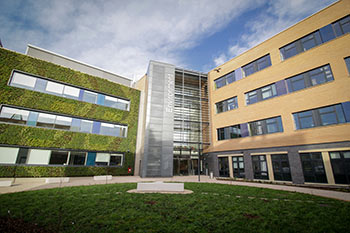
Our bespoke building contains purpose-built labs, lecture theatres and seminar rooms.
You will be based in the Department of Environment and Geography, which is based on Campus West.
Our beautiful green campus offers a student-friendly setting in which to live and study, within easy reach of the action in the city centre. It's easy to get around - everything is within walking or pedalling distance, or you can use the fast and frequent bus service. Take a campus tour.
Each module will be assessed either by coursework, closed or open examinations, or a combination of both. Coursework can include:
If you’re looking to broaden your skill set and widen the scope of your degree, sustainability and environmental awareness can be worked positively into any employment opportunity, and the Sustainbility Clinic module is a great way to find out how.
Your degree in physical geography and environment will help you become a numerate graduate with practical, applied skills. You'll also learn to communicate clearly in written reports and during oral presentations. Find out more about careers and employability.
| Qualification | Typical offer |
|---|---|
| A levels |
We accept the following subjects as a second science: Biology, Chemistry, Environmental Studies, Geography, Geology, Mathematics, Physics, Psychology or Life and Health Sciences |
| BTEC National Extended Diploma | DD in the BTEC National Diploma plus A level Geography or Geology. If you are studying for the BTEC National Extended Diploma or a different combination of A levels and BTEC qualifications please contact us at ug-admissions@york.ac.uk for advice. |
| European Baccalaureate | 80% overall including Geography or; 75% overall including Geography plus a second science (Biology, Chemistry, Environmental Studies, Geography, Geology, Mathematics, Physics, Psychology or Life and Health Sciences) |
| International Baccalaureate | 35 points including 5 in Geography at Higher Level or; 34 points including 5 in Geography at Higher Level plus a second science (Biology, Chemistry, Geography, Geology, Mathematics (either Analysis and Approaches or Applications and Interpretations), Physics, Psychology or Life and Health Sciences) at Higher level. |
| T levels | We are currently not accepting T Levels for this course unless an additional A Level (or equivalent qualification) in Geography has been taken. |
| Scottish Highers / Advanced Highers | Advanced Highers - B in Geography plus Scottish Highers - BBBB We may also be able to consider three Advanced Highers or a combination of Highers and Advanced Highers, where an applicant does not meet the grade requirement through Highers alone. Please contact us to discuss your qualifications. |
| International foundation programme | Foundation Certificate from our International Pathway College or an appropriate alternative. |
| Other international qualifications | Equivalent qualifications from your country |
You should also have GCSE Mathematics at grade 4 (C) or above, or equivalent.
Meeting the following additional criteria may qualify you for an alternative offer.
| Criteria | Adjustment |
|---|---|
| Widening participation | BBC including B in Geography or Geology. This is conditional upon successful completion of the WP programme including the YorJourney module (Black Access Programme, Next Step York) or successful completion of Realising Opportunities More about widening participation. |
| Contextual offer | BBB including Geography or Geology |
| EPQ | If you achieve C or higher in the EPQ, you may be eligible for an alternative offer up to one A level grade (or equivalent) below our typical offer. |
| Core Maths | If you achieve B or higher in Core Maths, you may be eligible for an alternative offer up to one A level grade (or equivalent) below our typical offer. |
| MOOCs | If you successfully complete our online course Tackling environmental challenges for a sustainable future, you may be eligible for an alternative offer up to one A level grade (or equivalent) below our typical offer. Details about how to evidence completion of the MOOC will be sent in your offer letter. Please note: you do not need to pay for the certificate. More about MOOCs. |
If English isn't your first language you may need to provide evidence of your English language ability. We accept the following qualifications:
| Qualification | Minimum requirement |
|---|---|
| IELTS (Academic) | 6.5, with a minimum of 6.0 in each component |
| IB English | A score of 4 in English A or 5 in English B (Higher Level or Standard Level) |
| Cambridge CEFR | 176, with a minimum of 169 in each component |
| Oxford ELLT | 7, with a minimum of 6 in each component |
| Oxford Test of English Advanced | 136, with a minimum of 126 in each component |
| Duolingo | Integrated subscores: 120 overall, with a minimum of 105 in each component |
| GCSE/IGCSE/O level English Language (as a first or second language) | Grade C / Grade 4 |
| LanguageCert SELT | B2 with a minimum score of 33/50 in each component |
| LanguageCert Academic | B2 with a minimum score of 33/50 in each component |
| Kaplan Test of English Language | 478 Main Flight score with 444 in each component |
| Skills for English | B2: Merit overall, with Pass with Merit in each component |
| PTE Academic | 61, with a minimum of 55 in each component |
| TOEFL | 87 overall, with a minimum of 21 in each component (taken before January 2026) 4.5 with 5 in Listening and 4.5 in each other component (taken after January 2026) |
| Trinity ISE III | Merit in all components |
| Other English language qualifications | We also accept other English Language qualifications, including various school-leaving certificates. |
For more information see our undergraduate English language requirements.
You may be eligible for one of our pre-sessional English language courses. These courses will provide you with the level of English needed to meet the conditions of your offer.
The length of course you need to take depends on your current English language test scores and how much you need to improve to reach our English language requirements.
After you've accepted your offer to study at York, we'll confirm which pre-sessional course you should apply to via You@York.
Get in touch if you have any questions