Skip to content Accessibility statement

BSc (Hons) Economics and Management

Combine Economics and Management to explore complex social, financial, and organisational challenges.

Year of entry: 2026/27

UCAS code
LN12
Institution code
Y50
Start date
September 2026
View semester dates
Length
3 years full-time
Typical offer
UK (home) fees
£9,535 (TBC)
International and EU fees
£27,500

Apply for this course

Are you curious about how markets work and what drives management decision-making in business and government?  This programme brings together the two disciplines of Economics and Management to equip you with the skills and knowledge to examine complex economic and business issues.

Whether you aspire to work in consultancy, policy, finance, business, or further study, this programme will provide you with the required rigorous analytical training of Economics and the practical knowledge of Business and Management.

Economics is concerned with how consumers, firms and governments make decisions that together determine how resources are allocated and Management is concerned with their effective use.  By combining these two disciplines you will learn to gather and evaluate relevant data, and use economic principles and management theories to inform sound, ethical decisions.

 It's been a long journey, and I always emphasize that it started at York, where I learned so much of the economics I've used throughout my career.

Professor Daron Acemoğlu (BA Economics, 1989; Nobel Prize for Economic Sciences, 2024)

We’re 14th in the UK for research - according to the Times Higher Education’s ranking of the latest REF results (2021).
Committed to equality
The Department received an Athena SWAN Bronze Award in 2020 in recognition of our commitment to gender equality.
Highly Regarded
We're ranked 18th in the UK for Economics in the Complete University Guide (CUG) 2026.

Course content

Throughout the programme you will be taught by experts in Economics and Management, learn through real-world case studies and engage with data-driven projects in a collaborative learning environment.  You’ll also be supported in developing your digital and professional skills, through use of technology-enhanced learning tools and data software, as well as opportunities to present your work in multiple formats. If you choose to take a placement year, you will gain valuable experience in applying your learning in a practical setting.

Year 1

Core modules

Academic integrity module

In addition to the above you will also need to complete our online Academic Integrity module.

This module covers some of the essential skills and knowledge which will help you to study independently and produce work of a high academic standard which is vital for success at York.

This module will:

  • define academic integrity and academic misconduct
  • explain why and when you should reference source material and other people's work
  • provide interactive exercises to help you to assess whether you've understood the concepts
  • provide answers to FAQs and links to useful resources.

Our modules may change to reflect the latest academic thinking and expertise of our staff, and in line with Department/School academic planning.

Learning outcomes

Every course at York has been designed to provide clear and ambitious learning outcomes. These learning outcomes give you an understanding of what you will be able to do at the end of the course. We develop each course by designing modules that grow your abilities towards the learning outcomes and help you to explain what you can offer to employers. Find out more about our approach to teaching and learning.

Learning outcomes for this course
  • Promote reflective, internationally, socially, and ethically-aware approaches and principles to complex economic and management issues.
  • Identify and analyse complex societal and organisational challenges by drawing on economic principles and management theories, applying them appropriately in a range of business and policy contexts.
  • Apply logical, mathematical, and computational reasoning to economic and managerial problems, including through the use of formal models and simulations, with critical awareness of their assumptions and limitations.
  • Collect, evaluate, and present economic, financial, and operational data, demonstrating understanding of data limitations, and using suitable tools for evidence-based analysis and recommendations.
  • Critically assess public policy and management strategies in terms of economic logic, institutional constraints, and socio-ethical outcomes, demonstrating global and inclusive awareness.
  • Make sound managerial and policy decisions by integrating quantitative evidence, ethical reasoning, and strategic thinking, while considering diverse cultural, societal, and environmental impacts.
  • Communicate economic and management arguments clearly, using a range of media and styles suitable for academic, technical, and professional audiences.
  • Demonstrate critical self-awareness, reflect on learning and practical experience, and adapt to new challenges in economic and managerial contexts, promoting lifelong learning and personal development.                                                                                                                                                
In my time at York, I have never felt as if I was being taught a ‘textbook version’ of economics. Given the level of expertise each lecturer has in delivering their modules, and the breadth of choice, it was truly a unique learning experience.
Daian, BSc Economics and Econometrics. Read Daian's blog post.

Fees and funding

The fees and funding information here is for students starting in the 2026/27 academic year.

If you take a year abroad or year in industry you'll pay a reduced rate of fees for that year.

Annual tuition fees

UK (home) International and EU
£9,535 (TBC) £27,500

The UK government has announced its intention to increase tuition fees from £9,535 to £9,790 for the 2026/27 academic year. We expect this to apply to new UK (home) undergraduate students starting their studies in September 2026.

UK (home) or international fees?

The level of fee that you will be asked to pay depends on whether you're classed as a UK (home) or international student. Check your fee status.

Fees for subsequent years

  • UK (home) fees may increase within the government fee cap in subsequent academic years. We will notify you of any increase as soon as we can.
  • International fees are subject to increase in subsequent years in line with the prevailing Consumer Price Index (CPI) inflation rate (up to a maximum of 10%).

More information

For more information about tuition fees, any reduced fees for study abroad and work placement years, scholarships, tuition fee loans, maintenance loans and living costs see undergraduate fees and funding.

Funding

We'll confirm more funding opportunities for students joining us in 2026/27 throughout the year.

York, Oxford, Cambridge, Imperial

Just four UK universities are rated Gold for teaching and top ten for research* in the latest national assessment exercises.

* Awarded joint 10th in the Times Higher Education ranking of the Research Excellence Framework 2021.

Teaching and assessment

You’ll study and learn with academics who are active researchers, experts in their field and have a passion for their subjects. Our approach to teaching will provide you with the knowledge, opportunities, and support you need to grow and succeed in a global workplace. Find out more about our approach to teaching and learning.

Teaching format

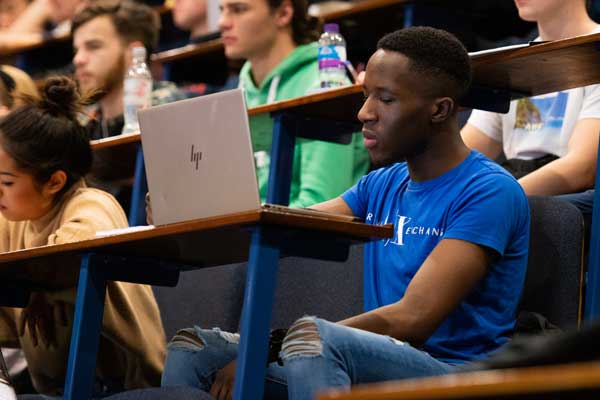
You will be encouraged to work creatively and independently but you won’t be on your own. Our expert tutors are available to offer guidance and support. Modules are taught via a series of lectures supported by discussion group seminars and practical classes. We place a strong focus on applying academic theory to real-life situations to improve planning, teamwork and research skills.

Our academics have links with industry and are knowledgeable about emerging developments in the sector, so you can be sure you will gain a well-informed account of the issues and challenges facing the fields of economics and management. In addition, each module has its own area on the virtual learning environment that provides easy access to supporting learning materials.

In the UK, full-time students are expected to spend 1,200 hours a year learning. That's about 40 hours of classes and independent study each week during semesters. Everyone learns at a different rate, so the number of hours you spend on independent study will be different to other students on your course.

Teaching location

You will be based in the Department of Economics and Related Studies on Campus West. Your teaching will take place in a variety of locations on Campus West.

About our campus

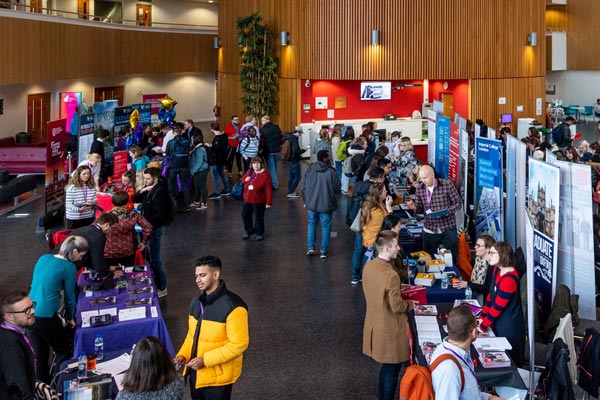
Our beautiful green campus offers a student-friendly setting in which to live and study, within easy reach of the action in the city centre. It's easy to get around - everything is within walking or pedalling distance, or you can use the fast and frequent bus service. Take a campus tour.

Assessment and feedback

Assessment varies from module to module and includes a combination of exams, written essays and project work.

Your tutors will give feedback in a variety of forms depending on the specific needs of the module. This may consist of written feedback, in-class discussion, model answers, one-to-one discussions or online responses.


Careers and skills

This course has been developed to provide you with the skills to meet the needs of the business world. Whether you’re looking for a career in banking, finance, the public sector, an information organisation or in management consultancy, career prospects for graduates are excellent. The programme also embeds the York Strengths employability programme in specific modules - Data, Evidence and Policy; Macroeconomic Analysis and Policy; Econometric Analysis.

Following graduation around a third of our students go on to postgraduate study and many progress to an MSc here at York. The Department of Economics has one of the largest graduate schools in the country for training and research.

Career opportunities

In recent years graduates have gone on to work with:

  • KPMG UK
  • The World Food Programme
  • Jaguar Land Rover
  • HM Treasury
  • PwC
  • Nestlé

Transferable skills

Economics students graduate with a wide range of transferable skills. As well as developing your subject-specific knowledge, an economics degree will equip you with:

  • Analytical thinking
  • Empirical and interpretive skills
  • Communication skills
  • Problem-solving

Entry requirements

Qualification Typical offer
A levels

AAB. A level Mathematics is a preferred subject, but not essential. If you do not have an A level in Mathematics then GCSE Mathematics Grade 7(A) is essential.

Access to Higher Education Diploma 36 credits at Distinction and 9 at Merit or higher plus Level 3 units in Mathematics. If you do not have Level 3 Mathematics units then GCSE Mathematics Grade 7(A) is essential.
BTEC National Extended Diploma DDD. A-Level Mathematics is a preferred subject, but not essential. If you do not have an A level in Mathematics then GCSE Mathematics Grade 7(A) is essential. We may also consider relevant units in your BTEC as A Level/GCSE Mathematics equivalent.
European Baccalaureate 80% overall including 80% in Mathematics at either elementary or standard level
International Baccalaureate 35 points, 5 in Higher Level Mathematics or 7 in Standard Level Mathematics (either Analysis and Approaches or Applications and Interpretations) is preferred, but not essential. If you do not have HL or SL Mathematics then MYP Mathematics Grade 6 or GCSE Mathematics Grade 7(A) is essential.
T levels We consider a range of T Level qualifications, in combination with an A Level in Mathematics (or equivalent qualification). If you do not have an A level in Mathematics then GCSE Mathematics Grade 7(A) is essential. Please contact us to discuss your qualifications.
Scottish Highers / Advanced Highers Advanced Highers - B in Mathematics plus Scottish Highers - BBBB OR AABBB in Scottish Highers including Mathematics

We may also be able to consider three Advanced Highers or a combination of Highers and Advanced Highers, where an applicant does not meet the grade requirement through Highers alone. Please contact us to discuss your qualifications.
International foundation programme Foundation Certificate from our International Pathway College or an appropriate alternative.
Other international qualifications Equivalent qualifications from your country

Additional requirements

We require GCSE Mathematics at grade 7 (A) or equivalent.

Alternative offers

Meeting the following additional criteria may qualify you for an alternative offer.

Criteria Adjustment
Widening participation BBC. A-Level Mathematics is a preferred subject, but not essential. If you do not have an A level in Mathematics then GCSE Mathematics Grade 7(A) is essential.
This is conditional upon successful completion of the WP programme including the YorJourney module (Black Access Programme, Next Step York) or successful completion of Realising Opportunities More about widening participation.
Contextual offer BBB. A-Level Mathematics is a preferred subject, but not essential. If you do not have an A level in Mathematics then GCSE Mathematics Grade 7(A) is essential.
EPQ If you achieve A or higher in the EPQ, you may be eligible for an alternative offer up to one A level grade (or equivalent) below our typical offer.

English language

If English isn't your first language you may need to provide evidence of your English language ability. We accept the following qualifications:

Qualification Minimum requirement
IELTS (Academic) 6.5, with a minimum of 6.0 in each component
IB English A score of 4 in English A or 5 in English B (Higher Level or Standard Level)
Cambridge CEFR 176, with a minimum of 169 in each component
Oxford ELLT 7, with a minimum of 6 in each component
Oxford Test of English Advanced 136, with a minimum of 126 in each component
Duolingo Integrated subscores: 120 overall, with a minimum of 105 in each component
GCSE/IGCSE/O level English Language (as a first or second language) Grade C / Grade 4
LanguageCert SELT B2 with a minimum score of 33/50 in each component
LanguageCert Academic B2 with a minimum score of 33/50 in each component
Kaplan Test of English Language 478 Main Flight score with 444 in each component
Skills for English B2: Merit overall, with Pass with Merit in each component
PTE Academic 61, with a minimum of 55 in each component
TOEFL 87 overall, with a minimum of 21 in each component
Trinity ISE III Merit in all components
Other English language qualifications We also accept other English Language qualifications, including various school-leaving certificates.

For more information see our undergraduate English language requirements.

If you haven't met our English language requirements

You may be eligible for one of our pre-sessional English language courses. These courses will provide you with the level of English needed to meet the conditions of your offer.

The length of course you need to take depends on your current English language test scores and how much you need to improve to reach our English language requirements.

After you've accepted your offer to study at York, we'll confirm which pre-sessional course you should apply to via You@York.

Discover York

We offer a range of campus accommodation to suit you and your budget, from economy to premium.
Explore campus and city life and hear what our current students have to say about living here.
Lively, full of culture and beautiful, York is regularly voted one of the best places to live and visit in the UK.
Find out more about York. Chat to staff and students and take the tour, on campus or online.