Skip to content Accessibility statement

BA (Hons) Italian and Spanish (with a year abroad)

Hone your language skills and explore the history, politics and culture that have shaped Italian and Spanish-speaking countries.

Year of entry: 2026/27

UCAS code
R3R4
Institution code
Y50
Start date
September 2026
View semester dates
Length
4 years full-time
Typical offer
UK (home) fees
£9,535 (TBC)
International and EU fees
£26,900

Apply for this course

1st in the Russell Group for 'teaching on my course'

in Iberian studies (National Student Survey 2025)

4th in the UK for Iberian languages (Spanish)

Complete University Guide 2026

1st in the UK for the study of Iberian languages

The Times and Sunday Times Good University Guide 2026

Why study Italian and Spanish at York?

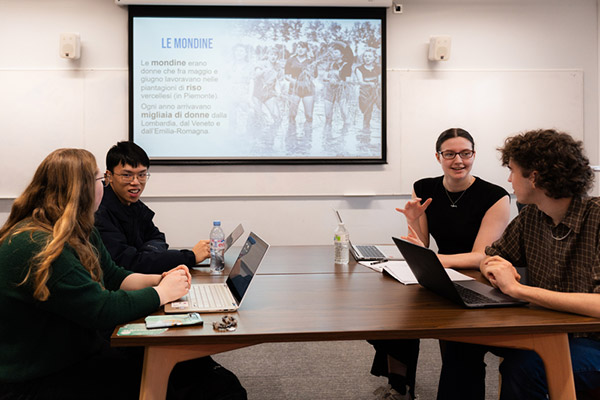
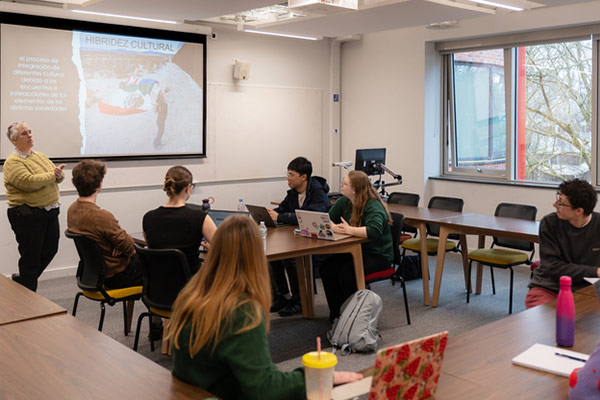
Develop your language proficiency. We have a distinctive approach to teaching. You'll be taught in the language you’re learning, with a focus on society, politics and culture. Guided by our supportive staff, many of whom are native speakers, you’ll rapidly develop your fluency and knowledge. You'll study Italian as a beginner (ab initio). You'll be amazed at how you progress.

Extensive range of modules. From history and politics to arts or translation, you’ll be able to follow your own interests. You can even get a head start in Teaching English as a Foreign Language with TEFL modules that help you prepare to gain a qualification.

Immerse yourself in language and culture with a year abroad. You’ll study at one of our partner universities and/or take up a work placement or internship. Past placements have been in the media, translation, heritage, marketing and finance sectors around the world. Your plans will be supported by our year abroad coordinators.

Join a vibrant international community. Our department comprises modern languages, English language and linguistics, drawing together staff and students with a shared love of language. You’ll be invited to regular events and talks.

As part of your degree, you can choose to take a credit-bearing module in a variety of languages - from Medieval Latin to Japanese, to Arabic or Chinese.
You'll take the Italian part of this programme ab initio (from scratch).
We’re ranked 1st in the UK for the quality of our research - according to the Times Higher Education’s ranking of the latest REF results (2021).
At York we have an amazing choice of societies that you can get involved in. In my second year, I joined the Latin American Society and attended their end of term party. We learned some bachata and salsa moves and it was a real laugh!
Caitlin, Language and Linguistic Science student.

Course content

During your degree, you will study mainly modules in languages and cultures. You can add modules in linguistics, choose from a range of elective modules across the university, including a third language.

Your linguistics modules will help you understand the nature of language itself: how it is structured, how it has evolved, and how we use and understand it within our society. These modules will enable you to think critically and approach your studies from an analytical point of view.

You’ll go abroad in your third year. You can choose a work placement, internship or studying at one of our partner universities. Our internship students have been to a wide range of organisations including in schools, the heritage sector, the media, translation, marketing and finance sectors around the world. Your plans will be supported by our departmental year abroad coordinators.

Throughout your programme, you can tailor your degree to your interests. You can:

  • focus on studying Italian and Spanish in equal terms in Years 2 and 3.
  • choose to study either Italian or Spanish predominantly in Years 2 and/or 3.
  • choose to add linguistics modules throughout your degree.
  • add elective modules, including a third language, or interdisciplinary modules.

Study Italian from scratch

You will study Italian ab initio, meaning you don't need to have any knowledge of the language before you arrive. In your first year, you will make rapid progress in your language skills. You will also develop your understanding of Italian society and culture in order to be prepared for more advanced studies from your second year onward.

Year 1

Core modules

Option modules

You will study one option module. Examples can be found below. Some option module combinations may not be possible. The options available to you will be confirmed after you begin your course.

Academic integrity module

In addition to the above you will also need to complete our online Academic Integrity module.

This module covers some of the essential skills and knowledge which will help you to study independently and produce work of a high academic standard which is vital for success at York.

This module will:

  • define academic integrity and academic misconduct
  • explain why and when you should reference source material and other people's work
  • provide interactive exercises to help you to assess whether you've understood the concepts
  • provide answers to FAQs and links to useful resources.

Year 2

Core modules

Option modules

You will also study four option modules, including at least one option in Spanish and one option in Italian. Examples can be found below. Some option module combinations may not be possible. The options available to you will be confirmed after you begin your course.

Your studies will focus on issues of cultures and society in the Italian- and Spanish-speaking worlds. You will develop skills in critical analysis of sources and communicate your findings using Italian and Spanish in different registers. You'll tackle questions such as:

  • Why does regional cultural diversity play such an important role in modern Italian society?
  • Why is there still a broad economic divide between Northern and Southern Italy?
  • Why is the Spanish Civil War still a difficult topic in Spain?
  • What is the relationship between the human rights movement and democratisation in Latin America?

The options available to you will be confirmed later in the year. For further information please get in touch.

Year 3

In your third year, you’ll go abroad for a year. You can choose to study at another university or complete a work placement/internship. You may also be able to complete a British Council English Language Assistantship. The year abroad is assessed on a pass/fail basis by the University of York.

Immersing yourself in the language and culture of another country will enable you to become fluent in the language, both orally and written. The skills you gain will prepare you for both your final year of study and your future career.

Find out more.

Year 4

Core modules

You'll study core language modules in your final year. These are designed to consolidate your critical skills through in-depth research and analysis. By this stage in your degree, you'll be able to demonstrate oral and written fluency, as well as accurate language use in its social and cultural contexts.

Option modules

You will also study four option modules, including at least one option in Spanish and one option in Italian. Examples can be found below. Some option module combinations may not be possible. The options available to you will be confirmed after you begin your course.

Language modules:

Linguistics modules:

The options available to you will be confirmed later in the year. For further information please get in touch.

Elective modules

You may be able to replace one option module with an elective module, studying a complementary subject, a language or an interdisciplinary topic.

Our modules may change to reflect the latest academic thinking and expertise of our staff, and in line with Department/School academic planning.

Learning outcomes

Every course at York has been designed to provide clear and ambitious learning outcomes. These learning outcomes give you an understanding of what you will be able to do at the end of the course. We develop each course by designing modules that grow your abilities towards the learning outcomes and help you to explain what you can offer to employers. Find out more about our approach to teaching and learning.

Learning outcomes for this course
  • Understand key aspects of the societies and cultures of the studied languages based on effective research and critical evaluation of key positions, viewpoints and perspectives. (Knowledgeable researcher)
  • Apply creatively and critically your understanding of languages and cultures in their transnational context in order to help negotiate and solve problems arising from social, cultural and linguistic diversity. (Creative problem solver
  • Communicate effectively orally and in writing in your language(s) of study to provide evidenced, structured and well-supported information, arguments and advice to mono- as well as multilingual audiences. (Multilingual communicator)
  • Mediate concepts and texts in a range of settings using your full repertoire of languages to facilitate the achievement of collective aims in trans- and intercultural contexts (Effective mediator)
  • Design, manage, and contribute efficiently and effectively to individual and collaborative projects using your knowledge and expertise, as well as leadership and negotiation skills. (Resourceful team worker)
  • Develop your expertise in the languages, cultures and societies as well as your language repertoire by recording, reflecting upon and evaluating your practices and identifying appropriate resources for your personal and professional learning needs. (Reflective practitioner)
  • Engage with confidence in multilingual and transcultural encounters based on your acquired awareness of, and sensitivity to, the relativity of social, cultural and linguistic norms. (Transcultural agent)
Learn directly in your language of study
At York, we teach all of our core language modules in their language of study. Our students develop fluency and confidence quickly, benefiting wholly from this approach.
Study abroad
Observe different transcultural practices and values first-hand, and gain valuable experience speaking in your language of study.
Take our in-house CertTESOL teaching qualification before you go abroad.
The thing that really sets Languages at York apart from other universities is that they teach the languages in the language. Of course, if you really just can’t wrap your head around something, they will explain it in English if need be.
Hannah, Language and Linguistic Science student.

Fees and funding

The fees and funding information here is for students starting in the 2026/27 academic year.

If you take a year abroad or year in industry you'll pay a reduced rate of fees for that year.

Annual tuition fees

UK (home) International and EU
£9,535 (TBC) £26,900

The UK government has announced its intention to increase tuition fees from £9,535 to £9,790 for the 2026/27 academic year. We expect this to apply to new UK (home) undergraduate students starting their studies in September 2026.

UK (home) or international fees?

The level of fee that you will be asked to pay depends on whether you're classed as a UK (home) or international student. Check your fee status.

Fees for subsequent years

  • UK (home) fees may increase within the government fee cap in subsequent academic years. We will notify you of any increase as soon as we can.
  • International fees are subject to increase in subsequent years in line with the prevailing Consumer Price Index (CPI) inflation rate (up to a maximum of 10%).

More information

For more information about tuition fees, any reduced fees for study abroad and work placement years, scholarships, tuition fee loans, maintenance loans and living costs see undergraduate fees and funding.

Additional costs

Set texts are available from the Library or online, but you may wish to buy your own copy for some modules. These typically cost between £10 and £30. For ab-initio languages you may need to buy books with a total cost of £50 to £60. Second hand books are often available more cheaply.

Funding

We'll confirm more funding opportunities for students joining us in 2026/27 throughout the year.

Departmental funding

Find out more about funding specific to Languages and Linguistics.

Doing two languages can keep you quite busy but there is still plenty of time to explore other hobbies of yours. Here at York, we have societies for many different languages. Some of the exciting socials you can look forward to include movie nights, cooking classes and quizzes!
Lucy, Language and Linguistic Science student.

York, Oxford, Cambridge, Imperial

Just four UK universities are rated Gold for teaching and top ten for research* in the latest national assessment exercises.

* Awarded joint 10th in the Times Higher Education ranking of the Research Excellence Framework 2021.

Teaching and assessment

You’ll study and learn with academics who are active researchers, experts in their field and have a passion for their subjects. Our approach to teaching will provide you with the knowledge, opportunities, and support you need to grow and succeed in a global workplace. Find out more about our approach to teaching and learning.

Teaching format

We offer you extra study support in several ways. Our Peer Assisted Learning programme gives you the opportunity to work with other students.

Italian and Spanish

Our focus at York is on effective communication in Italian and Spanish. That is why:

  • we are unique in teaching our core modules in their language of study
  • we teach mainly in small seminars
  • classroom interactions and assessments are in Italian and Spanish
  • we emphasise issues of cultures and society, allowing you to develop a high level of transcultural awareness to underpin your language skills
  • many of our staff are native-speakers of the languages we teach

Contact hours

In the first year of the degree, you will typically have 11 hours of contact time per week per semester, most of which is organised as seminars or workshops. Contact hours in the second and final year can vary depending on individual module choices.

In the UK, full-time students are expected to spend 1,200 hours a year learning. That's about 40 hours of classes and independent study each week during semesters. Everyone learns at a different rate, so the number of hours you spend on independent study will be different to other students on your course.

Facilities

We have our own e-Lab for teaching. Here, you'll have access to a variety of resources, including specialist linguistics software and online language-learning materials.

Teaching location

You will be based in the Language and Linguistic Science buildings on Campus West.

About our campus

Our beautiful green campus offers a student-friendly setting in which to live and study, within easy reach of the action in the city centre. It's easy to get around - everything is within walking or pedalling distance, or you can use the fast and frequent bus service. Take a campus tour.

Assessment and feedback

You'll be assessed in a variety of ways, including essays, projects, written, oral and listening exams. Assessments include formative work which will help you practice or develop skills, but will not count towards your final degree mark. 

Instructors provide you with feedback in a variety of forms, for example: written feedback, in-class discussion of common problems, model answers, one-on-one discussion of research projects, or online responses to questions posted on the module discussion board.

Your year abroad is assessed. All students must complete two assessments in their language of study. If you are studying at a university, you must attend courses and sit the exams. If you are on a work or teaching placement, you must satisfactorily complete the duties set out in the placement agreement. However, your marks on the year abroad assessments do not contribute towards your overall degree mark.

Disability information

We can make reasonable adjustments to assessment procedures for students with disabilities. However, if you have dyslexia please note that it is not possible to make adjustments in the marking of work written in a closed language exam. This is because accurate spelling is one of the assessment objectives for language exams. Closed exams make up only a proportion of the assessment types used for languages. There are other assessment types such as coursework and oral presentations which are also used. As a student with dyslexia you could apply for extra time in closed exams, if this would be of assistance. See the University's disability support pages for further details.

Careers and skills

  • The study of language and linguistics at York equips you with effective communication, critical thinking, and project management skills, which translate readily into any work context.
  • The combination of the analytic, transcultural, and communicative competencies you'll learn during your degree ensures that you are a highly sought-after graduate. You'll become proficient in all aspects of managing small-scale linguistic analysis projects, from identifying the research questions, to communicating the findings. This skill set will open the door to many different careers.
  • Our graduates have an excellent record of pursuing fulfilling paths after graduation. Learn more about graduate career destinations.

Career opportunities

  • Marketing and communications
  • Publishing
  • Broadcasting and journalism
  • Local government and public service
  • Business, finance and accountancy
  • Teaching
  • Translation and interpreting
  • IT and software development

Transferable skills

  • Effective communication skills
  • Intercultural awareness
  • Critical thinking
  • Project management
  • Independent learning
  • Data analysis
  • Problem solving
  • Teamwork

Entry requirements

Qualification Typical offer
A levels

AAB including Spanish

Access to Higher Education Diploma Obtain Access to HE Diploma with 36 credits at Distinction and 9 credits at Merit or higher. An A level or equivalent qualification in Spanish will be required.
BTEC National Extended Diploma DDD. An A level or equivalent qualification in Spanish will be required.
European Baccalaureate 80% overall average including 80% in Spanish
International Baccalaureate 35 points including 5 in German at Higher Level.
T levels We are currently not accepting T Levels for this course unless an additional A Level (or equivalent qualification) in Spanish has been taken.
Scottish Highers / Advanced Highers Advanced Highers - B in Spanish plus Scottish Highers - BBBB

We may also be able to consider three Advanced Highers or a combination of Highers and Advanced Highers, where an applicant does not meet the grade requirement through Highers alone. Please contact us to discuss your qualifications.
International foundation programme Foundation Certificate from our International Pathway College or an appropriate alternative.
Other international qualifications Equivalent qualifications from your country

Additional requirements

You can only take the Italian language part of this programme ab initio (from scratch, or with a qualification at AS level or below). It is not suitable for those who already have an A level in this language.

Our language programmes are designed to develop fluency. For this reason we do not normally offer places to native or near-native speakers who wish to study their own language.

Alternative offers

Meeting the following additional criteria may qualify you for an alternative offer.

Criteria Adjustment
Widening participation BBC including B in Spanish
This is conditional upon successful completion of the WP programme including the YorJourney module (Black Access Programme, Next Step York) or successful completion of Realising Opportunities More about widening participation.
Contextual offer BBB including Spanish
EPQ If you achieve C or higher in the EPQ, you may be eligible for an alternative offer up to one A level grade (or equivalent) below our typical offer.
Core Maths If you achieve B or higher in Core Maths, you may be eligible for an alternative offer up to one A level grade (or equivalent) below our typical offer.
MOOCs If you successfully complete our online course The Power of Languages, you may be eligible for an alternative offer up to one A level grade (or equivalent) below our typical offer. Details about how to evidence completion of the MOOC will be sent in your offer letter. Please note: you do not need to pay for the certificate. More about MOOCs.

English language

If English isn't your first language you may need to provide evidence of your English language ability. We accept the following qualifications:

Qualification Minimum requirement
IELTS (Academic) 6.5, with a minimum of 6.0 in each component
IB English A score of 4 in English A or 5 in English B (Higher Level or Standard Level)
Cambridge CEFR 176, with a minimum of 169 in each component
Oxford ELLT 7, with a minimum of 6 in each component
Oxford Test of English Advanced 136, with a minimum of 126 in each component
Duolingo Integrated subscores: 120 overall, with a minimum of 105 in each component
GCSE/IGCSE/O level English Language (as a first or second language) Grade C / Grade 4
LanguageCert SELT B2 with a minimum score of 33/50 in each component
LanguageCert Academic B2 with a minimum score of 33/50 in each component
Kaplan Test of English Language 478 Main Flight score with 444 in each component
Skills for English B2: Merit overall, with Pass with Merit in each component
PTE Academic 61, with a minimum of 55 in each component
TOEFL 87 overall, with a minimum of 21 in each component
Trinity ISE III Merit in all components
Other English language qualifications We also accept other English Language qualifications, including various school-leaving certificates.

For more information see our undergraduate English language requirements.

If you haven't met our English language requirements

You may be eligible for one of our pre-sessional English language courses. These courses will provide you with the level of English needed to meet the conditions of your offer.

The length of course you need to take depends on your current English language test scores and how much you need to improve to reach our English language requirements.

After you've accepted your offer to study at York, we'll confirm which pre-sessional course you should apply to via You@York.

Discover York

We offer a range of campus accommodation to suit you and your budget, from economy to premium.
Explore campus and city life and hear what our current students have to say about living here.
Lively, full of culture and beautiful, York is regularly voted one of the best places to live and visit in the UK.
Find out more about York. Chat to staff and students and take the tour, on campus or online.