View semester dates
2 years part-time
Develop professional language skills and understand the technologies transforming multilingual communication.
Year of entry: 2027 (September)
Gain advanced translation technology skills. Build practical experience with professional translation technologies and develop the digital, technical and problem-solving skills needed to work confidently with technology-assisted translation. You’ll apply these skills in a dedicated PC lab and work with specialist multilingual resources, gaining experience of professional translation workflows and the technologies that support them.
Work with English, plus one or more from Arabic, Chinese, French, German, Italian, Japanese and Spanish. You’ll specialise in translation between English and the languages of your choice, with language-specific workshops intensive language enhancement designed to strengthen your linguistic skills and build confidence in your chosen languages.
Understand the technologies behind the transformation of multilingual communication. Explore computer science and language technologies at a fundamental level, from computer architecture, networks and digital audio to real-time communication, AI and large language models.
Study under world-leading researchers and practising professionals. You'll be taught by passionate academics whose expertise covers many areas of languages and linguistics. You’ll also learn from practising translators who continue to work professionally alongside teaching.
This course helped me acquire specific skills and methods in my translation tasks, while developing my English proficiency. I would recommend it to anyone who wants to develop their translation skills, general and cultural knowledge, and combines languages and technologies in work.
Victoria, MA Interpreting, Translation and Applied Technologies student.
Our teaching combines language-specific practice with sessions that bring students across languages together. You’ll develop core professional skills, engage with contemporary workflows and explore the business, management and technological dimensions of multilingual communication.
You’ll put these skills into practice through realistic, problem-based scenarios. This will help you tackle challenges faced by language professionals and develop your ability to analyse problems, evaluate options, exercise professional judgement and make informed decisions.
As part of the Professional Translation Practice module, you'll work on a terminology project with the World Intellectual Property Organisation. This will then be assessed by their team of terminologists.
You'll study five core modules and an independent project. Two modules will each be in semesters one and two, and the fifth module and independent project will be in the summer semester.
You can choose two option and/or elective modules. You'll study one in semester one and one in semester two. Some option module combinations may not be possible. The options available to you will be confirmed after you begin your course.
The options available to you will be confirmed after you begin your course. For further information, please get in touch.
Our modules may change to reflect the latest academic thinking and expertise of our staff, and in line with Department/School academic planning.
You may be able to replace one option module with an elective module, studying a complementary subject, a language or an interdisciplinary topic.
In the summer semester, a core professional practice module will provide language enhancement to help get you ready for the world of professional translation and interpreting, while you learn key employability skills and start to grow your professional network. You'll also apply your newly acquired knowledge and skills to translation and/or interpreting assignments.
Alongside the core practice module, you'll complete an independent study module that can be either a research-based or a practice-based reflective study. You'll learn the skills required to successfully carry out your independent project throughout the course.
Previous independent project topics:
Every course at York is built on a distinctive set of learning outcomes. These will give you a clear understanding of what you will be able to accomplish at the end of the course and help you explain what you can offer employers. Our academics identify the knowledge, skills, and experiences you'll need upon graduation and then design the course to get you there.
| Study mode | UK (home) | International and EU |
|---|---|---|
| Full-time (1 year) | £12,420 | £27,840 |
| Part-time (2 years) | £6,210 | £13,920 |
Fees are for year one. Fees for future years are subject to confirmation.
UK (home) or international fees? The level of fee that you will be asked to pay depends on whether you're classed as a UK (home) or international student. Check your fee status.
Find out more information about tuition fees and how to pay them.
Discover your funding options to help with tuition fees and living costs.
We'll confirm more funding opportunities for students joining us in 2027/28 throughout the year.
If you've successfully completed an undergraduate degree at York you could be eligible for a 10% Masters fee discount.
We are pleased to work with Chevening Scholars to offer funding for our Masters programmes. Chevening Scholarships provide one year of fully-funded postgraduate study in the UK for international (including EU) students. The scholarships are open to early and mid-career professionals who have the potential to become future leaders.
The course brings together professional practice and current research across language professions. You'll explore developments in the field alongside the practical realities of working in the language industry.
You'll be taught by both experienced academics and industry specialists. Our staff also contribute to active research and industry practice. Across the Department, we have a range of specialisms in particular genres and settings.
We're corporate members of the Institute of Translation and Interpreting (www.iti.org.uk) and members of the Association of Programmes in Translation and Interpreting Studies (APTIS) (www.aptis-translation-interpreting.org). Our discipline leader, Dr Eloísa Monteoliva García, is currently president of APTIS. These and other connections give you opportunities to engage with professional networks and access learning and practice opportunities beyond your course.
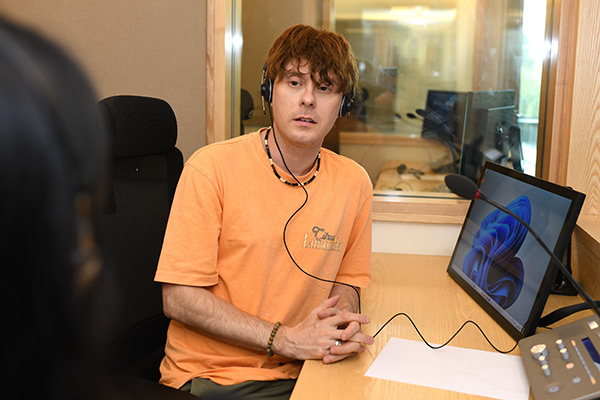
You'll have exclusive access to dedicated PC labs with specialist translation software that you'll use throughout your course. You will also be able to access specialist software from any location or device for independent study and class projects. Our dedicated multilingual conference suite will also be available for you to use.
You’ll use specialist software throughout the course to develop experience of contemporary professional workflows. Current platforms include Trados, Matecat and ZOO.
We are also using Phrase in our translation courses free of charge. Phrase is a complete translation platform that includes translation memory, integrated machine and human translation, terminology management, and both online and desktop CAT tools.

You will be based in the Department of Language and Linguistic Science on Campus West. Most of your contact hours will be in Spring Lane Building and Vanbrugh College, with some additional teaching in other locations on Campus West.
Our beautiful green campus offers a student-friendly setting in which to live and study, within easy reach of the action in the city centre. It's easy to get around campus - everything is within walking or pedalling distance, or you can always use the fast and frequent bus service.
You'll receive extensive individual and group feedback in practice sessions and will develop both self and peer assessment skills. Assessments include translation assignments, reports, projects, presentations, exams and essays.
You’ll graduate with advanced translation skills alongside management, problem-solving and intercultural communication skills. You’ll develop the confidence to apply these skills in a changing professional landscape.
As technologies evolve, you’ll have the foundations to understand them and the confidence to adapt. You’ll also develop the professional judgement to work effectively alongside people, technology and AI. This means identifying where technology can help, where human expertise matters and how the two can work together.
| Qualification | Typical offer |
|---|---|
| Undergraduate degree | 2:2 or equivalent. |
| Other international qualifications | Equivalent qualifications from your country |
If English isn't your first language you may need to provide evidence of your English language ability. We accept the following qualifications:
| Qualification | Minimum requirement |
|---|---|
| IELTS (Academic and Indicator) | 6.5, minimum 6.0 in each component |
| Cambridge CEFR | B2 First: 176, with 169 in each component |
| Oxford ELLT | 7, minimum of 6 in each component |
| Oxford Test of English Advanced | 136, minimum 126 in each component |
| Duolingo | 120, minimum 105 in all other components |
| LanguageCert SELT | B2 with 33/50 in each component |
| LanguageCert Academic | 70 with a minimum of 65 in each component |
| Kaplan Test of English Language | 478-509, with 444-477 in all other components |
| Skills for English | B2: Merit overall, with Pass with Merit in each component |
| PTE Academic | 60 with 52 in Listening, 53 in Reading, 65 in Speaking, and 59 in Writing |
| TOEFL | 4.5, with 5 in Listening and 4.5 in each other component |
| Trinity ISE III | Merit in all requirements |
For more information see our postgraduate English language requirements.
You may be eligible for one of our pre-sessional English language courses. These courses will provide you with the level of English needed to meet the conditions of your offer.
The length of course you need to take depends on your current English language test scores and how much you need to improve to reach our English language requirements.
After you've accepted your offer to study at York, we'll confirm which pre-sessional course you should apply to via You@York.
Get in touch if you have any questions