Skip to content Accessibility statement

MA History of Art (Fashion History)

Explore the production of the dressed body and apply research to answer novel questions about the modern world. Work confidently across images, text and objects.

Year of entry: 2026 (September)

Start date
September 2026
View semester dates
Length
1 year full-time,
2 years part-time
School/department

Apply for this course

Why study fashion history at York?

Develop individual specialisms. You'll gain skills in interpretation, object handling and analysis. Our modules will also help you make connections between the global and the local. This will enable you to respond to the concerns and challenges of the present, such as sustainability, belonging and inequality. 

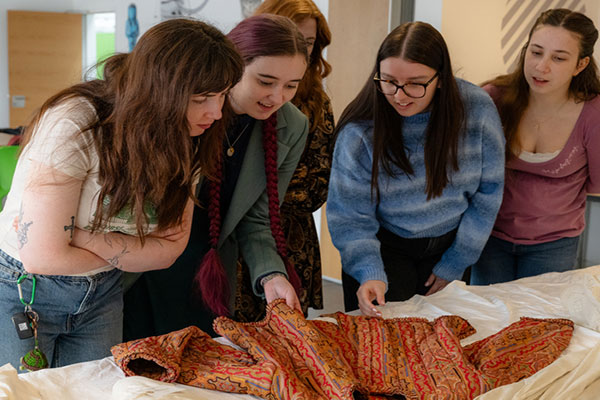
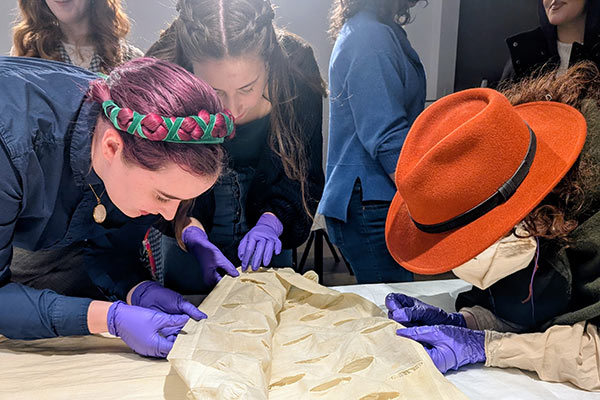
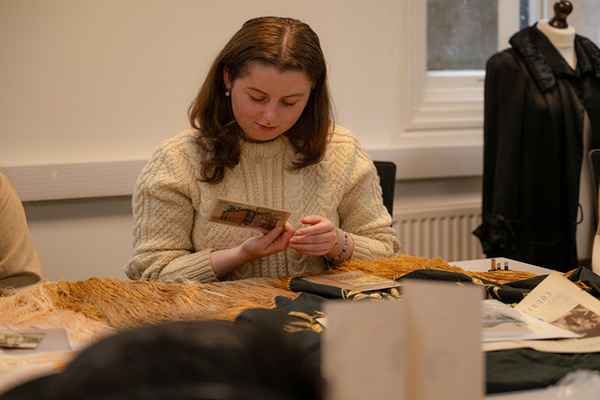
Work directly with collections. You'll study York’s own handling collections. These are housed in a purpose-built store and handling space that is kept to professional conservation standards. Sessions held here will give you hands-on experience of handling, packing, storing and analysing fashion objects.

Explore an exciting range of option modules. You can tailor your degree to match your own academic and professional interests. We offer both fashion-specific and more general option modules, allowing you to gain a comprehensive understanding of the field.

Join a vibrant, interdisciplinary community. We're one of the largest art history departments in the UK. Our expert staff have research interests that span geographical and historical boundaries, from the ancient to the contemporary.

A group of students on a field trip to an art gallery.
An academic delivering a seminar on fashion history.
Our collaborations support your learning and research through jointly designed modules, privileged access to collections and studentship opportunities.
Our research is 1st in the UK for its impact and environment - the support we give to researchers (Times Higher Education’s ranking of the latest REF results, 2021).
As well as your department's facilities, you'll have access to the Grade II listed Heslington Hall, a hub with gallery space for events and collaboration.
Alongside option modules related to specific art medium, periods and themes that allow students to develop their own specialities towards dissertation, the core module 'Research Skills in History of Art' provides very practical guidance on how to write art history within a range of theoretical frameworks that feed into current trends, including feminism, post-colonisation and global art history.
Hahyun, MA History of Art (Modern and Contemporary). Read Hahyun's blog post.

Course content

This course will allow you to explore a range of different topics related to fashion and art history. You'll be able to choose from options across a range of periods, from the ancient to the contemporary.

The core module, Research Skills in History of Art, will equip you with the fundamental skills needed to research and write independently. This module, combined with the breadth of option modules available to you, will enable you to put together an expert dissertation. You'll graduate as an interdisciplinary professional ready to succeed in a range of careers.

Modules

You'll study one core module and a dissertation. You'll then choose four option modules, two of which must be from the fashion history list. Your other two choice will then be from our general option module list. You may be able to replace up to two of the general option modules with option modules from other departments and centres in the Faculty of Arts and Humanities.

Core module

Fashion history option modules

General option modules

Some option module combinations may not be possible. The options available to you will be confirmed after you begin your course.

Our modules may change to reflect the latest academic thinking and expertise of our staff, and in line with Department/School academic planning.

Dissertation

You'll complete your dissertation with the support of your academic supervisor. The dissertation will be 10,000-12,000 words.

You can make use of staff expertise to explore a range of topics as part of your dissertation. These include, but are not limited to:

  • Curatorial collecting practices and the acquisition of mid-twentieth century fashion: A case study of York Castle Museums
  • Peacock fashions: the impact of synthetic dyes on women’s clothing, 1890-1920
  • Can fur be sustainable? The history of animal rights activism in fashion, 1960-2020
  • Textiles as colonial knowledge exchange: John Forbes Watson and ‘The Textile Manufactures of India’
  • Leigh Bowery: Queer subcultural style on the BBC

Learning outcomes

Every course at York is built on a distinctive set of learning outcomes. These will give you a clear understanding of what you will be able to accomplish at the end of the course and help you explain what you can offer employers. Our academics identify the knowledge, skills, and experiences you'll need upon graduation and then design the course to get you there.

Learning outcomes for this course
  • Demonstrate in-depth understanding of current research, theoretical approaches, context, sources and advanced scholarship at the forefront of fashion, textiles, and art historical studies (depth of knowledge)
  • Synthesise information in a sophisticated and mature fashion and critically analyse a wide range of materials by rigorously applying observational, descriptive, analytical and methodological skills (methodological rigour)
  • Formulate independent research questions stemming from the accurate location and evaluation of material, archival, written, and visual sources and informed by knowledge of scholarly arguments and relevant disciplinary approaches (originality)
  • Analyse and critique the assumptions, theoretical principles and the use of evidence employed in present and past scholarship and situate them within larger historical dynamics (critical evaluation)
  • Confidently utilise a range of verbal, visual, and material mediums to high professional standards to present relevant information and sophisticated arguments to a range of academic and public audiences (communication and digital literacy)
  • Initiate, conduct, and take responsibility for independent research projects, drawing on skills honed by graduate-level research training (project management)

Fees and funding

Annual tuition fees for 2026/27

Study modeUK (home)International and EU
Full-time (1 year) £12,000 £26,900
Part-time (2 years) £6,000 £13,450

Students on a Student Visa are not currently permitted to study part-time at York.

For courses which are longer than one year, the tuition fees quoted are for the first year of study.

  • UK (home) fees may increase in subsequent years (up to a maximum of 2%).
  • International fees may increase in subsequent years in line with the prevailing Consumer Price Index (CPI) inflation rate (up to a maximum of 10%).

Fees information

UK (home) or international fees? The level of fee that you will be asked to pay depends on whether you're classed as a UK (home) or international student. Check your fee status.

Find out more information about tuition fees and how to pay them.

Funding information

Discover your funding options to help with tuition fees and living costs.

We'll confirm more funding opportunities for students joining us in 2026/27 throughout the year.

If you've successfully completed an undergraduate degree at York you could be eligible for a 10% Masters fee discount.

Funding opportunities

Chevening Scholarships

We are pleased to work with Chevening Scholars to offer funding for our Masters programmes. Chevening Scholarships provide one year of fully-funded postgraduate study in the UK for international (including EU) students. The scholarships are open to early and mid-career professionals who have the potential to become future leaders.

Teaching and assessment

You’ll work with world‐leading academics who’ll challenge you to think independently and excel in all that you do. Our approach to teaching will provide you with the knowledge, opportunities, and support you need to grow and succeed in a global workplace.

Teaching format

You'll be taught with lectures, seminars and one-to-one meetings with your lecturer or supervisor. We also offer an extensive programme of research seminars and events. These are an invaluable way to engage with different aspects of your subject.

Each option module is taught by weekly two-hour seminars. You'll also have the opportunity to go on field-trips organised by the Department to view art and architecture. These will be an integral part of your learning.

Facilities

The University boasts an impressive 900+ piece art collection. You'll engage directly with this throughout the course. You can also view many of the pieces by exploring our campus, or through our online catalogue.

York is also home to the Norman Rea Gallery, the only student-run gallery in the UK. This space provides a platform for local and regional artists, and gives students a unique work experience in a contemporary campus-based art gallery.

Teaching location

You'll be based in the Department of History of Art in Vanburgh College on Campus West.

About our campus

Our beautiful green campus offers a student-friendly setting in which to live and study, within easy reach of the action in the city centre. It's easy to get around campus - everything is within walking or pedalling distance, or you can always use the fast and frequent bus service.

Assessment and feedback

You'll submit a 4,000-word essay per option module. For the Research Skills in History of Art module, you'll produce a dissertation portfolio as your assessment. You'll also complete a dissertation.

Careers and skills

You'll gain the skills needed to succeed in a range of careers and in pursuing a research degree. We have staff who are experts in fashion history, meaning that you'll learn directly from professionals in the field. We also have a dedicated careers officer to support you when you need it.

We have an extensive range of partnerships and placements with organisations that you can make use of. Some of these include the National Gallery, Tate, The Hepworth Wakefield and York Museums Trust.

Career opportunities

  • Curator
  • Collections manager
  • Exhibition designer
  • Art consultant
  • Gallery manager
  • Auction house specialist
  • Provenance researcher
  • University lecturer
  • Arts programme coordinator
  • Editor and publisher

Transferable skills

  • Analytical skills
  • Intrapersonal skills
  • Independent thinking and autonomy
  • Communication
  • Time-management
  • Critical thinking

Entry requirements

Qualification Typical offer
Undergraduate degree 2:2 or equivalent
Other international qualifications Equivalent qualifications from your country

English language

If English isn't your first language you may need to provide evidence of your English language ability. We accept the following qualifications:

Qualification Minimum requirement
IELTS (Academic and Indicator) 6.5, minimum 6.0 in each component
Cambridge CEFR B2 First: 176, with 169 in each component
Oxford ELLT 7, minimum of 6 in each component
Oxford Test of English Advanced 136, minimum 126 in each component
Duolingo 120, minimum 105 in all other components
LanguageCert SELT B2 with 33/50 in each component
LanguageCert Academic 70 with a minimum of 65 in each component
Kaplan Test of English Language 478-509, with 444-477 in all other components
Skills for English B2: Merit overall, with Pass with Merit in each component
PTE Academic 61, minimum 55 in each component
TOEFL 87, minimum of 21 in each component
Trinity ISE III Merit in all requirements

For more information see our postgraduate English language requirements.

If you haven't met our English language requirements

You may be eligible for one of our pre-sessional English language courses. These courses will provide you with the level of English needed to meet the conditions of your offer.

The length of course you need to take depends on your current English language test scores and how much you need to improve to reach our English language requirements.

After you've accepted your offer to study at York, we'll confirm which pre-sessional course you should apply to via You@York.

Next steps

Discover York

We offer a range of campus accommodation to suit you and your budget, from economy to premium.
Explore campus and city life and hear what our current students have to say about living here.
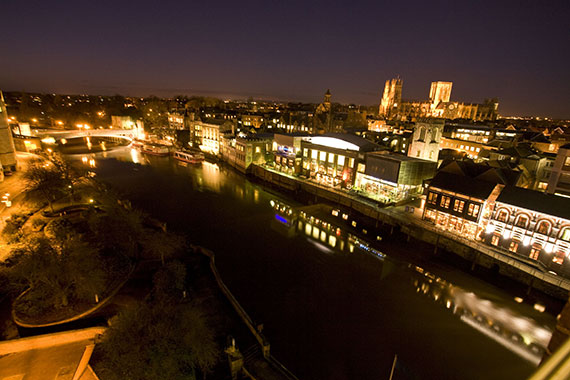
Lively, full of culture and beautiful, York is regularly voted one of the best places to live and visit in the UK.
Find out more about York. Chat to staff and students and take the tour, on campus or online.