
Turning lessons from Afghanistan into global action

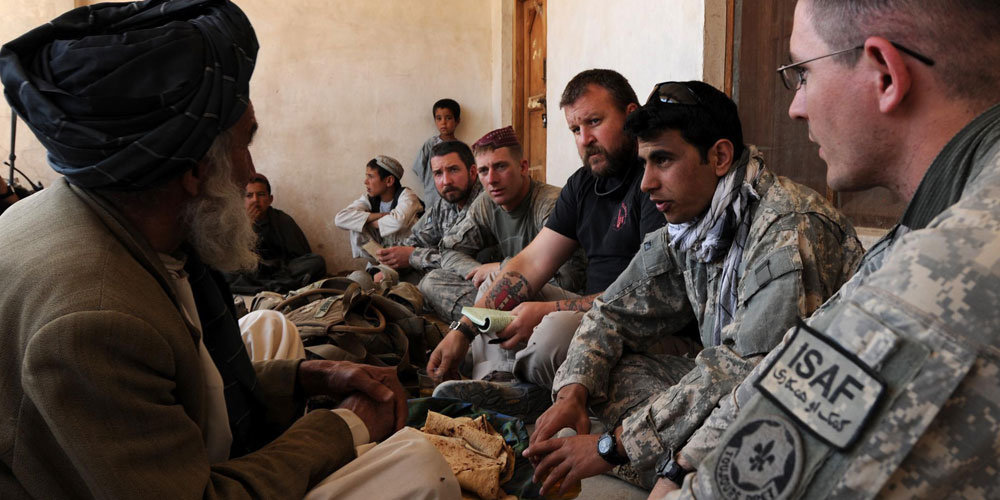
We're talking about interpreters and other local staff who were indispensable in political and humanitarian missions, but there is no overarching rights framework to protect them.
Professor Sara de Jong, Department of Politics and International Relations.
A problem hiding in plain sight
Long before the fall of Kabul in 2021 brought global attention to the plight of Afghan interpreters, Sara had already identified a critical gap. "One of the first things I noticed," she says, "was that while missions are often international, the rights and protections for local staff are mostly forgotten or handled at the national level. There's no coordination."
The consequences of that fragmentation have been severe. Across conflicts — from Iraq to Afghanistan and beyond — locally employed civilians have faced retaliation, displacement and even death once international forces withdraw.
"For context," Sara explains, "journalists and humanitarian workers have status under law but often they can only do their work with a local person by their side. If they are injured or killed, the local person is a footnote. A number of Afghan interpreters have died in exactly the same attacks but wouldn't be recognised."
"There is no legal framework, so lawyers have been trying to draw on other areas of law, like immigration or employment law. In France, a lawyer argued that Afghan interpreters should be covered by 'functional protection' — a legal mechanism that includes relocation and new identity provisions. The highest court there agreed," she says. "That's a good example of success."
Sadly, these successes are rare and inconsistent. "It might sound surprising," she adds, "but even within NATO missions, the employment of local staff is not coordinated. Contracts differ, protections differ and evacuation policies differ. It's astonishing."
Why now?
Although Sara's work began as a niche research area, the urgency escalated dramatically in 2020 and 2021. "From that point on, the work became very immediate," she says. "There were so many Afghan interpreters who needed support."
Many of the veterans, lawyers and advocates she had been interviewing for her research were already involved in trying to help those left behind. Together, they began asking a bigger question — how could future crises be prevented? "We're approaching five years since the evacuation from Afghanistan," Sara explains. "Many countries have produced 'lessons learned' reports. But we are quite concerned those lessons might not actually be learned."
Her response was to shift from reactive to proactive. "If we are serious about 'never again', then we need a forward-looking framework," she says.
“Going forward we need to ensure that from the beginning, as soon as we employ local staff, they have proper contracts. If they get injured, their rights should be enshrined. This includes mental health support. We see significantly more mental health issues for US soldiers arising from their missions as their tours of duty are longer than for UK soldiers, who are deployed for six months at a time. But local staff can even be employed for years and years. And that without getting the kind of mental health support that may be needed when you're exposed to so much violence and potential trauma. We want to make sure there's no difference, no matter which army you work for or whether you are a soldier or locally employed civilian."
Meanwhile, a secondment brought in US immigration lawyer Betsy Fisher, allowing the team to work on two complementary outputs — a set of practical Guidelines for the Protection and Rights of Local Staff in International Missions alongside a legal report and index mapping court cases across multiple countries where lawyers could see where local workers had fallen between the cracks of law.
"I couldn't have written the legal report without Betsy," Sara admits. "That legal expertise was essential."
Team work was also essential for preparing the Guidelines. "The team at Local Staff International, which included veterans who had served in Afghanistan and other missions, would draft sections, then we'd come back together, compare notes and refine." "We structured the guidelines into four phases — pre-engagement, during engagement, transition and evacuation," she explains.
Alongside this, Sara drew on nearly ten years of research and an extensive international network. "I'm not really an ivory tower academic," she says. "I have a lot of people I can draw on — veterans, lawyers, advocates. That was crucial."
From research to real-world impact
The result is a comprehensive set of guidelines outlining minimum standards and principles for the protection of locally employed staff.
For Sara and her collaborators, the impact is already significant. "It has given us the opportunity to finally put down on paper the lessons we've learned over the years," she says. "Otherwise, that experience and knowledge would get lost."
For LSI, the project has been transformative. It's one thing to have a mission and a vision," she explains. "It's another to bring concrete guidelines, backed by evidence and real-life scenarios." She likens the approach to that of Amnesty International. "They produce human rights country reports and base their advocacy on them. That's the model I had in mind."
There has also been a powerful personal impact. "For some of the veterans involved, there was a real sense of frustration and even moral injury," she says. "We had seen the same problems happen time and time again. Psychologically, it was great to be more hopeful, more forward looking than just going on about the mess we have found ourselves in. Not just talking about what went wrong, but doing something practical to prevent it."
The power of collaboration
The project brought together a unique mix of academic, professional and lived experience — something Sara believes was critical to its success. "These guidelines would not have happened without this project. Having the financial support through the university to step back one day a week from teaching and administrative duties was essential. The document is much more credible because it's a collective effort," she says. "Academics, veterans, practitioners — we all brought something different."
The collaboration also helped address blind spots. "We initially approached things from a military perspective, but through consultation with humanitarian organisations and diplomats, we were able to adapt the language and make it relevant to a broader audience."
And the benefits flowed both ways. "For academics, it's important to test whether our ideas make sense in real-world contexts. For practitioners, it's valuable to step away from day-to-day firefighting and reflect. It was a real cross-fertilisation. A win-win."
What happens next?
"We're in the process of getting ambassadors and other signatories to our new set of principles," Sara explains. "People who will not only support the guidelines, but commit to implementing them."
Meetings are already underway with international organisations and military networks to promote adoption. For example, EUROMIL, the European Organisation of Military Associations and Trade Unions, has already endorsed the Guidelines. At the same time, the work is expanding. "We've partnered with Afghan Evac to build a global alliance. One pillar is 'finish the mission,' making sure promises to Afghans are fulfilled. The other is 'never again,' which is where the guidelines come in."
A key next step is accountability. "If states fail in their duty of care," she says, "we need to think about who can hold them accountable."
A model for impact
For Sara, this collaboration is proof of what can happen when research, experience and urgency come together. "The sum is greater than the individual parts," she says. "We couldn't have done this without each other."
And if the guidelines achieve their goal, the impact could be global, ensuring that in future conflicts, those who stand alongside international missions are no longer forgotten.