
How York's human rights leadership is sparking a UK-wide network
It's challenging working on human rights at the moment... The national discourse is quite hostile, quite polarised. There hasn't really been political leadership supporting human rights for many years.
Professor Paul Gready, Director of the Centre for Applied Human Rights.
Testing the appetite for a national network
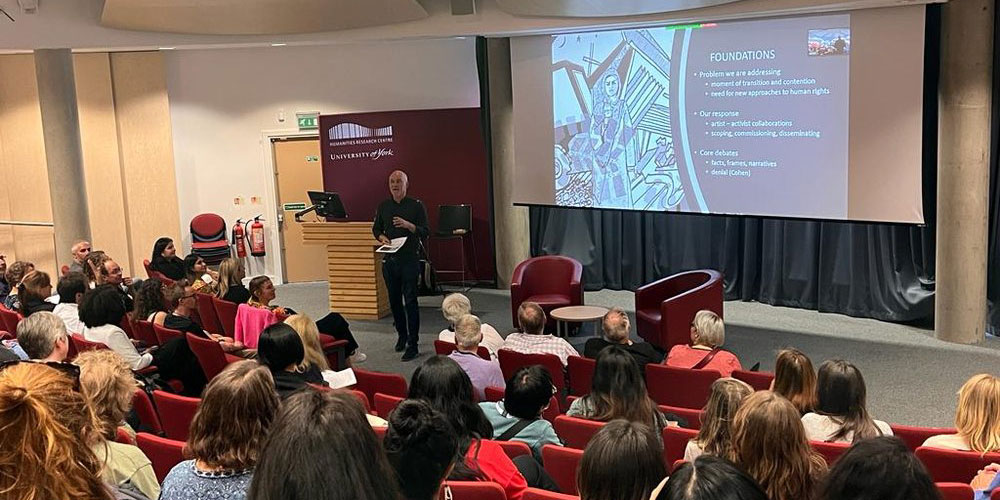
Professor Gready has been involved in working on human rights in the city of York for over a decade. At its core, he says, the project was simple to test whether there was appetite for a national network. "We applied for IAA money to host an event in July 2025 simply to explore the potential. There was broad interest in setting up a UK network, so we're now in the process of doing that."
Why cities, why now?
"It's challenging working on human rights at the moment," he reflects. "The national discourse is quite hostile, quite polarised. There hasn't really been political leadership supporting human rights for many years."
Cities, by contrast, offered a different kind of possibility.
"We wanted to do work at a city level that showed that a more enabling vision of human rights in politics and society was possible. The other challenge was a recognition that lots of cities were doing interesting work on human rights, but in isolation. So we're trying to think of ways in which we can better connect cities and share knowledge and experience."
A lifelong commitment to human rights
Paul's own path into this work helps explain his commitment. "I was born in South Africa and lived in Zimbabwe," he says. "I'd grown up in the context of apartheid." His early career included a role at Amnesty International and "in a sense, everything else has flowed from there." That trajectory has shaped a belief that human rights must be lived and practiced locally, not just debated globally.
Human rights affects everyone
This philosophy has guided the Centre's work in York. "People often think of human rights as something that happens elsewhere, not really affecting us in York." Challenging that assumption became a "pathway to impact," leading to partnerships with civil society organisations and the local council that created "a very deep and significant impact within the city."
As York's reputation grew, other places began to seek advice. Swansea, for example, approached the team when exploring what it would mean to become a human rights city. These conversations were happening on an ad hoc basis, drawing on York's experience whenever another city reached out. It became clear that the learning needed to be shared in a more structured way, so the move to a national network is, in part, about scaling and demonstrating that impact.
"For the last REF (Research Excellence Framework), we weren't really considered as an impact case. It was thought that just working in York was too specific, so to be able to argue that something like this has a national significance strengthens it."
From idea to infrastructure
In practical terms, the project is still evolving. Plans include an online knowledge platform, secondments between cities and an annual event, with the second network meeting scheduled in Glasgow. However, Paul says the IAA funding played a pivotal role. "It funded the initial event, which was key. It was the event at which we tested the idea. More broadly, we're looking to use the IAA money essentially as pump-prime money (early-stage funding that helps get a new initiative off the ground) to take that to funders to seek funding for the first two years of the network."
What impact looks like in practice
One example in York centres on young people not in education, employment or training (NEETs).
"We had been tracking NEETs through our annual Human Rights Indicator Report and we demonstrated that this was a kind of stubborn problem in the city." The Centre's recommendations were taken up by the council, leading to new research, which consulted directly with young people who were either NEET or had previously been NEET, something earlier initiatives had not done. Targeted interventions followed, backed by new funding, leading to "a drop in the number of NEETs in the city."
Another example is the "Reverse the Ban" campaign, which challenged post-COVID restrictions that prevented blue badge holders from accessing the city centre.
"There was a decision to put bollards around the city centre to stop vehicles going in, primarily as an anti-terrorism measure. We contested this, framing it as a human right issue, not purely as a security issue – but also an issue of non-discrimination and the right to movement and access for all residents. Doing this can shift the conversation and give it more leverage.
That campaign was successful, so seven thousand blue badge holders now do have access to the city centre. Another example whereby the work we've done has made a concrete difference in the city."
The importance of collaboration
In cases like this, partnerships with organisations such as York CVS and local disability groups have been essential. "Where they needed a more technical or detailed human rights analysis, we provided that."
The relationship, though, is reciprocal – academic expertise supports practice, while lived experience informs theory. The work has also reshaped the Centre itself.
"It's become a kind of learning environment," he reflects, not only for him and other academics, but for students who have been able to work directly on projects linked to York's status as a human rights city. That involvement has opened the door to "more creative ways of working," from arts-based projects to student-led film festivals and other public events across the city.
Embedding human rights in decision-making
Perhaps most significantly, the work has changed how decisions are made in York. After the city declared itself a Human Rights City, the council established a Human Rights and Equalities Board, an institution that hadn't existed before and is now central to mainstreaming human rights within the council.
"Another example is when councils are developing new policies, they have to carry out Equalities Impact Assessments. We've worked with them to integrate human rights into that, so it's now a combined Human Rights and Equalities Assessment Tool. It means that from the earliest stages of any new policy through to evaluation, officers now consider the implications for both human rights and equalities. So this is shaping decision-making within the city in a fundamental way."
Looking ahead and scaling the network
Much now depends on funding. "If we get funding, there's more we can do," he says. The ambition is to grow the network to "five to ten human rights cities over the next couple of years," expanding both its reach and its influence. For now, the focus is on building momentum, "establishing the knowledge platform, better communication and more secondments between cities."
IAA funding as an entry point
"We found the IAA money is really useful for proof of concept," he says. "We thought a network would be a good idea, but we needed to get buy-in. It's very early days but we now have a network that we wouldn't have had otherwise. So I would definitely encourage academics who are interested in more applied work to use the IAA money as a kind of entry point to the sort of impact that they're looking to achieve."