View semester dates
2 years part-time
Learn how to apply linguistics, phonetics and acoustics to legal investigations and proceedings.
Year of entry: 2026 (September)
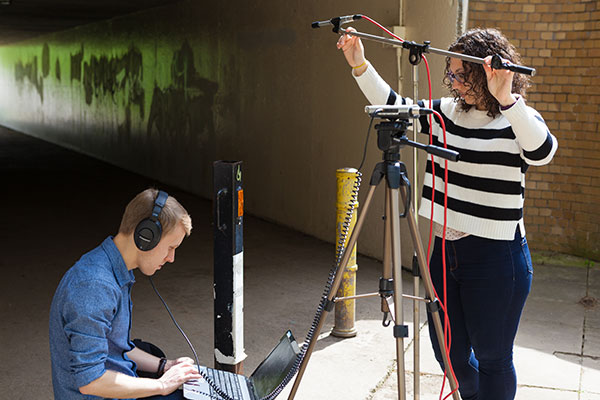
Forensic Speech Science (FSS) comprises various applications of phonetics, linguistics, acoustics, and computer science to tackling problems in police work or providing evidence in legal cases.
This course will equip you with the core practices of FSS without the need to carry out a dissertation at the end of it. It is designed and delivered in partnership with two professional forensic speech and audio laboratories, The Forensic Voice Centre and Forensic Speech Services. Their staff will also contribute to taught modules.
The learning experience integrates scholarly and professional contexts, allowing you to develop expert witness communication skills and gain hands-on experience of the latest generation of automatic speaker recognition technology. We have extensive partnerships with leading speech technology companies.
We also offer a PGCert in Forensic Speech Science and an MSC in Forensic Speech Science.
I’ve found the staff in the Department to be brilliant. Support staff answer all your questions and lecturers deliver content with genuine enthusiasm that really adds to the experience. Lecturers will adapt their teaching to meet the needs of everyone.
You do not need a prior background in phonetics or linguistics to apply to this course.
Semester 1 provides a general introduction to the field of FSS and a grounding in key areas of phonetics and linguistics. If you have little or no background in these subjects, you'll take introductory modules. More advanced options are available if you have substantial experience.
In Semester 2, you'll progress to detailed phonetic and linguistic analysis of speech recordings, which can be applied in the forensic context. There is no dissertation in this course.
If you're studying this course part-time, you'll study three modules in your first year and two in your second year.
You'll also study one option module:
The options available to you in Semester 2 will be confirmed after you begin your course. For further information, please get in touch.
Our modules may change to reflect the latest academic thinking and expertise of our staff, and in line with Department/School academic planning.
Every course at York is built on a distinctive set of learning outcomes. These will give you a clear understanding of what you will be able to accomplish at the end of the course and help you explain what you can offer employers. Our academics identify the knowledge, skills, and experiences you'll need upon graduation and then design the course to get you there.
| Study mode | UK (home) | International and EU |
|---|---|---|
| Full-time (1 year) | £9,020 | £20,200 |
UK (home) or international fees? The level of fee that you will be asked to pay depends on whether you're classed as a UK (home) or international student. Check your fee status.
Find out more information about tuition fees and how to pay them.
Discover your funding options to help with tuition fees and living costs.
We'll confirm more funding opportunities for students joining us in 2026/27 throughout the year.
If you've successfully completed an undergraduate degree at York you could be eligible for a 10% Masters fee discount.
We are pleased to work with Chevening Scholars to offer funding for our Masters programmes. Chevening Scholarships provide one year of fully-funded postgraduate study in the UK for international (including EU) students. The scholarships are open to early and mid-career professionals who have the potential to become future leaders.
You’ll work with world‐leading academics who’ll challenge you to think independently and excel in all that you do. Our approach to teaching will provide you with the knowledge, opportunities, and support you need to grow and succeed in a global workplace.
You'll be taught with a mixture of lectures, seminars, workshops and practical training. You'll have approximately three contact hours a week for each module. For some modules, you’ll complete collaborative group work outside your classes. You’ll be set essential reading and will complete weekly assigned exercises.
All of our modules have Virtual Learning Environment (VLE) websites where all crucial materials. Reading lists, handouts, discussion boards are always accessible.
We have our own departmental e-Lab for the teaching and study time of our students. Here you will have access to a variety of resources, including specialist linguistics software, collections of text and speech, and online language-learning materials. Our Forensic Speech Science Lab houses specialist software for analysis of speech and audio recordings.
You will be based in the Department of Language and Linguistic Science on Campus West. Most of your contact hours will be in Vanbrugh College, with some additional teaching on Campus West.
Our beautiful green campus offers a student-friendly setting in which to live and study, within easy reach of the action in the city centre. It's easy to get around campus - everything is within walking or pedalling distance, or you can always use the fast and frequent bus service.
You'll complete a variety of assessments, from lab reports, exams, presentations, transcriptions and analysis of speech samples, to case reports and 1,500 or 2,500 word essays. You'll also complete exercises and assignments which do not contribute to your final grade that will give you useful feedback on your progression.
By completing the PGDip, you'll develop confidence and critical skills, equipping you to exercise independent learning in future careers. This course provides excellent postgraduate training, as well as skills in professional forensic speech analysis. It also enables you to develop transferrable skills to an advanced level suitable for entry into a range of professions, including police work.
| Qualification | Typical offer |
|---|---|
| Undergraduate degree | 2:2 or equivalent |
| Other international qualifications | Equivalent qualifications from your country |
If English isn't your first language you may need to provide evidence of your English language ability. We accept the following qualifications:
| Qualification | Minimum requirement |
|---|---|
| IELTS (Academic and Indicator) | 6.5, minimum 6.0 in each component |
| Cambridge CEFR | B2 First: 176, with 169 in each component |
| Oxford ELLT | 7, minimum of 6 in each component |
| Oxford Test of English Advanced | 136, minimum 126 in each component |
| Duolingo | 120, minimum 105 in all other components |
| LanguageCert SELT | B2 with 33/50 in each component |
| LanguageCert Academic | 70 with a minimum of 65 in each component |
| Kaplan Test of English Language | 478-509, with 444-477 in all other components |
| Skills for English | B2: Merit overall, with Pass with Merit in each component |
| PTE Academic | 61, minimum 55 in each component |
| TOEFL | 87, minimum of 21 in each component |
| Trinity ISE III | Merit in all requirements |
For more information see our postgraduate English language requirements.
You may be eligible for one of our pre-sessional English language courses. These courses will provide you with the level of English needed to meet the conditions of your offer.
The length of course you need to take depends on your current English language test scores and how much you need to improve to reach our English language requirements.
After you've accepted your offer to study at York, we'll confirm which pre-sessional course you should apply to via You@York.
Get in touch if you have any questions