View semester dates
2 years part-time
Become a leader in collaborative and inclusive music making
Year of entry: 2026 (September)
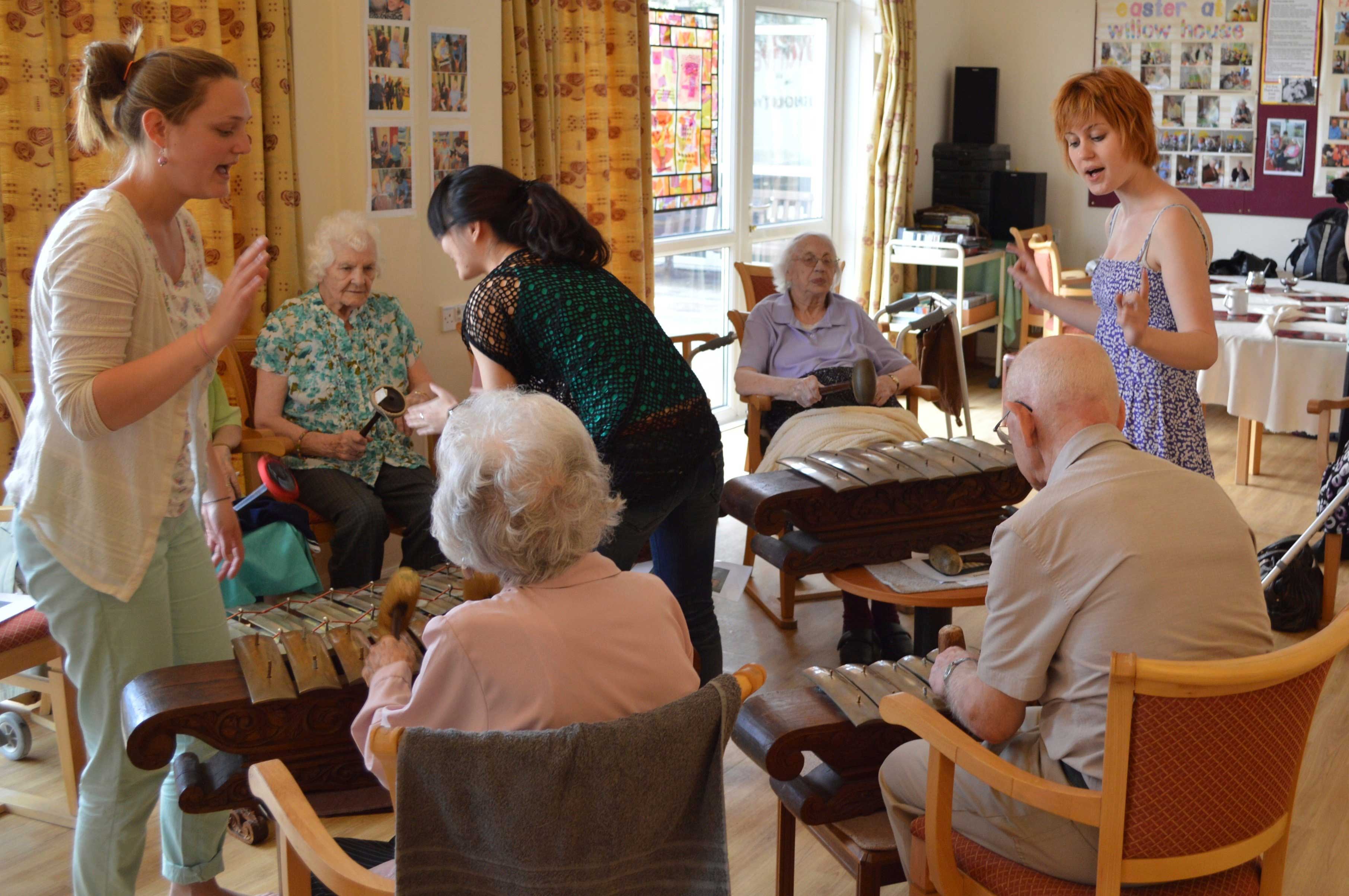
The MA in Community Music will enable you to facilitate inclusive and creative music activities with diverse groups of people in a variety of social contexts and for a range of purposes, including education, healthcare, leisure, social justice and wellbeing.
The course will provide you with the skills and knowledge needed to design and deliver participatory projects, and to carry out primary research using practice-based approaches, critical thinking and safe data management. The course builds skills in practical musicking and critical reflection and nurtures your ability to move flexibly across the diverse contexts encountered in the field of community music. This practical approach is complemented by topics in arts administration, project management and underpinning philosophies.
The course has proven attractive to recent graduates, mature students and international students alike, taking a person-centred approach to developing your professional skills and enabling you to meet the demands of related employment. Typical applicants may have an interest in the use of music in various participatory settings such as education, health, and personal or community-development but may not wish to train exclusively within one of these areas; they may be attracted to the growth in job opportunities in arts management, administration and consultancy; or they may wish to develop a portfolio career in a range of scholarly, professional and charitable settings. The programme aims to meet these needs and interests through its wide-ranging course structure that balances breadth of subjects with the opportunity to carry out specialist research projects.
"It is all about making music with others in an accessible and fun way to everyone involved! It's giving the opportunity of musicking to anyone who who wants it, especially those who may struggle to access it in day-to-day life."
The MA Community Music is based on a series of modules, seminars and a supervised independent study module.
You'll cover a range of topics relating to professional issues in community music.
In addition to the modules, we strongly encourage you to engage with local community music opportunities, participate in musical ensembles and attend weekly research seminars, performance classes and composition seminars relevant to your studies.
You will choose one option module. Examples may include:
Some option module combinations may not be possible. The options available to you will be confirmed after you begin your course.
Our modules may change to reflect the latest academic thinking and expertise of our staff, and in line with Department/School academic planning.
You'll begin work on the Capstone Project with sufficient time to plan your fieldwork. You'll have the freedom to take on a project relevant to your own interests.
Recent Capstone Projects have carried out research and analysis on community music activities at:
Every course at York is built on a distinctive set of learning outcomes. These will give you a clear understanding of what you will be able to accomplish at the end of the course and help you explain what you can offer employers. Our academics identify the knowledge, skills, and experiences you'll need upon graduation and then design the course to get you there.
| Study mode | UK (home) | International and EU |
|---|---|---|
| Full-time (1 year) | £12,000 | £26,900 |
| Part-time (2 years) This is the year 1 fee. Fees for future years are subject to confirmation. |
£6,000 | £13,450 |
| Part-time (3 years) This is the year 1 fee. Fees for future years are subject to confirmation. |
£4,000 | £8,966 |
Students on a Student Visa are not currently permitted to study part-time at York.
For courses which are longer than one year, the tuition fees quoted are for the first year of study.
UK (home) or international fees? The level of fee that you will be asked to pay depends on whether you're classed as a UK (home) or international student. Check your fee status.
Find out more information about tuition fees and how to pay them.
Discover your funding options to help with tuition fees and living costs.
We'll confirm more funding opportunities for students joining us in 2026/27 throughout the year.
If you've successfully completed an undergraduate degree at York you could be eligible for a 10% Masters fee discount.
We are pleased to work with Chevening Scholars to offer funding for our Masters programmes. Chevening Scholarships provide one year of fully-funded postgraduate study in the UK for international (including EU) students. The scholarships are open to early and mid-career professionals who have the potential to become future leaders.
You’ll work with world‐leading academics who’ll challenge you to think independently and excel in all that you do. Our approach to teaching will provide you with the knowledge, opportunities, and support you need to grow and succeed in a global workplace.
The MA in Community Music uses a range of teaching and learning approaches, including:
We have a range of outstanding facilities, including the Sir Jack Lyons Concert Hall and dozens of teaching rooms and practice facilities. All spaces are designed to be flexible and are used for projects, seminars, ensemble rehearsals and recordings.
Our beautiful green campus offers a student-friendly setting in which to live and study, within easy reach of the action in the city centre. It's easy to get around campus - everything is within walking or pedalling distance, or you can always use the fast and frequent bus service.
Assessment options on the MA in Community Music are varied, allowing you to tailor the programme to your own specialisms and interests.
Typically, Community Music students are assessed on a reflective journal, at least two substantial written pieces of work (essay, evaluation or project proposal) and a choice of practice-based submissions accompanied by a contextual commentary (e.g. performance, workshop, session plan, composition).
You will also produce a substantial independently-managed capstone project, which could be a written dissertation or a larger scale practical project with an extended critical commentary.
"We create music experiences together with all sorts of people. Everyone is equal and can actively participate in the musical space."
Graduates of this course are highly placed in many of the UK arts institutions, with many employed at UK and overseas institutions. Others have taken advantage of the diverse portfolio of arts management and administration gained from this course, or gone on to qualify further as music therapists. You'll also be perfectly equipped to continue your studies to PhD level.
| Qualification | Typical offer |
|---|---|
| Undergraduate degree | 2:2 or equivalent in Music or another relevant subject. |
| Other international qualifications | Equivalent qualifications from your country |
If English isn't your first language you may need to provide evidence of your English language ability. We accept the following qualifications:
| Qualification | Minimum requirement |
|---|---|
| IELTS (Academic and Indicator) | 6.5, minimum 6.0 in each component |
| Cambridge CEFR | B2 First: 176, with 169 in each component |
| Oxford ELLT | 7, minimum of 6 in each component |
| Oxford Test of English Advanced | 136, minimum 126 in each component |
| Duolingo | 120, minimum 105 in all other components |
| LanguageCert SELT | B2 with 33/50 in each component |
| LanguageCert Academic | 70 with a minimum of 65 in each component |
| Kaplan Test of English Language | 478-509, with 444-477 in all other components |
| Skills for English | B2: Merit overall, with Pass with Merit in each component |
| PTE Academic | 61, minimum 55 in each component |
| TOEFL | 87, minimum of 21 in each component |
| Trinity ISE III | Merit in all requirements |
For more information see our postgraduate English language requirements.
You may be eligible for one of our pre-sessional English language courses. These courses will provide you with the level of English needed to meet the conditions of your offer.
The length of course you need to take depends on your current English language test scores and how much you need to improve to reach our English language requirements.
After you've accepted your offer to study at York, we'll confirm which pre-sessional course you should apply to via You@York.
Get in touch if you have any questions