
Visualising the invisible: how art is bringing global supply chains to life
Posted on Thursday 9 July 2026
A creative collaboration between York researchers and an artist is changing that by turning complex data on commodities into powerful visual stories.
Supported by funding from the 2023-2025 ESRC Impact Acceleration Account at the University of York, the initiative brings the hidden human and environmental costs of consumer choices out of the spreadsheets and into the spotlight.
From fields to markets: bridging the gaps
The project brought together Dr Judith Krauss and Prof Tony Heron from the Department of Politics, alongside Prof Chris West from the Stockholm Environment Institute at York. Working closely with artist Luke Scoffield, the team transformed intricate research on four commodities - baobab and charcoal, soy and cocoa - into accessible visual summaries.
The goal is to help consumers, policymakers and industry stakeholders grasp the real-world dynamics shaping global trade and local livelihoods.
Baobab and charcoal in Mozambique
Judith Krauss (Politics) - (a fuller reflection on this arts-research collaboration can be found in this journal article)
.png)
Building on a global research project exploring Covid-19 livelihood impacts in rural Mozambique, Dr Judith Krauss mapped how the pandemic reshaped local trade. The resulting illustrations reveal two starkly different realities:
- The baobab value chain adapted successfully thanks to a civic-minded alliance between a local social enterprise, an organic certifier and an institutional donor, protecting income for female collectors as global and domestic demand for health foods grew.
The domestic charcoal value chain collapsed as train travel was stopped, driving down volumes and prices for small-scale producers who lacked a unified network to increase their bargaining power.
.png)
The creative process pushed researchers to think beyond text, helping to distill key messages.
The hidden footprint of global soy
Tony Heron and Paulina Flores-Martinez (Politics) (please see here for a related paper)
Prof Tony Heron and Paulina Flores-Martinez highlighted soy as the ultimate invisible ingredient. While rarely appearing on supermarket labels, it serves as the primary feed for poultry, pork and farmed fish. Driven by shifting diets across Asia, massive soy expansion in Latin America has triggered widespread deforestation.
.png) The artwork exposes a troubling disconnect: consumers remain largely unaware of this embedded footprint, whilst farmers face few economic incentives to switch to sustainable practices. With major markets like China lacking strict deforestation rules, and existing schemes like the Amazon Soy Moratorium facing legal setbacks in Brazil, the illustrations make these systemic vulnerabilities impossible to ignore.
The artwork exposes a troubling disconnect: consumers remain largely unaware of this embedded footprint, whilst farmers face few economic incentives to switch to sustainable practices. With major markets like China lacking strict deforestation rules, and existing schemes like the Amazon Soy Moratorium facing legal setbacks in Brazil, the illustrations make these systemic vulnerabilities impossible to ignore.
Cocoa and the compliance crunch
Chris West (SEI-Y) (please see here for a related paper)
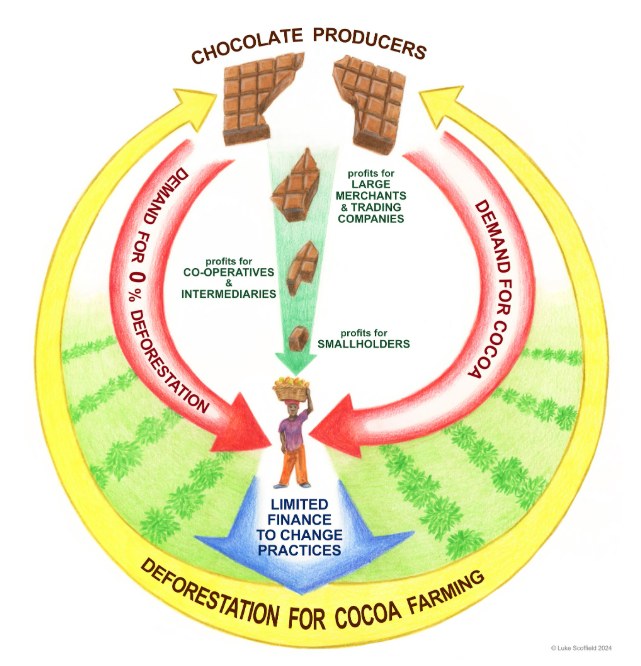
For cocoa, the focus shifts to the incoming European Union Deforestation Regulation. Prof Chris West examined how these new rules may impact West African smallholders. While having the potential to protect forests, requirements to geolocate production demand time and resources from vulnerable farmers.
The visual summary highlights a stark economic imbalance:
- Recent spikes in chocolate prices driven by climate change and disease are swallowed up by downstream traders, merchants and manufacturers.
- Very little profit reaches the smallholders who actually harvest the crops and carry the burden of data compliance.
Without a fairer distribution of wealth, regulations risk locking the poorest farmers out of European markets entirely, inadvertently driving deforestation further into less regulated regions or alternative land uses.
Why visual research matters
By translating dense academic insights into vivid narratives, this collaboration ensures vital environmental and social findings reach far beyond university walls. It prompts us to look closely at our shopping baskets and ask deeper questions about fairness, sustainability and the true cost of global trade.