

MA Music Performance: Solo Voice Ensemble Singing
Work with top level professionals to hone your skills in this genre.
Year of entry: 2026 (September)
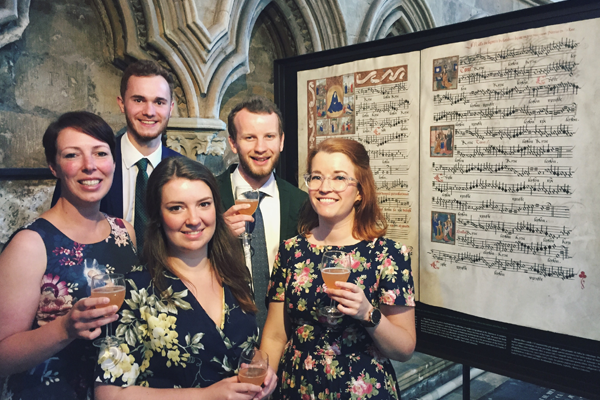
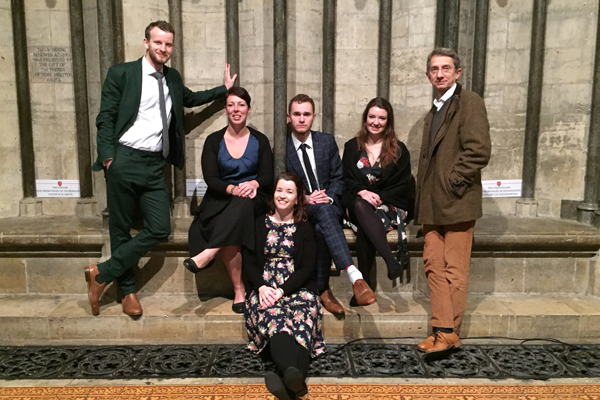
Until recently, postgraduate music education has barely touched on the connection between solo and choral singing. In this unique course led by Robert Hollingworth, director of the innovative solo-voice ensemble I Fagiolini, you'll explore the intricacies of this sophisticated genre.
You'll explore how audiences receive this repertoire, much of which was not written with public concert performance in mind, and consider how this affects presentation and performance.

The greatest thing about the year was discovering just how high a performance standard it is possible to achieve with time, dedication, and diplomacy. Put simply, the course changed the way I approach making music.
Course content
Throughout the year, you'll work within your ensemble to support each other and develop your skills within a consort environment.
We place an emphasis on independence and creativity - you will have the freedom to study the areas that interest you, in consultation with your ensemble.
Over the year, you'll study a series of core and option modules, and perform assessed recitals. In addition, we strongly encourage you to participate in musical ensembles and attend weekly research seminars, performance classes and composition seminars relevant to your studies.
You'll receive a very generous allowance of high quality one-to-one lessons with a member of our vocal teaching staff. Contact programme leader Robert Hollingworth to discuss how this tuition can be tailored to support your musical development.
Modules
Core modules
- Recital I
- Developing Your Artistic Practice I
- Research Skills for Musicians
- Developing Your Artistic Practice II
- Recital II
Our modules may change to reflect the latest academic thinking and expertise of our staff, and in line with Department/School academic planning.
Final project
Your course will conclude with a substantial public recital showcasing your artistic and scholarly insight through a programme of your own design.
Learning outcomes
Every course at York is built on a distinctive set of learning outcomes. These will give you a clear understanding of what you will be able to accomplish at the end of the course and help you explain what you can offer employers. Our academics identify the knowledge, skills, and experiences you'll need upon graduation and then design the course to get you there.
Learning outcomes for this course
- Research independently and collaboratively with the sophistication, close attention to detail and creative flair developed through the advanced study of music at Masters level
- Lead, or constructively contribute to, advanced-level musical activity by performing and communicating about performance at a professional level, supported by advanced skills of critical listening, analysis and reflective practice as appropriate
- Plan and execute critically informed performances through rigorous planning and the application of appropriate principles and methods, theoretical knowledge, methodologies, practical techniques and experience, and artistic imagination with sophisticated command of individual expressive capability within an ensemble context
- Make use of acoustically pure intonation and perform according to its implications, both melodically and harmonically, as well as to analyse any score - of any period - with these skills and be able to pass on this understanding to others
- Communicate at an advanced level on a range of issues relating to the history and present of musical repertoire and its performance, its relation to wider culture, and its technical and artistic execution, using appropriate written and oral media and music-making activities
- Apply the musical and transferable skills gained throughout the programme with confidence and aptitude in a range of national and international professional contexts, for example performance (whether in small consort or larger-scale choral contexts), teaching, project management, academic work, and collaboration
- Apply self-evaluative skills of reflective practice to inform current work and continuing professional development in performance with creativity, imagination and initiative.
Fees and funding
Annual tuition fees for 2026/27
| Study mode | UK (home) | International and EU |
|---|---|---|
| Full-time (1 year) | £12,000 | £27,250 |
Fees information
UK (home) or international fees? The level of fee that you will be asked to pay depends on whether you're classed as a UK (home) or international student. Check your fee status.
Find out more information about tuition fees and how to pay them.
Funding information
Discover your funding options to help with tuition fees and living costs.
We'll confirm more funding opportunities for students joining us in 2026/27 throughout the year.
If you've successfully completed an undergraduate degree at York you could be eligible for a 10% Masters fee discount.
Funding opportunities
Chevening Scholarships
We are pleased to work with Chevening Scholars to offer funding for our Masters programmes. Chevening Scholarships provide one year of fully-funded postgraduate study in the UK for international (including EU) students. The scholarships are open to early and mid-career professionals who have the potential to become future leaders.
Subject-specific funding
Teaching and assessment
You’ll work with world‐leading academics who’ll challenge you to think independently and excel in all that you do. Our approach to teaching will provide you with the knowledge, opportunities, and support you need to grow and succeed in a global workplace.
Teaching format
Your teaching will largely take the form of weekly seminars, covering musicological teaching and vocal coaching, and one-to-one tutorials. You'll also be expected to arrange regular rehearsals with your ensemble, as well as participating in rehearsals of musical ensembles, including The 24.
You will have regular meetings with your supervisor, who will advise you and help develop your ideas as you progress through your studies.
We encourage you to get involved with our lively community, from our ensembles to our weekly seminars, performance classes and research seminars.
Facilities
We have a range of outstanding facilities, including the Sir Jack Lyons Concert Hall and dozens of teaching rooms and practice facilities. All spaces are designed to be flexible and are used for projects, seminars, ensemble rehearsals and recordings. Discover our facilities.
Teaching location
Your teaching will take place within the School of Arts & Creative Technologies, which has sites on both Campus West and Campus East. The majority of your core teaching for this MA programme will take place in the Sir Jack Lyons Concert Hall buildings on Campus West.
About our campus
Our beautiful green campus offers a student-friendly setting in which to live and study, within easy reach of the action in the city centre. It's easy to get around campus - everything is within walking or pedalling distance, or you can always use the fast and frequent bus service.
Assessment and feedback
Within your group, you’ll develop three concert programmes for assessment throughout the course. The first two recitals will be based on repertoire agreed with the course tutor, while the third focuses more on independent choice. Alongside these you will have written and presentation assessments designed to help you develop communication and research skills relevant to your work as a performer.
Careers and skills
This course is directly beneficial to students wishing to break in to the commercial world of classical singing. You'll gain vital skills for performing your repertoire professionally, enabling you to be competitive within the professional solo and choral worlds.
Career opportunities
- Choral Professional (freelance or salaried)
- Solo Performance
- Music teacher
- Performance research and PhD study
- Private music tutor
Transferable skills
- Understanding auditions
- Repertoire knowledge
- Dealing with performance anxiety
- Time management
- Teamwork
- Collaboration

Turn ambition into achievement with our expert guidance and connections. From your first day here to life after graduation, we'll help you find your career advantage.
Entry requirements
| Qualification | Typical offer |
|---|---|
| Undergraduate degree | 2:2 or equivalent in Music or another relevant subject. |
| Other international qualifications | Equivalent qualifications from your country |
Additional requirements
You can apply as a pre-formed group, or as an individual. In either case the process starts by contacting Robert Hollingworth with a short CV and some audio or video evidence of your voice (in Western Art Music) - normally solo voice but consort performance is also fine. (Do not make the online application until you have been asked to do so.)
If you are invited to apply for the course, we will match you with other candidates. If you're on different continents, each singer will be encouraged to video-record two pieces (either solo or in consort with others) and make them available to the other singers so that each of you has a proper chance to listen to your colleagues in advance.
English language
If English isn't your first language you may need to provide evidence of your English language ability. We accept the following qualifications:
| Qualification | Minimum requirement |
|---|---|
| IELTS (Academic and Indicator) | 6.0, minimum 5.5 in each component |
| Cambridge CEFR | B2 First: 169, with no less than 162 in each component |
| Oxford ELLT | 6, minimum of 5 in each component |
| Oxford Test of English Advanced | 126, minimum 116 in each component |
| Duolingo | 105, minimum 95 in all other components |
| LanguageCert SELT | B2 with 33/50 in each component |
| LanguageCert Academic | 65 with a minimum of 60 in each component |
| Kaplan Test of English Language | 444-477, with 410-443 in all other components |
| Skills for English | B2: Pass with Merit overall, with Pass in each component |
| PTE Academic | 55, minimum 51 in each component |
| TOEFL | 79, minimum 17 in Listening, 18 in Reading, 20 in Speaking and 17 in Writing |
| Trinity ISE III | Pass in all components |
For more information see our postgraduate English language requirements.
If you haven't met our English language requirements
You may be eligible for one of our pre-sessional English language courses. These courses will provide you with the level of English needed to meet the conditions of your offer.
The length of course you need to take depends on your current English language test scores and how much you need to improve to reach our English language requirements.
After you've accepted your offer to study at York, we'll confirm which pre-sessional course you should apply to via You@York.
Next steps
Contact us
Get in touch if you have any questions

Discover York

We offer a range of campus accommodation to suit you and your budget, from economy to premium.

Explore campus and city life and hear what our current students have to say about living here.

Lively, full of culture and beautiful, York is regularly voted one of the best places to live and visit in the UK.

Find out more about York. Chat to staff and students and take the tour, on campus or online.