
Maternal Health and Floods
Flood events affect low-, middle-, and high-income countries and are becoming increasingly common and severe due to climate change. They affect access to, and the provision of, healthcare services. Those who are pregnant are vulnerable to these events during pregnancy, delivery and post-delivery. This can lead to adverse physical and mental health outcomes.
Aims and Objectives
The aim of the study is to investigate the impact of flood events on maternal health in two coastal cities: Accra in Ghana and Kingston upon Hull (Hull) in England.
Research Ouputs
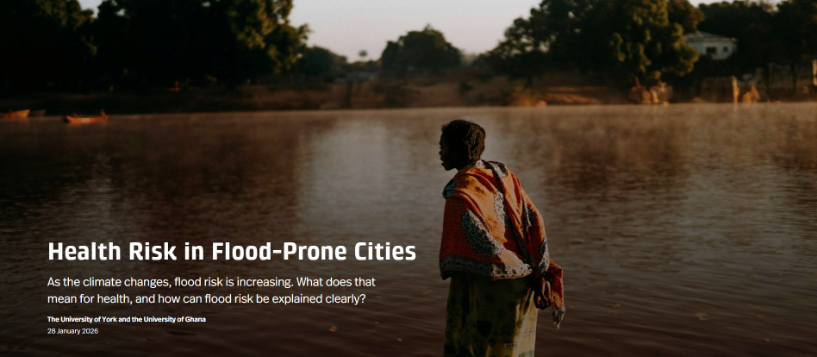
A new StoryMap has been developed exploring how flood risk is understood, communicated, and experienced, with a particular focus on maternal health as an underrepresented vulnerability. As climate change increases the frequency and severity of flooding, commonly used terms such as “1-in-100-year flood” may be inadequate, as they are often difficult to interpret and can be misleading. The StoryMap moves beyond abstract probabilities to illustrate how flood risk is encountered in everyday life, including disrupted access to healthcare, increased exposure to disease, and impacts on mental health. Focusing on Accra (Ghana) and Kingston upon Hull (UK), the StoryMap highlights how geographically distinct cities can face similar challenges at the intersection of climate, flooding, and health, while also demonstrating how risk communication can be improved through clearer, more accessible, and human-centred approaches.
Key York Contact
Amanda Mason-Jones, Department of Health Sciences
Principal and Co-Investigators
Amanda Mason-Jones (Health Sciences, University of York)
Beth Mroz (Health Sciences, University of York)
Lindsay Stringer (Environment and Geography, University of York)
Samuel Adjorlolo (Nursing and Midwifery, University of Ghana)
Caroline Dinam Badzi (Nursing and Midwifery, University of Ghana)