Skip to content Accessibility statement

MSc Fusion Energy Science and Technologies

Push the boundaries of science and technology in the quest for limitless clean energy.

Year of entry: 2027 (September)

Start date
September 2027
View semester dates
Length
1 year full-time,
2 years part-time,
3 years part-time

Apply for this course

Why study Fusion Energy Science and Technologies at York?

Become a member of the York Plasma Institute. Connect with leading researchers advancing the science of fusion energy. Through frequent seminars, you'll have opportunities to interact with visiting experts from academia and industry and experience the wide-ranging value of your developing fusion-relevant skills as you discover how the frontiers of fusion are linked to other fields such as high-energy-density physics and technological applications of plasma science.

Prepare for a career in the future of clean energy, through a programme designed with support from UKAEA. Explore how the science shapes the technology enabling fusion energy. You'll develop the knowledge and skills needed to contribute to the development of future fusion energy systems, in time for joining the growing fusion industry, or other highly technical industries.

Build the skills to work across the fusion industry. Through visiting our external partners, you will build your understanding of how physicists, engineers, data scientists and project leaders work together to deliver complex, state-of-the-art projects. You'll gain the interdisciplinary perspective and collaborative skills needed to contribute to this rapidly developing sector.

Develop expertise in your chosen area of fusion energy. Learn the foundations needed for any fusioneer: discover what fusion involves, why it matters, how it could reshape the power generation ecosystem and to what fundamental scientific questions and technological advances (e.g. AI) it is linked. Building on these foundations and your specific background, let your interests guide your choice of a specialism to launch your career as a fusion physicist, engineer, computer scientist or project leader.

Sign up for email updates to keep up with all our latest news about the MSc Fusion Energy Science & Technologies.

Women in science

We are the proud holders of an Athena SWAN Silver Award and an IOP Juno Champion award, recognising of our commitment to gender equality, and women in STEM.

 Institute of Physics - Juno Champion

Athena SWAN Silver Award

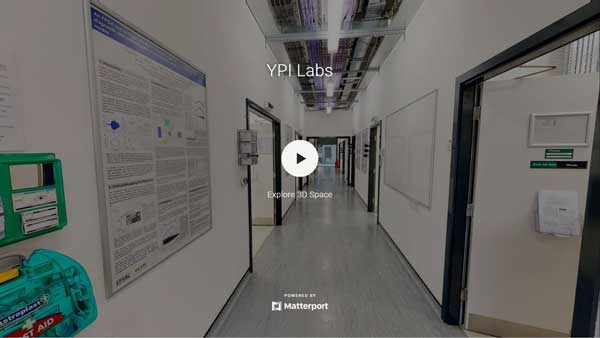
YPI Labs virtual tour

Take a virtual tour of York Plasma Institute's laboratories, showing a current experiment, some of our equipment and facilities.

World-leading tutors
Learn from internationally renowned engineers and physicists pushing the boundaries of knowledge in fusion energy
Cutting-edge techniques and facilities
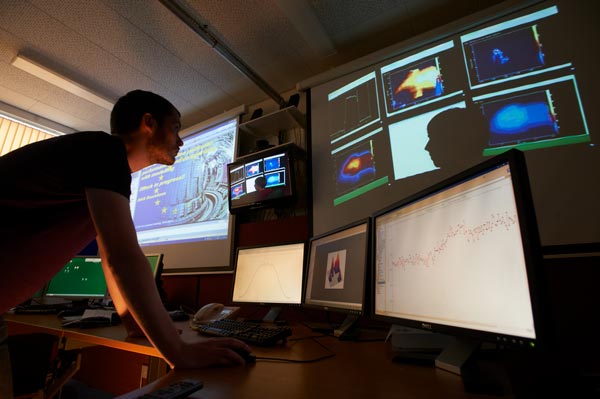
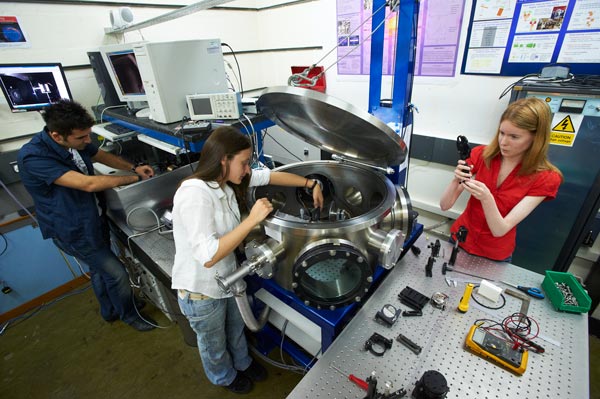
Access to state-of-the-art data analysis techniques and equipment, in purpose-built teaching, research and laboratory spaces
According to the Times Higher Education’s ranking of the latest REF results (2021). And our research environment - the support we give to our researchers - is ranked 5th.

Course content

You'll start your studies with a series of foundation modules covering the essential concepts that underpin the main approaches to achieving fusion energy. With this background, you'll learn about both the science and technologies necessary for magnetic and inertial confinement approaches to fusion. These topics are supported by opportunities to develop and apply academic and technical skills to topics important to fusion.

As part of Semester 2, you will engage in two intensive one-week courses, delivered by visiting expert speakers, covering the engineering and science technologies and frontiers of fusion research.

You'll complete the MSc with a team research project. Under the supervision of world-leading experts at the York Plasma Institute and the School of Physics, Engineering and Technology, you will develop deep knowledge in a specific aspect of fusion or a related area of plasma science or technology. Team Projects are based at York Plasma Institute with some opportunities to visit and study in collaboration with industry partners and national laboratories.

Modules

Core modules (Semester 1)

Option modules (Semester 1)

You will study one option module from the following:

Core Modules (Semester 2)

Option modules (Semester 2)

You will study one option module from the following:

Our modules may change to reflect the latest academic thinking and expertise of our staff, and in line with Department/School academic planning.

Research project

A Team Project may consist of several sections addressing important scientific, engineering, technological and management questions. You will lead one section and contribute to the whole team via briefings, and addressing broader questions raised by this collective effort.

Each Team Project is supported by a specific member of staff as supervisor who will give advice and assistance as needed. Available Team Projects, and sections within each Project, may vary from year to year, to reflect the interests of our staff and developments in fusion. Some examples of the kind of team projects that might be available are:

  • Design and build of critical focal spot monitoring diagnostic for a VULCAN PW laser experiment.
  • Designing experiments to control and understand the MAST Upgrade Super-X divertor
  • Statistical analysis of fluctuation fields in a linear plasma device

Team Projects are based at York Plasma Institute with some opportunities to visit and study in collaboration with industry partners and national laboratories.

There is also potential for students to propose their own customised section within a Team Project, this will require careful liaison with the MSc leader and administrative support.

Learning outcomes

Every course at York is built on a distinctive set of learning outcomes. These will give you a clear understanding of what you will be able to accomplish at the end of the course and help you explain what you can offer employers. Our academics identify the knowledge, skills, and experiences you'll need upon graduation and then design the course to get you there.

Learning outcomes for this course
  • Knowledge & understanding: Articulate the opportunities, challenges and unknowns at the forefront of fusion energy science and technology, indicating how these are being addressed via different engineering, mathematical, computational, experimental, and management approaches to enable working fusion energy schemes.
  • Finding solutions: Develop and present solutions to complex problems using scientific, engineering, management and/or computational techniques, to make measured, informed judgements about what the approaches may be for addressing specific problems in fusion energy science and technology. 
  • Critical analysis: Critically evaluate research, technical, management or policy literature and data, paying attention to the techniques used, and their limitations, to provide reliable and robust conclusions, sensible recommendations and - where appropriate - suggest alternative approaches.
  • Delivering a project: Within a team, outline, develop and execute an open-ended independent investigation in fusion energy. Through your own contributions and making use of a diverse range of individual competencies, apply the appropriate methodology and bring the investigation to a robust conclusion.
  • Communicating to stakeholders: Communicate complex ideas associated with fusion science and technology in clear, precise, and accessible terms to a variety of audiences. Articulate how current research and development in fusion energy science and technology may impact societal issues, and evaluate innovative solutions.    

What I enjoyed about the Fusion Energy MSc

The course had a lot of optionality to allow me to choose to do what I was most interested in.

Fees and funding

Annual tuition fees

Study mode UK (home) International and EU
Full-time (1 year) £14,390 £33,900
Part-time (2 years) £7,195 £16,950
Part-time (3 years) £4,797 £11,300

Fees are for year one. Fees for future years are subject to confirmation.

Fees information

UK (home) or international fees? The level of fee that you will be asked to pay depends on whether you're classed as a UK (home) or international student. Check your fee status.

Find out more information about tuition fees and how to pay them.

Details of our 2027/28 funding opportunities will be available soon.

It is an amazing program. It’s well structured and with a great community vibe in the York Plasma Institute, close to people that are always there to help you.
Ricardo. Read Ricardo's blog post.

Teaching and assessment

You’ll work with world‐leading academics who’ll challenge you to think independently and excel in all that you do. Our approach to teaching will provide you with the knowledge, opportunities, and support you need to grow and succeed in a global workplace.

Teaching format

Our active learning culture uses a wide range of teaching methods to suit different learning styles. As you develop a deep understanding of fusion energy we provide opportunities to grow in independence, build knowledge, skills and competencies for you to succeed in technologically advanced settings.

You'll learn through a range of teaching formats by interacting with:

  • Lectures
  • Industry speakers
  • Seminars
  • Frontier and practical workshops
  • Directed reading
  • Independent study

The York Plasma Institute and School are an inclusive, friendly, supportive and intellectually stimulating environment in which to study.

Teaching location

Most of your teaching will take place in the School of Physics & Engineering Technology and York Plasma Institute on Campus West. The majority of departments, colleges and facilities are based nearby.

Team Projects are based at York Plasma Institute with some opportunities to visit and study in collaboration with industry partners and national laboratories.

About our campus

Our beautiful green campus offers a student-friendly setting in which to live and study, within easy reach of the action in the city centre. It's easy to get around campus - everything is within walking or pedalling distance, or you can always use the fast and frequent bus service.

Assessment and feedback

You will be assessed with a mixture of closed- and open-book exams, essays and oral presentations.

The grade for your project is based on your project notebook, final report and viva.

Careers and skills

This course will start you off on a career in various fields within the growing plasma and fusion energy sector. You will develop strong foundations in plasma and fusion concepts with the skill sets needed for seeking solutions to challenging and often complex problems. The transferable skills unlock diverse career opportunities, including as a research, engineering or scientific specialist in fusion. You'll have the opportunity to foster invaluable industry connections and play a role in advancing fusion and plasma technologies for the benefit of society.

Many of our students are offered PhD positions in both fusion energy and other subject areas. Other students go straight into industry, both within fusion, and in a wide array of areas outside of fusion.

Career opportunities

  • Research scientist
  • Engineer
  • Software developer
  • Data scientist and analyst
  • Civil Service, energy policy
  • Project Manager
  • Further education lecturer

Transferable skills

  • Problem solving
  • Scientific computing
  • Data analysis & management
  • Creating innovative solutions
  • Communication
  • Teamwork
  • Research and analysis
  • Digital literacy & technical writing
  • Time & project management

Entry requirements

Qualification Typical offer
Undergraduate degree 2:2 or equivalent in a broad range of STEM subjects including engineering, mathematics, physics, computer science, environmental science, and related disciplines
Other international qualifications Equivalent qualifications from your country

English language

If English isn't your first language you may need to provide evidence of your English language ability. We accept the following qualifications:

Qualification Minimum requirement
IELTS (Academic and Indicator) 6.0, minimum 5.5 in each component
Cambridge CEFR B2 First: 169, with no less than 162 in each component
Oxford ELLT 6, minimum of 5 in each component
Oxford Test of English Advanced 136, minimum 126 in each component
Duolingo 105, minimum 95 in all other components
LanguageCert SELT B2 with 33/50 in each component
LanguageCert Academic 65 with a minimum of 60 in each component
Kaplan Test of English Language 444-477, with 410-443 in all other components
Skills for English B2: Pass with Merit overall, with Pass in each component
PTE Academic 52 with 46 in Listening, 47 in Reading, 53 in Speaking and 50 in Writing
TOEFL 79, minimum of 17 in Listening, 18 in Reading, 20 in Speaking and 17 in Writing
Trinity ISE III Pass in all components

For more information see our postgraduate English language requirements.

If you haven't met our English language requirements

You may be eligible for one of our pre-sessional English language courses. These courses will provide you with the level of English needed to meet the conditions of your offer.

The length of course you need to take depends on your current English language test scores and how much you need to improve to reach our English language requirements.

After you've accepted your offer to study at York, we'll confirm which pre-sessional course you should apply to via You@York.

Next steps

Contact us

Get in touch if you have any questions

School of Physics, Engineering and Technology Admissions

pet-admissions@york.ac.uk

01904 325842

Discover York

We offer a range of campus accommodation to suit you and your budget, from economy to premium.
Explore campus and city life and hear what our current students have to say about living here.
Lively, full of culture and beautiful, York is regularly voted one of the best places to live and visit in the UK.
Find out more about York. Chat to staff and students and take the tour, on campus or online.