
British Civil Wars
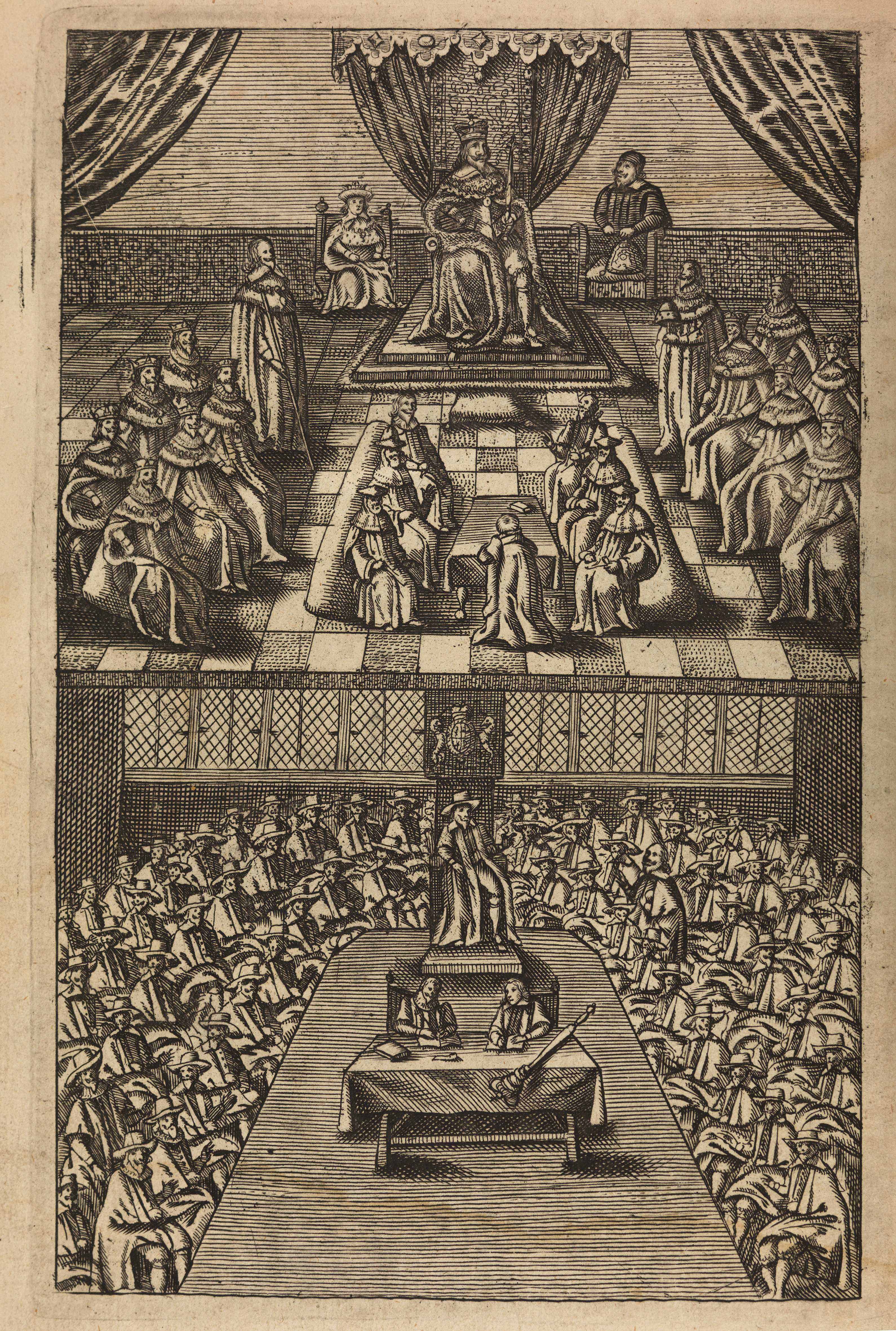
The collection includes political speeches, accounts of battles, opinions, sermons, descriptions of the trial and execution of Charles I, and newsbooks. Particular strengths are radical print, and the role of women in the 17th century book trade.
Researching British Civil Wars
The University of York and York Minster Library holds a substantial amount of material relating to the British Civil War period. This includes political speeches, accounts of battles, opinions, sermons, descriptions of the trial and execution of Charles I, and newsbooks. The material is an important historical resource and also provides information about the printing and book trade.
The British Civil wars lasted from 1642 to 1649, however there was a period both before and after this time that shaped events. Charles I ruled without Parliament for 11 years, finding other ways to make the money that Parliament would ordinarily have granted him. His personal rule ended when the money ran out and the King was forced to recall Parliament in 1640. Charles was unhappy with the series of strictures and checks that Parliament wanted to introduce and saw his only recourse as war.
Using the printing press for propaganda was an integral part of the war for both King and Parliament. Presses in London and the regions were kept busy producing cheap short tracts justifying the war, and attempting to win hearts and minds.
Radical Print
The civil war period saw the flourishing of new ideas and movements, and a subsequent increase in the use of print for radical propaganda. Tracts were produced by people across society, from common soldiers to politicians. However, if a piece of writing was considered inflammatory, or was something that might lead to persecution, authors and printers protected themselves by either staying anonymous or by giving fictitious names. Secret presses included the Cloppenburg Press and Margery Mar-prelat.
Women in the mid-17th-century print and book trade
Recent scholarship has revealed that women played a much larger role in the 17th-century print and book trade than previously thought. They were printers, distributors, sellers, and authors.
Female publishers and booksellers are rarely referenced by their full names; thus, abbreviated or initialled versions of their names are used. Maureen Bell, ‘Women writing and women written’ in The Cambridge History of the Book in Britain volume 4, provides the full names of many of these women.
Highlights include:
- “The Sacred Philosophie of the Holy Scripture…” 1635, printed by Anne Griffin and sold by Joyce Norton and her partner, reflecting the network of women within the publishing and book trade.
- “An Alarum of VVar, given to the Army, and to Their High Court of Iustice (so Called)...” 1649, calls for a ‘divorce’ between Parliament and the King. Written by Elizabeth Poole, this radical document was one of the few instances of a woman publicly commenting on a politically contentious issue of this scale.
- “A True Copy of the Petition of the Gentlewomen, [Sic] and Tradesmens-Wives in and about the City of London…” 1642, was one of the first examples of a mass female petition to Parliament and demonstrates how women understood the political situation within England and Europe in this period.
York in the Civil War
York was a Royalist stronghold until 1644, when the King’s forces fell to the Parliamentarians. Charles I set up his court in York for a short period in 1642. He bought his printer, Robert Barker, with him and printed a number of tracts.
The Rare Books collection and York Minster Library hold a significant number of the tracts printed in York and others that refer to events in the North of England during the period.
Highlights:
- His Majesties speech to the gentry of the County of York, attending His Majestie at the City of York, on Thursday the 12. of May, 1642.
- His Majesties declaration to all his loving subjects occasioned by a false and scandalous imputation laid upon His Majestie, of an intention of raising or leavying war against his Parliament ... 1642
- The petition of both houses of Parliament. Presented to His Majestie at York, the 23. of May 1642, concerning the disbanding of his guard.
Notable collections/collectors
Raymond Burton Yorkshire Collection
Raymond Burton deposited his collection of 1600 books on Yorkshire, covering all aspects of Yorkshire life including the county’s involvement in the British Civil Wars.
Highlights include
- Autograph letter from Thomas, 3rd Baron Fairfax to his father Lord Fairfax, June 13 1642. Concerns the delay of the King's journey to Lincolnshire, with mention of Lord Clare and others and of Lady Westmorland's coming to Nun Appleton.
- Autograph letter from Charles I to Sir John Goodricke, 1642. commanding Goodricke upon "paine of our heavie displeasure" not to leave Yorkshire for any reason whatsoever but to attend the King's service. Signed "Charles R" at head. "Dated at our Court at Yorke the sixthe of May 1642".
- Siege coin from Scarborough castle. Siege coins were emergency currency created when the besieged place was cut off from regular coin supplies
Petyt Collection
The collection consists of books collected by William Petyt (1635-1707) and his brother Silvester (1638-1719).
The brothers lived during the English Civil War and Commonwealth period, with the library reflecting the contemporary thought during the age. Therefore the collection contains books on religion (both Protestant and Catholic), politics and many Civil War tracts.
The Petyt Collection is strong in material from radical preachers such as William Prynne, John Lilburne, and John Saltmarsh.
Highlights include:
- “A pearle in a Dovnghill…” 1646, was written by John Lilburne, one of the most prolific writers of Leveller propaganda in this period. It is a criticism of the Long Parliament and has no named printer, indicating this was published by a secret press.
- “Mercurius coelicus: or, a caveat to all people of the kingdome, that now have, or shall hereafter happen to reade the counterfeit, and most pernicious pamphlet written under the name of Navvorth…” 1644, is an entertaining document originally written by John Booker, and republished with George Wharton’s (aka Naworth) snarky comments. This astrological almanack reflects how political tensions can turn all literary genres into radical print.
York Minster Archives
York Minster archives has related material including a 1644 battle plan for Marston Moor, and a contemporary account of the execution of Charles I.
How to access the collections
All the collections can be accessed via the Library's online catalogue. A valid University of York username and password is required to access content online.
Keywords to search for include
- Civil War, 1642-1649
- Great Britain--Politics and government--1642-1649
Items held in the library can be consulted on site. Most of these titles can be borrowed using a suitable library card, some titles might be reference only and can only be read on site.
Items held in the Borthwick can be consulted in the Borthwick Reading Room and copies can be made subject to copyright and condition. These materials cannot be loaned outside the University of York without the permission of the owners. Books in the Rare Books Collection may also be consulted at the Borthwick Institute for Archives.