
Semantics for Verifiable Maritime Autonomy (Seamantics)
Researchers are developing a framework that enables autonomous ships to reason using shared, verifiable knowledge, rather than learned patterns, so they can make safe decisions even when information is incomplete or communication is unreliable.
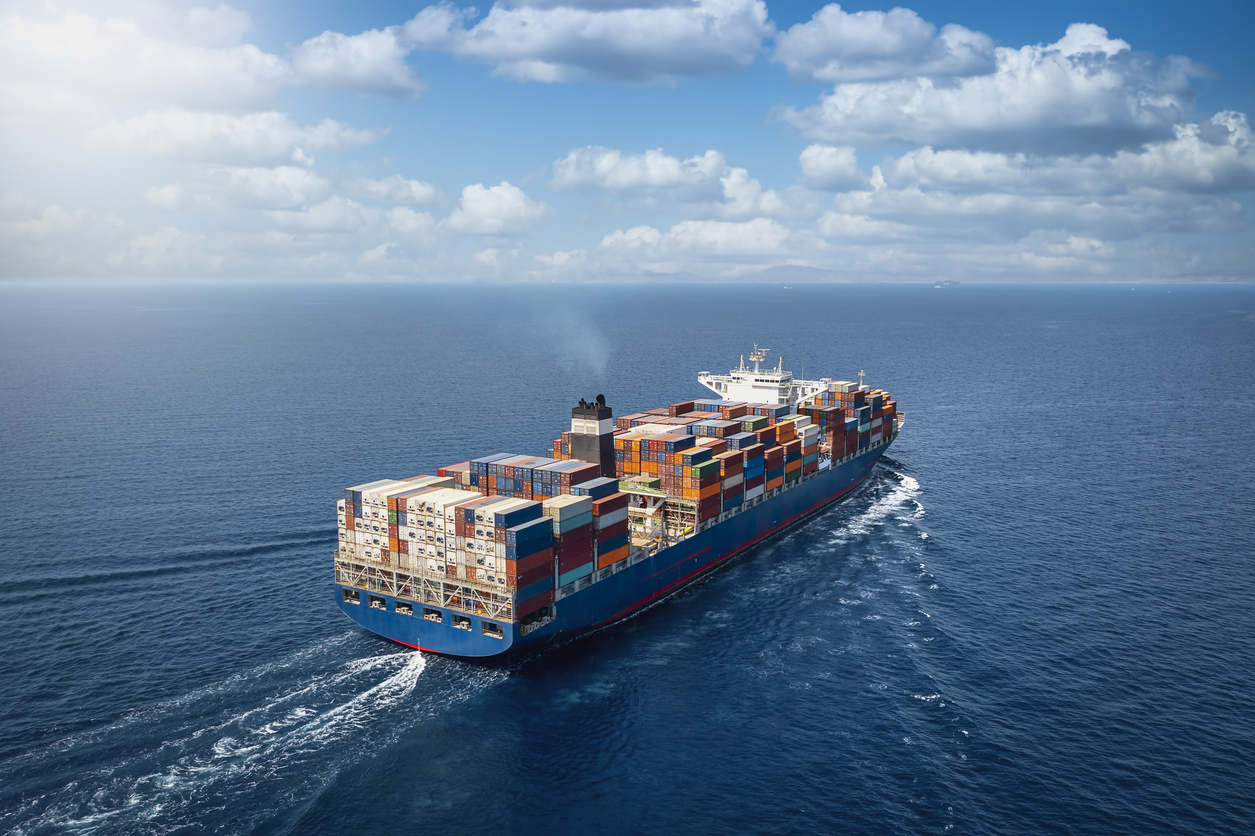
The growing field of maritime autonomy requires remote surface and underwater vessels to make verifiably safe and rule-compliant decisions while receiving instructions from a human operator, who may have only a partial picture of the whole situation. These increasingly-autonomous vehicles need to be able to not only follow highly abstract maritime regulations, but also communicate clearly with human operators and other vessels, each with different levels of knowledge.
The current state of the art is focused on learning-based systems. These systems build their "knowledge" from statistical patterns learned from data, rather than from explicit facts, making it hard to explain why autonomous systems made a particular decision, or to prove that the system will operate within safe limits. This project takes a different approach, embedding verifiable semantics directly into a vessel's control system, so it can receive and transmit information in clearly understandable, logical language to a human operator and other vessels with different knowledge, while maintaining its own built-in safety rules, which have been determined by logic rather than learned behaviour. No system like this currently exists for maritime use, and the project is setting out to build one.
Creating a system that is fundamentally safe, networkable and verifiable, relies on the unique community within ISA, combining expertise from the Institute’s three research pillars:
Design and verification: Grounding autonomy in verifiable symbolic reasoning, rather than learning-based systems, so a vessel's decisions can be checked and explained.
Communications: Encoding semantics efficiently for transmission over both high-bandwidth links, such as 5G and Wi-Fi, and low-bandwidth links, such as radio, text messages or underwater acoustic communications.
Assurance: Developing a preliminary safety argument for semantics in the context of maritime autonomy.
The use of semantics and verifiable knowledge within maritime systems will be increasingly important as demand for automation increases. Most ships at sea today and for decades to come, will still need a human crew, since older technology is likely to stay in use for a long time yet. Generative AI cannot be trusted as a bridging solution because of accuracy and reliability issues.
The potential long-term impacts could include making ships more resistant to satellite navigation jamming and allow autonomous systems to tap into existing data broadcasts over shortwave radio.
Outputs will include a peer-reviewed journal paper, conference papers and a field demonstration, with an EPSRC proposal aimed at submission in late 2027.
Project team: Dr Mark A Post (project lead), Dr John Molloy, Dr Tian Gan, Dr Gricel Nidteja Vazquez Flores, Dr Sinem Getir-Yaman, Professor Alister Burr, Dr Nils Morozs, Dr Simon Foster, Dr Alvaro Miyazawa, Dr Tianyuan Wang and Dr Rob Woolley
Cross-cutting challenges
Each year the Institute supports a number of cross cutting projects which encourage researchers to work across the three research pillars.