
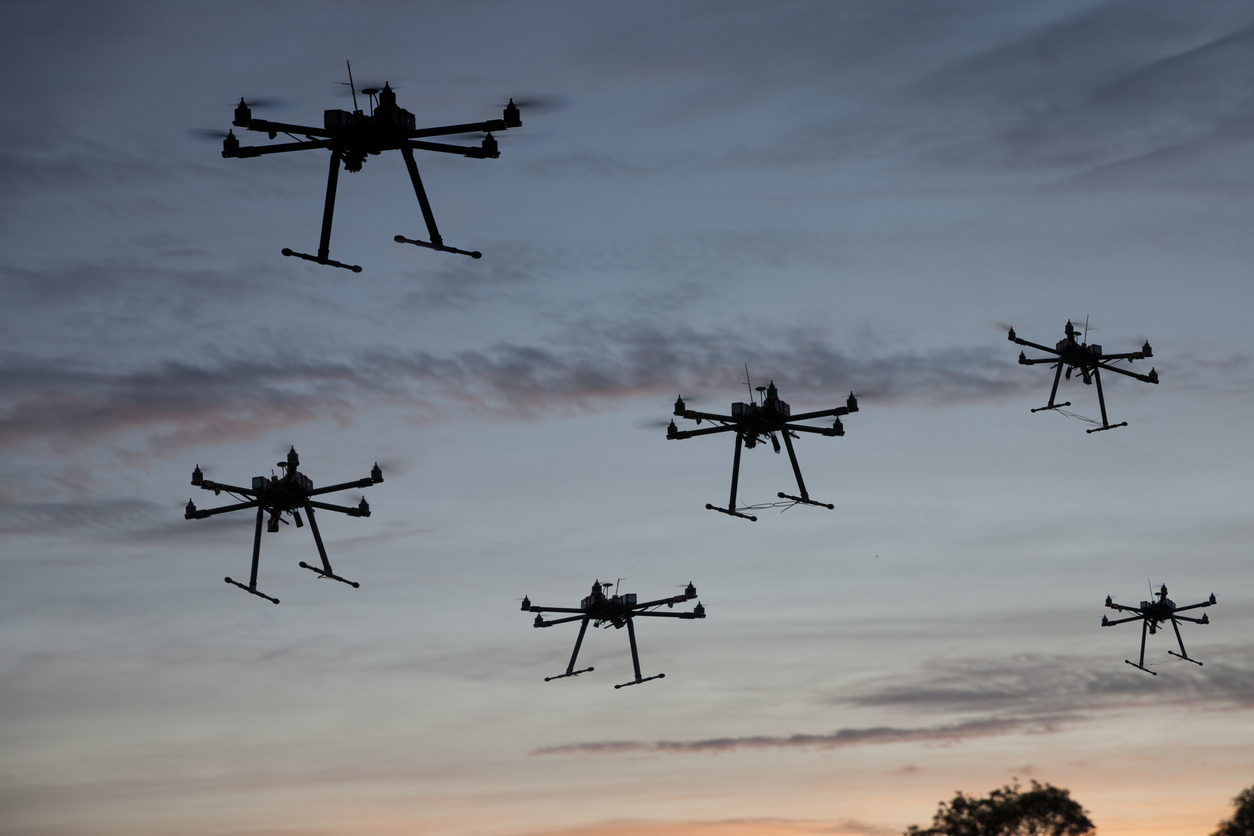
Drone swarm for fabric manipulation (D-FAB)
Researchers are developing a framework that will enable a swarm of drones to safely manipulate, grip and move protective fabrics, such as a fire retardant blanket or a camouflage net, in disaster zone settings.
While aerial drones have previously been used to carry rigid payloads, carrying flexible textiles in volatile environments remains a critical gap in robotic capabilities.
This project addresses that gap by developing control algorithms and real time sensory feedback loops that allow a drone swarm to grip the fabric and work together as a single coordinated unit. By continuously adjusting the relative positioning and pulling force, the swarm can stabilise and manipulate protective fabrics across diverse, unstructured environments. Meanwhile safety limits will be established in real time, ensuring the swarm can adapt or safely abort operations if conditions become unsafe.
This pioneering research has the potential to transform drones from simple couriers to active responders in humanitarian and emergency crisis scenarios. A synchronised swarm could rapidly deploy heavy fire retardant blankets over localised blazes or structural openings to starve fires of oxygen, or position safety nets in hazardous areas, all without exposing humans to danger. By streamlining logistics in disaster relief and defence scenarios, the system significantly reduces response times and improves operational safety.
The project transforms York’s long standing expertise in decentralised swarm theory into a critical real-world application, relying on ISA’s world class facilities and combined expertise from across all three of ISA’s research pillars.
Communications: Developing resilient, low latency mesh networks capable of keeping the swarm strictly synchronised in unstructured environments, where signal interference and environmental noise eg. wind, are significant variables.
Design and Verification: Creating a digital twin, a computer model of the drones and fabric, to mathematically guarantee that large-scale materials, such as fire-retardant blankets, can be deployed without drones colliding or becoming stuck, even under physical stress.
Assurance: Establishing automatic safety limits in real time, that ensure the swarm can adapt or safely abort operations in a volatile disaster zone, creating a rigorous safety case for deployable autonomy.
Researchers will collaborate with emergency response agencies, humanitarian organisations and defence research partners to evaluate system adaptability and deployment speed in simulated hazardous scenarios.
Over 12 months, the project aims to produce a resilient, field-ready prototype of a drone swarm deployment system for large textiles, along with an open-source digital twin toolkit for swarm coordination in unstructured environments, to be used by those working in high stakes logistics and inspection scenarios.
By combining robust communications, formal verification and environmental resilience, this research will enable connected autonomous systems to be safely assured and rapidly deployed in the field.
Project team: Dr Jihong Zhu (project lead), Professor Radu Calinescu, Professor Ana Cavalcanti, Dr Steven Xiaotian Dai, Dr Yi Chu, James Hilder, Josh Shackleton and Qisi Yao.
Cross-cutting challenges
Each year the Institute supports a number of cross cutting projects which encourage researchers to work across the three research pillars.