
Safe Outdoor Robotics in Complex Environments
Reliable Autonomy through Perception Assurance for Operational Robotics in Dynamic and Degraded Environments (RAPTOR)
Researchers are developing a framework for safe autonomy in outdoor robots, allowing them to recognise when their perception and communications can no longer be trusted and to respond by safely switching to verified modes with reduced operation. The framework aims to provide evidence-backed validation that’s transferable across sectors, helping de-risk the adoption and integration of outdoor robots in dynamic environments.
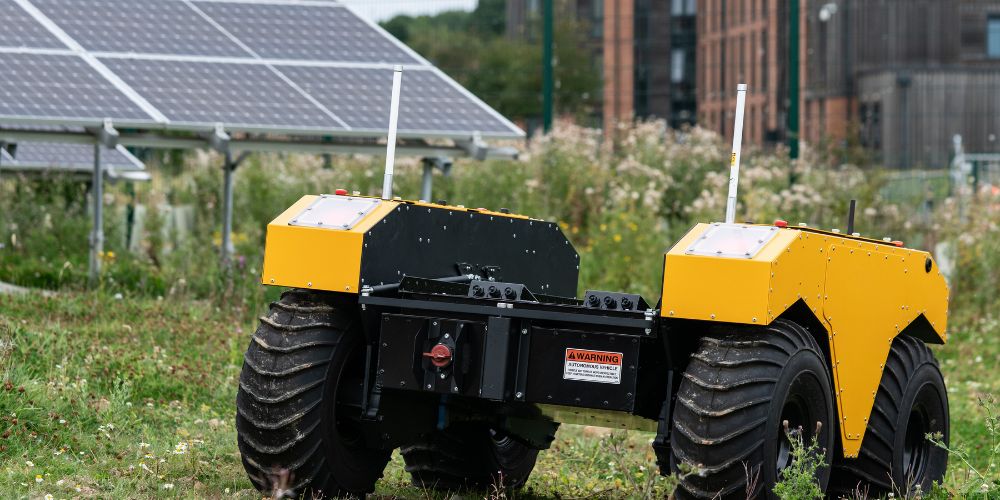
Robots operating outdoors, for example inspecting solar farms or construction sites, often experience unpredictable and unstable conditions including poor weather, uneven terrain and connectivity issues. Historically, robots operating in these conditions have had operations guided by fixed safety thresholds, which apply generic safety rules or pre-defined fallback behaviours, preventing them from completing tasks.
This project takes a different approach. Using ISA’s solar farm as an outdoor test facility, RAPTOR will develop a framework that links each of the tasks the robot needs to carry out, to the capabilities that the task requires and will continuously assess whether those capabilities are reliable enough to trust.
When a capability can no longer be trusted, the framework will switch to “degraded autonomy” modes. A digital twin, will run alongside the real system to generate real-time evidence of how it’s performing.
A critical asset of the project is ISA’s solar farm, an outdoor testbed which features real environmental challenges. The team is also constructing a wheeled photovoltaic (PV) test rig, which will allow testing indoors as well as outdoors, ahead of full field trials with a Clearpath Husky robot.
What sets this project apart is its interdisciplinary approach, with the research team drawing on expertise from across all three of ISA's research pillars:
Assurance: Assessing whether the robot's capabilities are reliable enough to trust and developing a runtime framework that governs safe switching between normal and degraded conditions.
Design & Verification: Mapping the robot's tasks to the specific capabilities each one requires.
Communications: Installing a 5G network across the ISA solar farm to keep autonomous systems reliably connected.
The project aims to provide an industry-ready solution for deploying autonomous robots safely in unpredictable outdoor environments, with evidence to support wider adoption.
Project team: Dr Olufemi Olayiwola (project lead), Dr Victoria Hodge, Dr Philippa Ryan, Dr Swarna Chetty, Dr Rob Alexander, Dr Alan Millard, Dr Edgar Buchanan, Dr Yi Chu, Josh Shackleton and James Hilder
Cross-cutting challenges
Each year the Institute supports a number of cross cutting projects which encourage researchers to work across the three research pillars.