‘Slow pit-cooking’ likeliest method to extract animal teeth for Stone Age ornaments, study shows
Posted on Monday 23 June 2025
It has long been known that women, men and children in the Mesolithic Stone Age era wore teeth as jewellery or ornaments on clothing, but research focus so far has been on how and why they were worn rather than how the teeth were extracted from animals to begin with.
Researchers, including archaeologists at the University of York and University of Helsinki, examined animal teeth at the Zvejnieki cemetery site in Latvia, one of the largest burial grounds known from this period, where more than 2,000 animal teeth have been excavated from graves dating between 7500–2500 BC.
Dr Andrew Needham, an experimental archaeologist and hunter-gatherer material culture specialist from the University of York’s Department of Archaeology, said: “It is fair to say that much of the research focus has been on how and why the animal teeth were used as ornaments, but relatively little is known about how they were extracted. Recent theories have suggested they may have been cut from the skull or possibly scavenged from carcasses.
“By testing different methods, it became clear that methods like cutting, hammering or pulling the teeth out of a fresh jaw is extremely difficult and often damages the teeth in the process. But what we see in these thousands of animal teeth at grave sites is that they are usually complete and undamaged by any extraction method.”
Various methods
The team used experimental archaeology to test how people during this Stone Age might have extracted the teeth, by evaluating different methods to see which ones left no visible traces of damage on the teeth.
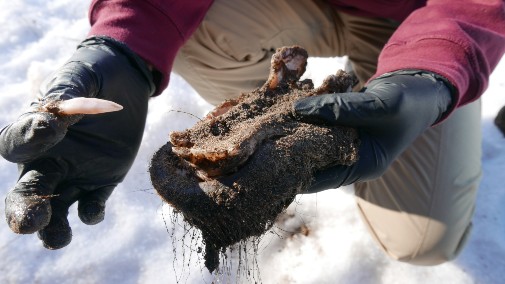
Dr Needham added: “The results from our experiments that were carried out over a year at the Īdeņa Experimental Centre in eastern Latvia, showed that pit steaming, as well as wet cooking, were the most effective, allowing for the teeth to be extracted with relative ease, without damaging them. This also meant that the meat could be eaten and the bones remained suitable for tool-making.”
Pit steaming is similar in nature to what is understood as ‘slow cooking’ today. Stones, hot coals and some water were added, with animal heads and mandibles covered by a layer of animal skins and vegetation. These were then left to cook overnight.
Worn by all
Dr Aija Macāne, from the University of Helsinki, said: “Our experiments show that tooth extraction was a deliberate, time-sensitive process embedded in daily life, especially cooking practices. This challenges the assumption that teeth used for ornaments were simply scavenged or easily available.”
The teeth, most commonly derived from elk, wild boar and red deer, but also a smaller number from at least another twelve species, including dogs and humans, would be made into ornaments for the body and clothing, worn by men, women and children of all ages.
During the long history of use of the site, the choices around which species to use seem to have changed, favouring large herbivores like elk in the earlier burials and carnivorous species like dog during the later use of the cemetery. The pendants tended to be found in greatest abundance around the head, torso and the arms.
Social activity
The researchers note that this practice of cooking gives an insight into the relationship between humans and animals at the time. Stone Age people appeared to understand that if they take the life of an animal, they should treat its remains with care, using every part of the animal, rather than leave any to waste.
Dr Aimée Little, Director of the York Experimental Archaeological Research (YEAR) Centre, part of the University of York’s Department of Archaeology, said: “This practice shows that Stone Age people were aware that there was a ‘right way’ to treat the animal remains in order to get everything they needed - from food to tools and ornaments.”
“Making personal ornaments from teeth was likely to have been a social activity linked to everyday cooking activities. It is easy to imagine that different members of Stone Age societies, including small children, were involved in their making, with the first stage of extracting teeth from mandibles happening as meals were being prepared. Such insights help break down the idea that prehistoric craft was highly specialised.”
The study, funded by the European Research Council (ERC), also involved researchers from Leiden University, the University of Alcala, and the University of Latvia, and is published in the journal Archaeological and Anthropological Sciences.
Further information
The YEAR Centre is an outdoor, forested space, adjacent to a lake, located on the University of York campus where Experimental Archaeology teaching and research takes place, often around a campfire.