Optical telescope on York rooftop to advance communication between space and earth
Posted on Wednesday 16 July 2025
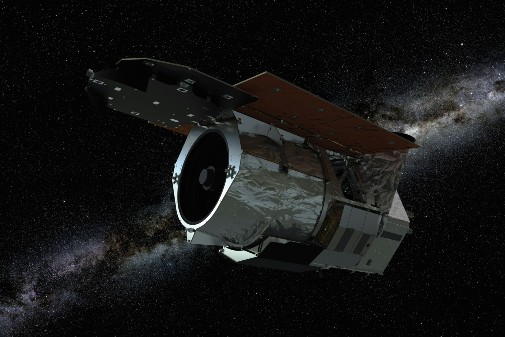
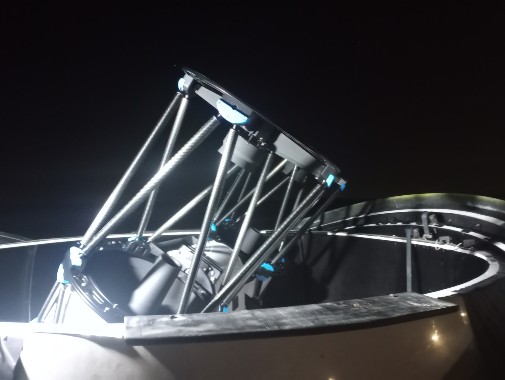
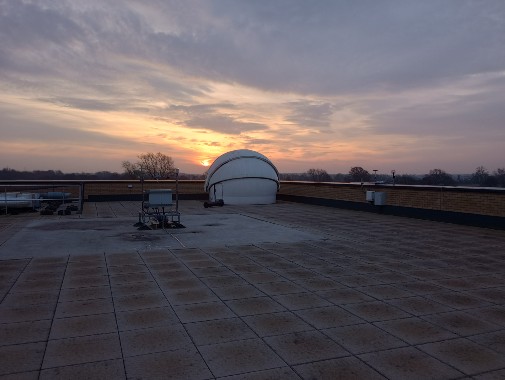
Housed in a dome on the roof of the University’s Institute for Safe Autonomy, the York Optical Ground Station (YOGS) has the ability to collect quantum optical signals from satellites in space.
The YOGS is connected to a 120km stretch optical fibre link spanning from York to Manchester, allowing businesses based along this stretch of network to be part of a wider quantum communication network, making this a unique quantum facility in the UK.
The facility will enable users across public and private sectors - such as the financial sector and railway industry - in the region to explore the potential of the technology for quantum secure communications, in academic research as well commercial exploitation.
Quantum communications operate on the principle that single particles of light – photons – can be used to transport information securely between remotely located users.
By exploiting the quantum nature of the light, this information can be made unhackable, supporting the security of banking , critical infrastructure, and other important internet traffic, against malicious attacks, both now and into the future.
Quantum communication using optical fibres, however, has limitations - specifically the distance the photons can travel. The longer the fibre distance, the more likely the photons are to be absorbed and lost, making it hard to reach intercontinental or global distances with fibre.
To overcome this limitation, one of the methods scientists are investigating to overcome this limitation is to use satellites for quantum communication.
Dr Rupesh Kumar, from the University of York's School of Physics, Engineering and Technology, said: “We know that photon loss over long distance optical fibre links on land is higher than low earth orbit-based satellite optical links.
“Satellites can provide global coverage, and distribute quantum information at national and international scales. What we need to do is to combine these quantum satellites with ground optical networks, to enable quantum communications over land and across oceans.
“Our new dual optical telescope provides this, with scope for developing new theoretical models for space-based quantum communications.”
The telescope uses specific tracking cameras, and features various quantum signal detectors that can detect very feeble quantum signals from the satellites. Beyond quantum communication, it will support conventional satellite communication, astronomy research, and atmospheric studies. It can also help to monitor space debris, which is crucial for keeping space safe and sustainable.
Global scale
By using two telescopes together as one system, YOGS improves signal accuracy, lowers infrastructure costs, and opens up opportunities for creating new technologies and patents.
Tim Spiller, Professor of Quantum Information Technologies at the University of York, said: "Quantum secure communications will protect data – for governments, businesses and individuals – even in a future, fully quantum-enabled, world.
“We know already that such communications are effective with optical fibres, but to address data security on a global scale we must add satellite capability. The establishment of suitable ground station facilities in the UK, such as the YOGS, represents a key next step to realising this capability.”
Professor Gerald Buller, Director of the Integrated Quantum Network Hub, added: “YOGS provides an important test bed for our researchers and quantum industries, and will open up significant new possibilities for the demonstration of critical quantum satellite communications technologies through partnership with the Integrated Quantum Networks Hub.”