
Staff spotlight - Bob French
Posted on Wednesday 10 June 2026
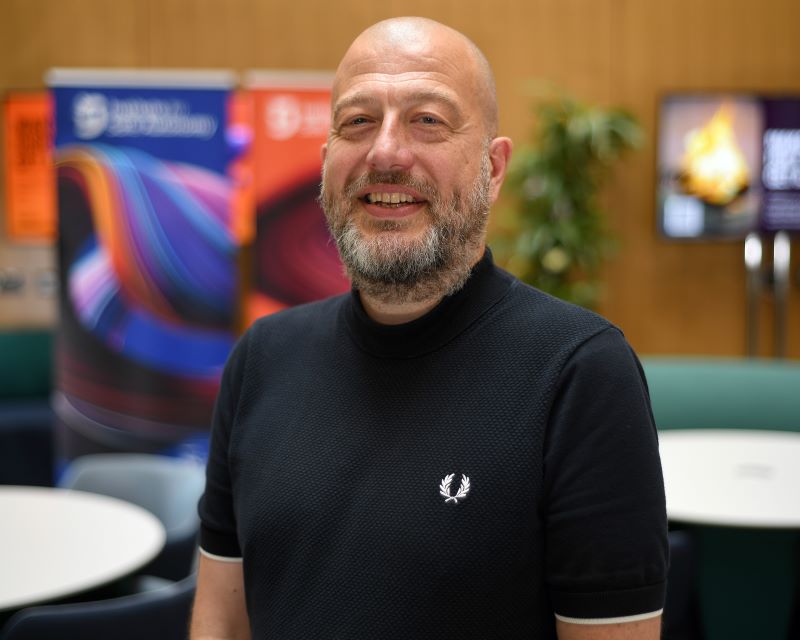
1. You are the CfAA’s Research and Innovation manager, can you tell us what this role entails?
When the role was originally advertised, as a new position within the precursor to the CfAA - the Assuring Autonomy International Programme - it flagged the existing and potential grant portfolio as being non-standard. The management of this would likely involve applications for funding that were considered ‘too complicated’, or ‘too large’ / ‘too small’ and ‘too difficult to resource’. As opposed to being problematic, for me this was a real positive. It offered a chance to push boundaries on standard approaches of income generation around research and innovation, whilst aiming for future financial sustainability for the CfAA. This is one of the primary reasons I am employed by the Centre, to help make it a more viable proposition, over the longer term, without relying solely on our grant from Lloyd’s Register Foundation.
On a day-to-day basis I provide pre-award support for grant applications that are outside of the standard support remit. I also provide post-award management of those grants, which are increasingly varied, across the fields of: foundational research, contract research, consultancy, continuing professional development, knowledge transfer, philanthropy, and doctoral training.
I act as a critical friend to the CfAA team as a whole, across applications and use of funds, and because of this I spend a lot of time involved in the interpretation of guidance, terms and conditions, as well as policy documents from funders, the University, and the UK Government. The best part of this, for me, is finding creative solutions to new and unusual problems. I’d like to call myself the CfAA Consigliere, but I’m not sure that’s a fully HERA evaluated role…
2. University research projects can often be complex, how do you manage this process across the CfAA and with wider University colleagues and departments?
Recently, the University has been going through a period of change in the way that it supports research. This process has been ongoing over a number of years now as the University as a whole tries to improve its service levels and rationalise the ways that those services are provided. As the CfAA is very much non-standard in its grant portfolio, there is frequent potential that we don't neatly fit within the University processes. To ameliorate any potential problems, I work closely with colleagues in central pre- and post-award teams, with our faculty accountants, and with those in our broader Research Innovation and Knowledge Exchange team as a whole. My aim is to ensure that things run as smoothly as they can for both the institution and the CfAA, across all aspects of financial and contractual management, as well as demonstrating a high quality and robust level of research integrity and ethics across our portfolio of grants.
Before joining the CfAA, I managed the Research Support Office in the Department of Computer Science, and also spent some time working in the central University Research Systems Support Hub. This gives me a well-rounded understanding of problems and solutions, from different perspectives, and helps, I think, to find ways forward that are acceptable for everyone. This background is also useful when working with academic colleagues, from other disciplines, and other institutions, where the ability to both support and influence the proposal process from a more removed position can be very beneficial.
3. What are the biggest challenges/changes you’ve seen in the research space?
Next year, I’ll have been working in and around the support of research for twenty years. Financial sustainability is the biggest challenge - and the increased need for it is likely the biggest change - over that time. Funders want to see more value for their investment, with higher levels of geared, or matched funding. Funding calls are more limited in budget, are oversubscribed, and are frequently more focused on the increasingly specific areas that the funder wants to see addressed.
This approach to research funding, which is often based on smaller budgets, designed to be spent over shorter periods of time, isn’t sustainable as a baseline model. It creates precarity for researchers, especially those at an early career stage, and stagnates free thinking and curiosity-driven research. Couple this with the financial climate across the Higher Education sector as a whole, and it becomes even more challenging.
What’s even more challenging is that there’s no easy, single answer to these growing challenges. Models such as distributed peer review, block grants or partial lotteries have all been mooted, but without systemic change in the sector as a whole, none seem to be a perfect solution.
4. What’s the process for organisations who’d like to fund a research project with us?
That’s a great question - I’m glad that you asked! And it’s an easy one to answer, talk to us. All great collaborations start with a conversation, and we’d love to talk to you about collaborative research, consultancy, or training and professional development. We look forward to hearing from you.
5. Finally, where can we find you outside of the CfAA?
I’m a firm believer in the importance of the three Rs: reading, running, and red wine (albeit not all at the same time). I’m a fan of nerdy sci-fi books, a bad club runner, and am easily led by a glass of good Greek or Lebanese wine (other countries are available, and I will drink their wine too).
I’m trying to see all of Shakespeare’s plays live on stage, so you may also find me in the theatre. Twelve down, only twenty-six to go. Over and above that, I’m likely trying to convince my two black cats - Hermia and Mab - that they have already had breakfast…