
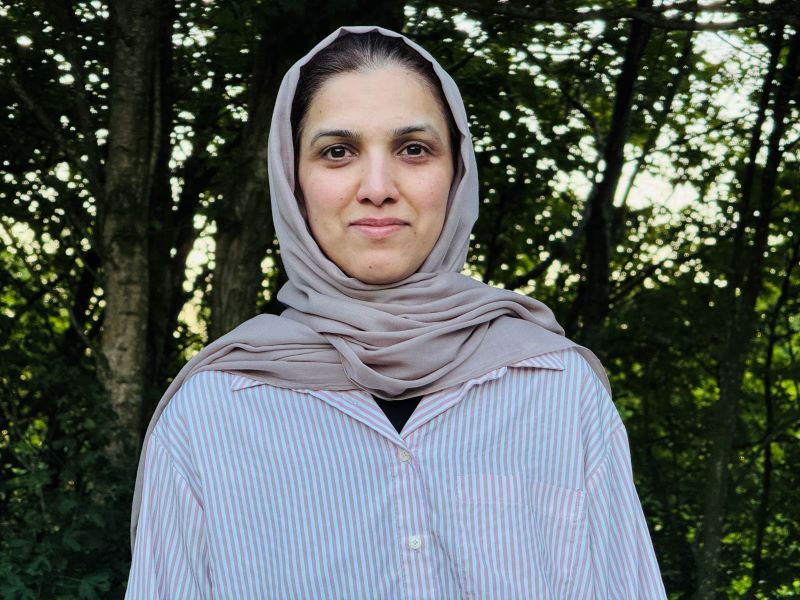
Meet our new researcher: Dr Maria Aslam
Posted on Thursday 4 June 2026
1. Can you detail your research background and specialities?
My research background centres on the assurance of complex systems, particularly through Model-Based Systems Engineering (MBSE). My work explores how AI-driven and emerging technologies can be designed and evaluated in ways that are technically robust, transparent, and aligned with human and organisational needs.
A key focus of my research is user-centric Explainable AI (XAI), particularly the integration of cognitive, social, and psychological factors into explanation design. This includes investigating how different stakeholders interpret explanations and how explanation methods can be tailored to varying expertise levels, operational contexts, and decision-making needs. I also examine explanation quality, evaluation approaches, and the lifecycle integration of explainability within AI systems.
More recently, I worked as a Research Associate at Loughborough University on the UKRI-funded QAssure project, which focuses on developing a security assurance framework for quantum communication systems, particularly Quantum Key Distribution (QKD). This involved developing structured assurance cases using methodologies such as Claims–Arguments–Evidence (CAE) and Goal Structuring Notation (GSN) to connect high-level security claims with operational evidence and system artefacts.
My broader research interests lie at the intersection of AI, assurance, human factors, and emerging technologies, with a focus on improving the trustworthiness, usability, and real-world deployment of intelligent systems.
2. What inspired you to come and work at the CfAA?
What particularly inspired me to come to the CfAA was its strong interdisciplinary focus, which aligns very well with my research interests. CfAA is committed to developing autonomous systems that are safe, trustworthy, and human-centred. My research interests align closely with these themes, especially in areas relating to assurance, explainability, and human interaction with complex autonomous and intelligent systems.
I was also very drawn to the Centre’s collaborative approach and its active engagement with industry and real-world applications. I value research that has practical impact and contributes to solving meaningful challenges beyond academia. The opportunity to work in an environment where technical innovation is combined with societal, cognitive, and user-focused considerations was especially appealing to me.
3. What does your role here entail and what are you currently working on?
My role primarily involves conducting research into the assurance of complex AI-driven autonomous systems, with a particular focus on the use of dialectic argumentation patterns to strengthen confidence in assurance cases. This includes investigating both proponent and sceptic argument structures to support balanced, transparent, and defensible assurance reasoning.
My current work explores the development of scalable assurance fragments capable of independently establishing robust assurance arguments while preserving the wider dependencies, interactions, and contextual relationships that exist across a larger assurance architecture. The aim is to avoid isolated reasoning and instead enable modular, yet interconnected, assurance structures.
The overarching objective of this research is to develop a generic and extensible methodology that can be implemented across large-scale assurance frameworks for complex and evolving systems.
4. What have been your career highlights so far?
One of the key highlights of my career so far has been the opportunity to work on the UKRI-funded QAssure project at Loughborough University, where I contributed to the development of assurance approaches for QKD systems. Working at the intersection of emerging technologies, security assurance, and systems engineering has been both technically challenging and highly rewarding.
Another significant highlight has been my research into user-centric XAI, particularly exploring how cognitive, social, and psychological factors can influence the design and evaluation of explanations. I have found it especially fulfilling to work on problems that bridge technical AI development with human-centred considerations, helping make complex systems more understandable and trustworthy.
I have also greatly valued opportunities to present and discuss my work with academic, industrial, and interdisciplinary audiences. Engaging with stakeholders from different sectors has strengthened my appreciation for research that has practical relevance and real-world impact.