
University Accessibility Awareness Day
Posted on Tuesday 21 April 2026
What is UAAD?
University Accessibility Awareness Day is a University of York day, inspired by Global Accessibility Awareness Day (Thursday 21 May) and led by the University E-Accessibility Working Group. As part of our programme for Thursday 14 May there will be events and activities to raise awareness of digital and physical/environmental accessibility issues.
We encourage all of our community to attend an event, watch one of the pre-recorded presentations or discuss accessibility within your teams and social groups. You don't need to attend the full day (although you're welcome to!) - just book for the sessions which appeal to you.
UAAD programme
For most of the events and activities, you can book using our single booking form. For a small number of events, where numbers are limited, there's a separate booking form linked from the description in the programme. If you have any questions, please email equality@york.ac.uk.
All events are taking place on Thursday 14 May: note that some of the sessions are running concurrently. Students are welcome at all events, but events marked ♦ may be of special interest to students.
We plan to record sessions where possible, and will share the recordings after the event (see the Photography and video notice below for details of how recordings may be used).
Book your place for UAAD sessions
Inaugural address ♦
9.30 to 9.45am, in-person and online, SLB/118
The official launch of the conference with Kiran Trehan.
International campuses, online teaching and digital accessibility - what you need to know
9.50am to 10.45am, in-person and online, SLB/118
Find out how various Accessibility Acts across the world may affect you, whether you are delivering modules or procuring systems and digital resources. Speakers: Richard Walker, Lilian Joy
Including Disabled people in research ♦
9.50am to 10.45am, in-person, SLB/005
This workshop is developed from a toolkit we created to support and equip researchers, across all disciplines, with guidance to make their research practices more inclusive and accessible to disabled people. Speaker: Dr Alex Reid
The guide offers you useful steps and reflections for every stage of your research cycle.
Badge-making relaxation station ♦
10am to 3pm, Spring Lane building foyer
Students, take a break from revision and make a badge of your choosing - pop along at any time during the session. We'd love to see you!
Fix your content drop in session
10.30am to 11.50am, in-person, SLB/006
Teaching staff! Please drop by with any questions or help in making teaching materials, reading lists or VLE sites more accessible. Facilitators: Lou Stringer, Jess Bull, Alice Bennett
Experience Community wheelchair skills taster day ♦
10.30am to 3pm, in-person, James Hall - G/N/028
Experience Community will be hosting an information stall from 10.30am at James Hall. They will then run wheelchair skills sessions at 12pm to 1pm and 2pm to 3pm.
This will be an opportunity for wheelchair users and their carers to learn skills on chairs, and for non-wheelchair users to experience what it's like to move around using a wheelchair on campus.
 , 1,627kb)
Vision impairment awareness raising session ♦
11am to 12.20pm, in-person, SLB/118
Five Ways of Seeing, Day in a Life ‘Meg and Bex’: MySight York will run this 1 hour 20 minute Vision Impairment awareness raising session. Facilitator: Vicky Colombi, MySight York
Student Expert Panel insights ♦
11am to 11.50am, in-person and online, SLB/005
Students from the Student Expert Panel will share their projects and virtual trails, providing staff with insights into the student experience and areas for improvement. Hosts: Sabrina Hua, Niamh Malone
BSL workshop ♦
12 noon to 12.50pm, in-person, SLB/007
Learn some finger spelling and some basic greetings so you can introduce yourself in BSL. Facilitator: Ella Stearn
Hidden in plain sight: Neurodiversity and the student experience
12 noon to 12.50pm, in-person, SLB/006
This 50-minute reflective session explores the quieter, structural barriers that shape neurodivergent student experience in higher education, including the unspoken expectations woven into everyday academic life. Drawing on student voices and the University's Neurodiversity Toolkit, the session creates space for peer discussion and shared reflection on how neurodiversity intersects with student success, and what that might mean for everyday practice. Facilitator: Tamlyn Ryan
Behind the scenes of accessibility: what staff need to know from academic support workers.
12 noon to 12.50pm, in-person and online, SLB/005
This session will take the form of a short guided discussion with academic support workers about what accessibility support looks like in real teaching and learning environments. Attendees will gain practical insight into what helps students, what creates avoidable barriers, and what staff can do differently to improve accessibility in their own teaching and learning environments. Facilitator: Sabrina Hua
Future-proofing your LaTeX docs ♦
12 noon to 12.50pm, online
Find out how you can future-proof your LaTeX documents by adopting the latest standards that output tagged PDFs with accessible maths. Cordelia will also showcase our latest Uni of York LaTeX template. Speaker: Cordelia Webb
Sighted Guiding session
1pm to 1.50pm, in-person, SLB/004
MySight York will be running an interactive Sighted Guiding Session, comprising a practical demonstration for up to 12 people, where participants will be guided through a physical tour that demonstrates what it's like for those with visual impairments navigating the world around them. Facilitators: Vicky Colombi, Meg Johnstone, MySight York
Braille Club workshop ♦
1pm to 1.50pm, in-person, SLB/006
A friendly, hands-on drop-in activity where attendees can learn how Braille works in practice and try writing or identifying their name in Braille. Attendees will have the opportunity to create a Braille label with words of their choice to take away, while developing a better understanding of tactile literacy and its importance in everyday accessibility. Facilitator: Sabrina Hua
Top 10 tips for making your social media content accessible ♦
1pm to 1.30pm, online
What good is trying to reach people with social media content if it's inaccessible for some people? This 30 minute bitesize session will show you a range of transferable principles and tips for making accessible social media content for a range of platforms. Speakers: John Downing, Alice Bennett
Accessible celebrations: Reviewing Relaxed Graduation, and what comes next? ♦
2pm to 2.50pm, in-person, SLB/006
A deep dive into how to make celebratory events more accessible, explaining the work already done on Relaxed Graduation as a case study, and discussing where we go next in terms of improving access to all celebratory events (eg Awards ceremonies, student showcases, and cultural days of celebration). Speaker: Abi Harrison, YorkSU
Could the use of AI be a reasonable adjustment for disabled students?
2pm to 2.50pm, online, live streamed in SLB/005
In recent years, we have seen AI uses which could potentially be considered asreasonable adjustments for disabled students. This session discusses Generative AI vs Non-generative AI as well as hybrid approaches embedded in some assistive technologies. How do we educate ourselves and our learners on the types, the use and risks to make more informed choices? Speaker: Ros Walker, University of St Andrews
Top 10 tips for accessible communications in the workplace
3pm to 3.30pm, online
We consider how to be mindful of accessibility in our everyday workplace communications. Speakers: John Downing, Alice Bennett
Beyond access: navigating intersectional hurdles in outdoor learning environments
3pm to 3.30pm, in-person and online, SLB/005
This presentation will outline efforts to redevelop residential field trips into more accessible and inclusive experiences and practice, co-designed with student partners. It will provide an honest reflection on the successes and challenges of co-creating EDI field trips that take account of the intersectionality using these methods. Speaker: Adrian Gonzalez
Disabled students and staff board game mixer ♦
3.30pm to 4.30pm, in-person, SLB/006
An opportunity for Disabled and Neurodivergent students and staff to get to know each other over board games! Facilitator: Abi Harrison
Disability Confident
Watch anytime
Pre-recorded presentation explaining our commitments on becoming a Disability Confident employer. Speaker: Jonny Lovell
Watch the Disability Confident presentation
For more information view the presentation slides.
Digital accessibility case studies
Watch anytime
Pre-recorded presentations of case studies gathered from teaching staff to highlight good practice in digital accessibility. Speakers: various academics
Watch the Digital accessibility case studies
Book your place for UAAD sessions
Photography and video notice
Photography and video recording will take place during the day, which may be used for marketing purposes by the University of York. If you have any concerns or would prefer not to feature, please email communications-support@york.ac.uk. For further information about how we use photography or video which includes you please see our privacy notice.
Posters and stands
Join us in the Spring Lane Building foyer throughout the day to browse our posters and stands and find more information about the following:
- Facilitation skills for better meetings - RIKE
- The Distractibles
- Everway (Texthelp) tools
Deep Focus Study Rooms ♦
We're providing deep-focus study rooms every day from Monday 11 May to Friday 15 May. They'll provide a silent, distraction-free study space for students to work towards specific goals.
- Piazza Building, PZA/109 - 9.30am to 10.30am - sign up using the form
- Spring Lane Building, SLB/104 - 1pm to 4pm - sign in at the room
BSL mural
A collaboration between @york.bsl.soc and @uoyartsociety, and made possible thanks to YuFund, this mural was created by 18 incredible student artists. It depicts the BSL alphabet, and was timed perfectly to be completed this week in time for Deaf Awareness Week, 4-10 May.
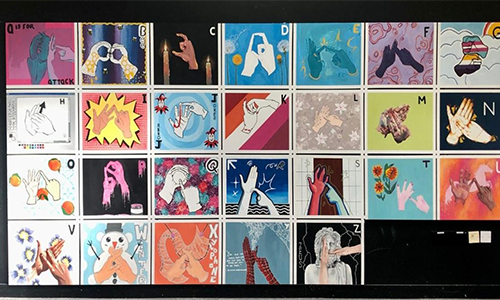
Pop to the Exhibition centre to see it in person.
Additional resources
Learn more about Accessibility at York and Digital Accessibility at York.
Find out more about the E-Accessibility Working Group and the University’s Disability Inclusion Framework.
Facilities
- Sensory Rooms and Quiet Spaces - the University has dedicated Quiet Spaces across campus designed for people who need a safe, controlled environment for self-regulation, especially for those with sensory processing or neurodivergence
- Study-Doubling Spaces - the Library has two Study Doubling Spaces to support productivity, accountability and wellbeing
For more information about accessible facilities on campus see the University’s Inclusive Facilities page.
Training and awareness raising
- Disability Awareness Modules (mandatory for all staff)
- Autism awareness online module (login required)
- Online Digital Accessibility Tutorial (login required)
- Digital Accessibility unit blog
Link and Learn
An informal network for all staff working with disabled students. It aims to share updates and good practice, identify needs, gaps or issues that might be affecting disabled students and/or the services we provide, and act as a catalyst for addressing those gaps and emerging needs in partnership.
Link and Learn feeds into the newly established Disabled Student Experience Working Group, which is part of the Disability Inclusion Framework. We meet three times a year in person, and also have a Slack channel for sharing information. For more information and to be added to the membership list, contact Susie Gridley, at student-communities@york.ac.uk.
Events
Our events calendar is a source of upcoming events that can help your development. Some upcoming events to be aware of:
- Thursday 21 May 2026: Global Accessibility Awareness Day (GAAD)
- Wednesday 24 June 2026: DigAcc26 - the University will host a local venue to attend this conference online and with others.
Peer support
It can be extremely useful for students and staff with accessibility needs to seek support from peers and there are a number of ways they can do this:
Students
- Spectrum - a group for those who identify as autistic to relax and chat. There are snacks and drinks, board games, and opportunities to talk/join in as much or as little as you'd like.
- The Distractibles - A friendly weekly group open to all students and staff who find themselves easily distracted
- Adopt a Society - These are student groups that previously existed but have been unable to secure a committee for the next academic year, and are available for ‘adoption’. That means you can take on the group and give it a new lease of life.
- Neurodivergent Society - a safe, accessible space for all neurodivergent identifying or curious students, and allies, at York. Aimed at anyone who feels as though their brain works differently to the societal norm.
- Sunflower Society - provides a range of events for students with visible and invisible disabilities
Staff
- INCLUDE: A network for staff with a disability, working to make the University more disability confident
- Dyslexia Peer Support Group: Monthly sessions for sharing experiences with other dyslexic staff
- Staff Autism Space: A slack channel as an open, safe space to discuss experience of autism
- The Distractibles: A friendly weekly group open to all students and staff who find themselves easily distracted
- Accessible Documents Group meetups: Meet up with colleagues to gain insight into the real challenges (and successes) with making documents accessible. Drop by to share resources you've come across or a challenge you would like help with.
- Digital accessibility slack channel: Any questions or useful links to share.
Looking ahead
What sessions would you like to see in future University Accessibility Awareness Days?