
AI and education
Embedding AI in education practices
AI has the power to support personalised learning paths, academic skills and aid in the fair and efficient evaluation of student work. It has far reaching implications for the ways in which we will develop our programmes, design assessment and feedback, and teach students of the future.



What Gen AI tools are you planning to use?
The University has an educational licence for Google Gemini which is available for staff and students, and is the recommended AI service to use. The educational licence ensures that staff and student personal data is not shared with the AI training model or with third parties. This means that prompts, which may be text, images or other files, are not used to train the AI models. Google NotebookLM and Microsoft Copilot, are also available under a protected licence agreement.
The University has also undertaken data privacy impact assessments for other centrally-supported AI toolsets, such as Blackboard Learn Ultra and Mentimeter, which similarly protect staff / student personal data and do not pass on data to develop the AI training model (AI tools for Learning Technology).
If you are proposing to use an AI tool which is not centrally supported and has not been subject to a data privacy impact assessment (DPIA) or cloud risk assessment, you will need to take steps to investigate data management issues - i.e. data privacy and the management / access of the tools to ensure that compliance and ethical considerations been addressed.
Please note that the University’s current advice is to only sign up for external (non-centrally supported) AI tools with your own personal account and not to use these tools to process university data, especially students’ assessments, such as the use of automated marking or AI detection tools.
How will the Gen AI tool(s) be employed - what methods will you use?
Some key questions include:
- What is your proposed use case for AI?
- How will the tool(s) be incorporated within the proposed learning activity?
- Are there any challenges associated with your proposed use case? If so, how will they be addressed?
For example, the use of AI may be focused on a diverse range of texts, including formative assessments, module material, books, discussions, or challenging concepts as flagged by the students, to understand user input, generate human-like responses, provide customised recommendations and feedback, and maintain coherent conversations on a wide range of topics.
Note that licensed texts and learning resources will have copyright protections, which may prohibit the inputting/uploading articles or books or other material into a generative AI tool, which could be in contravention with the terms of use set by the publishers or other rights holder.
Encouraging student engagement and evaluating your use of Generative AI
Some key questions include:
- What measures and support will be provided to help students in their use of the tools? This might, for example, include prior consideration of access and accessibility issues in using the tools (Goldenthal et al., 2021) or guidance on prompts when using Gen AI (UCL principles on effective prompting).
- What guidelines will be provided for students on the appropriate use of AI? For example, guidance on avoiding breach of copyright rules for licensed reading materials or how to cite / reference AI output correctly (Generative AI: A practical guide).
- What feedback loops / milestones will be put in place? How will student engagement and progress be monitored?
- What criteria will be used to evaluate the student experience?
- What methods will be used to capture the data to address your criteria?
1. Curriculum design and development
AI has the potential to revolutionise the methods and processes of curriculum design as well as the content of our curricula. Both will need to evolve to incorporate AI subject matter as well as teaching on the broader societal, ethical and legal implications of a world that relies heavily on AI in the future.
Below you will find links to resources from those recommending and pioneering change in these areas.
Academic integrity, ethics and quality
Quality Assurance Agency for Higher Education (QAA)
- Maintaining quality and standards in the ChatGPT era
- The rise of artificial intelligence software and potential risks for academic integrity
- Ethical considerations for using Generative AI in higher education
Recommendations on the ethical use of AI in Education from the European Network for Academic Integrity (ENAI); Article and Presentation Slides
Accessibility
AI and Accessibility: feature, the future or fad? University of York Digital Accessibility Unit
Generative AI and accessibility in education (JISC)
AI in inclusive education (SEN Magazine)
Digital accessibility in the era of artificial intelligence: Bibliometric analysis and systematic review (National Library of Medicine)
Toolkits and aids
- University of York AI in Assessment Framework (Coming soon)
- Assessment ideas for an AI enabled world: A menu of ideas to provoke discussion and reflection around assessment approaches in higher education (JISC)
- Designing assessments for an AI-enabled world (University College London)
- Assessments Menu.ppt (University College London)
- AI for assessment (Imperial College London)
- How to team up with AI: 3 steps for assessment redesign (AdvanceHE)
- Generative AI and assessment design (aiinhighered.com)
- The 'deep learn' framework: elevating AI literacy in higher education (Times Higher Education)
- JCQ AU Use in Assessments: Your role in protecting the integrity of qualifications Rev.2 (Joint Council for Qualifications)
Articles and reports
Reconsidering assessment for the ChatGPT era: QAA advice on developing sustainable assessment strategies
Webinar recording; Authentic Assessment in the era of AI (AdvancedHE)
ChatGPT and generative AI: 25 applications in teaching and assessment (Times Higher Education)
AI and Assessment in HE Spotlight Guide (Times Higher Education)
Transforming Higher Education: How we can harness AI in teaching and assessments and uphold academic rigour and integrity (University of Warwick, Warwick International Higher Education Academy)
Resources and tools
How can Generative AI be used in learning and teaching? (QAA)
Curriculum Design and Development (Queen's University Belfast)
AI for teaching (Imperial College London)
AI for learning (Imperial College London)
AI for assessment (Imperial College London)
Examples of Generative AI tools and resources (QAA)
ChatGPT and generative AI: 25 applications to support student engagement (Times Higher Education)
AI How To - Transcript Checking and Cleaning video (Queen's University Belfast)
Case studies
- Sharing experiences of integrating Gen AI within Learning, Teaching and Assessment (Webinar with presentations from the Departments of Politics and Language and Linguistic Science, and from the International Pathway College)
- Gen-AI: ideas and examples of applied practice: A series of collaborative "show-and-tell" events hosted by the International Pathway College (IPC) and the School for Business and Society (SBS)
- Using AI to promote Education for Sustainable Development (ESD) and widen access to digital skills: List of Case Studies (QAA)
- AI for Educators: Case studies (University of Leeds)
- Innovative Insights: AI success stories from the community (JISC)
- AI Garage (AdvanceHE)
- Case Study: Supporting students in using Generative AI (University of Bath)
- Case Studies: How is Generative AI being used at Bath (University of Bath)
- How an AI 'study buddy' is providing support for the University of London's students (JISC)
Presentations and events
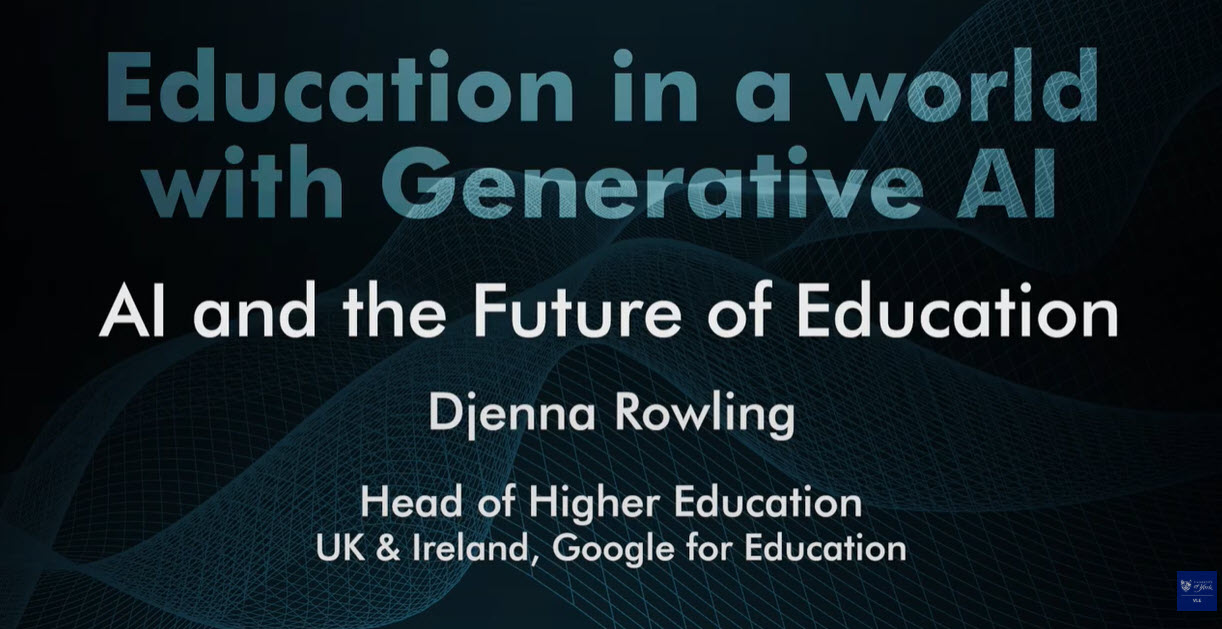
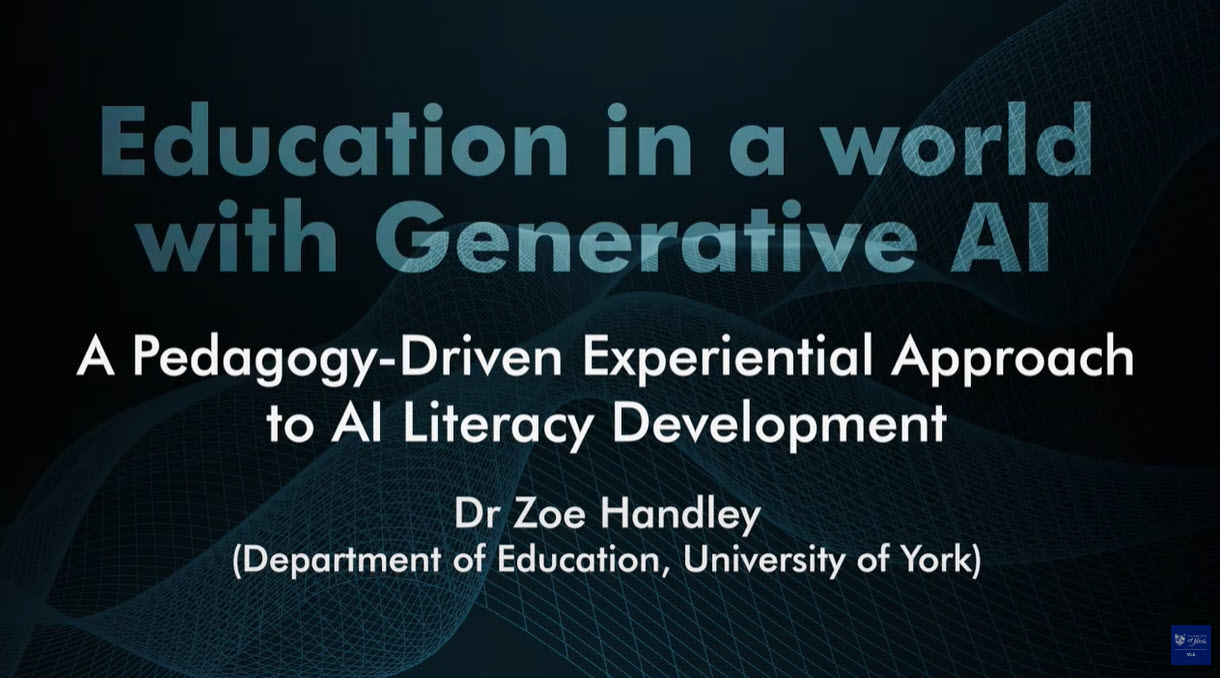
Education in a world with Generative AI mini-conference

School for Business & Society Masterclass Series
Join our School of Business and Society as they explore how AI can be used ethically in global businesses, both now and in the future.


