BA (Hons) Applied Social Science - Crime and Criminal Justice

Our Crime and Criminal Justice specialist Applied Social Science degree allows you to focus your studies on a specific area of social science, with a placement shadowing opportunity to see first hand the relationship of policy and practice. Find out more about this subject: What is applied social science?

Overview

  • You will receive a thorough grounding in sociology, social psychology, politics, economics and social policy as well as studying the history of the development of the criminal justice system and the welfare state.
  • You will undertake a placement, shadowing a professional working in a field relating to crime and criminal justice.
  • You will study core modules designed specifically for this degree programme and choose from a selection of over 20 option modules developed specially by the Department, or choose from a wider range offered by other Departments such as Politics or Sociology.
  • You could progress into careers in a range of criminal justice settings, including: the police service, probation, youth offending teams, the prison service, as well as more generally in public, private and voluntary sector organisations.

Our Applied Social Science - Crime and Criminal Justice programme is suited to you if you are interested in:

  • Understanding how crime is defined and what governments can do to address it
  • How increasingly sophisticated crime can be detected
  • The impact of crime upon victims
  • How policies on crime and criminal justice relate to other social policy areas 

What subjects should I have studied before?

Applied Social Science draws upon many disciplines, if you have previously studied sociology, politics, history, geography or psychology, you may be interested in this degree programme. Similarly, some of our students choose one of our Applied Social Science programmes because it is a subject they have not studied before, yet appeals to their interests.

Structure

Course structure

This is a 3-year, full time undergraduate programme.

 Year One Year Two  Year Three 

Introducing Social Policy

Sociology of Crime and Deviance

The Politics and Economics of Social Policy

Ways of Knowing about Crime and Criminal Justice

Understanding Crime and Deviance

Understanding Criminal Justice

Social Research Methods

Your choice of ONE other module from those offered across all four of our degree programmes

Degree-specific placement

Free choice of THREE option modules

A dissertation related to crime and criminal justice


 Examples of option modules:

  • Children, Young People and Social Policy
  • Comparative Social Policy
  • Environmental Policy
  • Social Inequalities
  • The Policy Process
  • The Social Psychology of Childhood and Adolescence

Examples of option modules:

  • Child Abuse and Social Policy
  • Crime and Place: Strategies for Urban Renewal
  • Comparative and International Social Policy
  • Demography, Society and Policy
  • Disability: Policy and Practice
  • Gender, Crime and Justice
  • Health and Inequalities
  • Housing Policy
  • Illicit Drug Use
  • Policing and Criminal Justice
  • Social Security
  • Staffing Public Sector Services
  • Sustainable Development and Social Inclusion
  • Understanding Families and Family Life
  • Well Being of Children and Young People
  • Working in Organisations
  • Youth Justice

See also: Social Policy and Applied Social Science Module Descriptions

Placement examples

During the summer vacation before the start of your third year, or during the Autumn Term, you will undertake a work-shadowing placement lasting for around 80 hours.

This is assessed through a placement report. In this you will be able to trace how national or international policy on children and young people gets translated into particular programmes at a local level. Through watching professional workers at work this offers a completely different form of learning experience which some students go on to develop within their dissertation or follow through in the development of their own career.

Recent examples of placements include:

  • Shadowing workers in a drug rehabilitation unit
  • Observing an education centre in a Youth Offender Institution
  • Shadowing a criminal barrister
  • Mentoring a young offender attached to a youth offending team

Important note about placements

To undertake a placement, you may be required to undergo a Criminal Records Bureau (CRB) check. Having a criminal conviction is not an automatic bar to entry but failure to disclose relevant information may result subsequently in termination of the placement. Should you declare a criminal conviction, it may be necessary to consult our partnership agencies in relation to placements.

Dissertation examples

The third year dissertation is a great opportunity to apply your knowledge and understanding in independent supervised research on a topic of your interest. Previous dissertation titles include:

  • Mad, Bad of Sad? Theories of why women kill
  • Fear of violent victimisation among young men
  • To what extent is the use of discretion exercised by the British Police detrimental to ethnic minorities
  • Crime in the NHS: how does it affect ethical policy and practice
  • The protection of sex trade victims in South Korea
  • Surveillance: ‘nineteen eighty-four’ and beyond

Teaching and support

Modules

How we teach: Murder Investigation [Watch the video]

Modules vary in length, credit weighting and the way in which they are assessed.

First and second year modules last for the full academic year (3 terms), count for 30 credits, involve lectures and seminars, some assessment throughout the three terms and a final assessment task in the third term.

In the second year students take 2 compulsory modules that introduce the core elements of theories relating to crime and criminal justice.

Third year option modules are taught in a single term, but count for 20 credits and have around three hours contact per week with a mixture of lectures and seminars. These may also encourage you to research topics in advance and make presentations to the group.

See: Social Policy and Applied Social Science module descriptions

Assessment

The most common form of assessment is essay work set for each module taken, typically around 3,500 words. The end of degree dissertation is 10,000 words in length. There is only minimal use of closed examinations in some modules.

Support

All students are allocated a personal supervisor who is responsible for supporting you throughout your three years. Most commonly, your supervisor will be a member of the staff team responsible for the degree and involved in teaching some of the core modules.

In 2010 the Department was awarded for continuing excellence in supervision by the Students' Union, with a total of 10 members of Social Policy staff nominated for Supervisor of the Year.

Your lectures and second and third year seminars will be delivered by academic staff and on occasion guest speakers. The majority of first year module seminars have the added benefit of being led by trained postgraduate students. Their role is to help you make sense of new subject material, give you the opportunity to ask questions and chat about your ideas.

Careers

Many of our students use the expertise they gain from their degree to enhance their employment careers. Recent examples include:

  • Youth Development work with a Youth Offending Team
  • Trainee police officer with the Metropolitan Police
  • Trainee probation officer

Others go on to develop their skills through

  • Postgraduate research on crime and criminal justice
  • Postgraduate training in forensic psychology and criminology
  • Postgraduate teaching qualifications

Others get jobs not specifically related to children and young people in, for example:

  • Management of a housing association
  • Work with a local authority on widening access initiatives

Some of the key skills that you will develop throughout your degree include:

  • Academic and evidence-based writing
  • Presentation skills
  • Information searching skills
  • Awareness of different backgrounds and global cultures
 
 
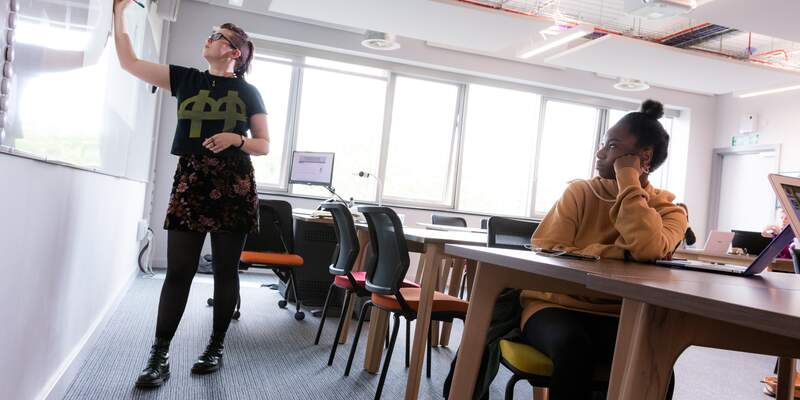
 SPSW student in a lecture hall
Bookmark and Share

3rd for Social Policy and Administration - Guardian University Guide 2012

Find us on Facebook [New window]

UCAS code: L433
Institution code: Y50

A levels: BBB
Alternative entry

Mature students are welcomed and considered individually.

Contact details

Enquiries

Tel: +44 (0)1904 32 1231

spsw-admissions@york.ac.uk

Dr Elizabeth McDermott
Admissions Tutor