

Play for the Planet Network
Co-lead: Lynda Dunlop
Department of Education
Co-lead: Prasad Sandbhor
Department of Computer Science
Co-lead: Pen Holland
Department of Biology
Co-lead: Judith Krauss
Department of Politics and International Relations
Co-lead: Anna Morfitt
Environmental Sustainability at York
Co-lead: Daisy Kemp
Environmental Sustainability at York
Connecting Game Designers, Researchers, and Educators to Tackle Planetary Crises Through Play
The Play for the Planet Network is a collaborative initiative based at the University of York, bringing together game designers, researchers, and educators who are passionate about addressing planetary crises through the power of play. Our mission is to explore a diverse range of playful materials—such as digital games, interactive narratives, simulations, and more—as tools for modelling, stimulating discussion, fostering learning, and building connections. We delve into various forms of play, including digital, tabletop (board, card, and role-playing games), physical, and hybrid play, to discover how these mediums can create pleasure, enhance learning, aid decision-making, and deepen empathy towards people, places, and our planet.
Why Play for the Planet Matters
Environmental crises like climate change, chemical pollution, and biodiversity loss can feel overwhelming and induce eco-anxiety. However, games offer a unique and enjoyable way to explore these challenges, envision futures, and connect with others. By engaging with games, we can investigate responses to planetary crises on multiple levels—from systemic political decisions to individual lifestyle choices. Despite their potential, environmental games remain under-researched, with most studies focusing primarily on knowledge acquisition. Our network aims to shift this focus by examining the design and evaluation of games as simulations, imaginative futures, provocations, facilitation tools, and activism. We aspire to foster research and impactful collaborations that raise awareness and inspire action on environmental issues.
Why Now?
The urgency of climate action has never been greater, and it is crucial to find engaging and enjoyable ways to address environmental challenges. According to the recently launched "Britain Talks Climate" report, people prefer not to face climate change alone. Games provide a means of connecting people around common themes, breaking down large problems, and incentivising real or imagined actions towards achieving goals. Numerous games and interactive artefacts focusing on environmental themes are being developed and evaluated globally. By joining the Play for the Planet Network, you will contribute to the expanding pool of knowledge and resources aimed at tackling these urgent issues.
Our Collaborative Efforts
The Play for the Planet Network is led by coordinators from a range of disciplines including social sciences (Education and Politics), sciences (Biology and Computer Science), and support teams from YESI and ESAY. We successfully organized the "Play for the Planet'' conference at the University of York, which featured participation from academics across various departments: Biology, Environment and Geography, Stockholm Environment Institute, Education, Sociology, Computer Science, Arts and Creative Technologies, Health Sciences, Business and Society, and more. External participants included academics, artists, and game developers from institutions such as the University of Cumbria, University of the Arts London, King's College London, University of Northumbria, and organisations like Beesknees Games, Megaverse, St Nick's, and FloodSkinner. This network exists to facilitate collaboration, ongoing communication and planning future projects.
Join us in harnessing the power of play to create a more sustainable and connected world. Let's tackle planetary crises together, one game at a time.
Upcoming Events
.png)
Play for the Planet 3: Play harder!
24th April 2026, In-person only, Venue TBC, University of York
Are you a games researcher, designer or player? Join us for a day of environmental games learning, discussion and play.
Call for papers now open (deadline 10th January)
Keep up to to date with all Play for the Planet events here.
Outputs
Dunlop, L., Joucoski, E., & Sandbhor, P. (2025). Learning through play? What board games reveal and conceal about climate change. Environmental Education Research, 1–21.
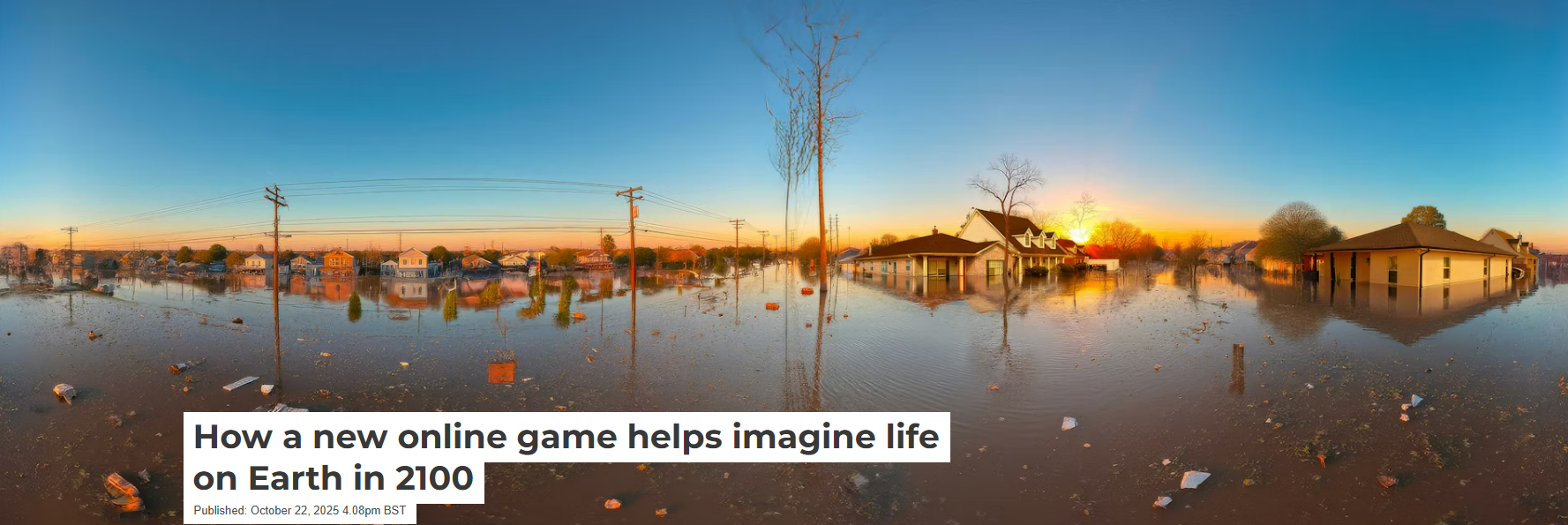
How a new online game helps imagine life on Earth in 2100, The Conversation, October 22, 2025. Lynda Dunlop (Dept of Education/ESAY) and Lecturer in Flood Resilience, University of Hull
Play for the planet: five climate change games for the festive season, The Converstion, 18 December. Lynda Dunlop (Dept of Education/ESAY) and Prasad Sandbhor (Dept of Computer Sciences/iGGi)
Members by Department/University/Organisation
Centre for Applied Human Rights
John Gray, Associate
Department of Biology
Prof Pen Holland, Deputy Head of Department (Teaching)
Department of Computer Science
Prasad Sandbhor, PhD student
Department of Education
Dr Lynda Dunlop, Director of Education, (ESAY), Senior Lecturer in Science Education
Weeraya Vichayaprasertkul, Documentary Filmmaker
Department of Environment and Geography
Dr Oliver Andrews, Senior Lecturer
Dr Adrian Gonzalez, Senior Lecturer in Sustainability
Department of History
Dr Sabine Clarke, Senior Lecturer in Modern History
Department of Politics and International Relations
Judith Krauss, Lecturer
Phalguni Reddy Mule, student
Department of Sociology
Andrew Macdonald, PhD Researcher/Graduate Teaching Assistant
Environmental Sustainability at York (ESAY)
Dr Lynda Dunlop, Director of Education, (ESAY), Senior Lecturer in Science Education
Daisy Kemp, Project Manager
Anna Morfitt, Communications Officer
Faculty of Social Sciences Impact Team
Ella Howes, Yorkshire Policy Collaboration Partnership Manager
Clare Lesley Hughes, Research Ethics Administrator
School of Arts and Creative Technologies
David Gochfeld, Research Affiliate
School of Architecture
Dr Farres Yasser, Lecturer in Architecture
External Members/Organisations
Stephanie Buller, PhD Researcher, Cardiff University
Carboned OUT, @carboned_out on insta and www.carbonedout.com coming soon
Sarah Clayton, TalentEd Tuition
Matt Coward-Gibbs, Lecturer in Social Sciences, York St John University
Holly Dear, Master's Student, UWA
Anastasia Filippoupoliti, Associate Professor Science Communication, Hellenic Open University, School of Humanities
Steven Forrest, Lecturer, University of Hull
Yirou (Eva) He, Postgraduate Researcher, Durham University, English Department
Shweata Hegde, Master's Student, Imperial College London
Dr Dom Henri, Senior Lecturer, University of Hull
Triinu Jesmin, Research Fellow of Serious Games, Tallinn University
Emerson Joucoski, Professor, Federal University of Paraná
Sharfaddeen Kamilu Ilah, Department of Environmental Management, Bayero University Kano
Vivienne Kuh, Lecturer in Responsible Innovation, University of Bristol
Matteo Menapace, Game Designer, Beesness Games Ltd
Brian Nalumenya, Coventry University
Marta Niedzicka, Postdoctoral Fellow, Teagasc, Crop Science Department
Wen Ting Ooi, PhD Student, Clark University
Jason Pudlo, East Carolina University
Tanvi Saxena, Masters Student, London School of Economics and Political Science (LSE)
Alok Singh, Lecturer - Data Science and AI
Paola Sofía Serrano Bravo, School of Natural Sciences, University of Galway
Tom de Simone, Web developer
Alok Singh, Lecturer - Data Science and AI
Chris Skinner, Science Communicator and Author, FloodSkinner
Lucy Thornton, Lecturer, SRUC
Tom Wright, Freelance Games Master, Coach, Trainer
Chen Zeng, Huazhong Agricultural University