Skip to content Accessibility statement

Researcher Development Framework

The skills and competencies that researchers develop are critical for a dynamic workforce that drives societal, economic, and environmental benefits. 

Professional and personal development for researchers at York is structured around a nationally recognised development framework, which values today's researchers and enables them to work across sectors while looking to the future needs of society.

Who are Vitae?

Vitae is a non-profit programme run by the charity the Careers Research and Advisory Centre (CRAC), which provides research, intelligence and innovation services to those who support career development.

The Vitae Researcher Development Framework

The Vitae Researcher Development Framework is a sector-led model that defines the values, knowledge, and behaviours of effective researchers for today’s evolving research landscape.

The framework has been designed and led by researchers and practitioners. It supports personal, professional, and career development while aligning with priorities like open research, research integrity, and knowledge exchange.

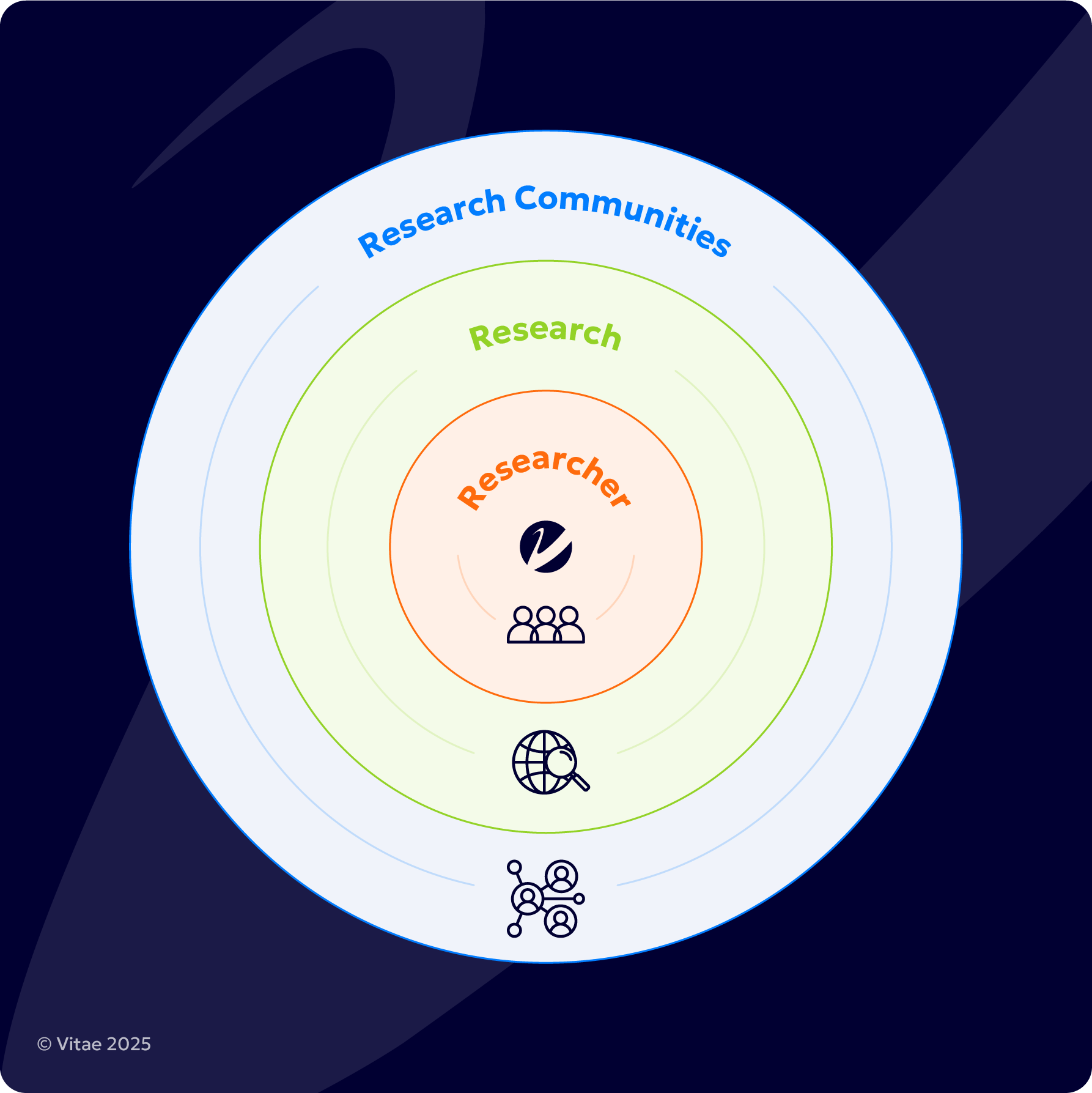
The framework identifies three areas to empower researchers to explore, shape and pursue the developmental opportunities that will drive meaningful progress towards their individual career aspirations. Within each area, key skills and behaviours are highlighted for researchers to focus on in their career development. 

(Vitae Researcher Development Framework (RDF). Vitae, © 2025 Careers Research and Advisory Centre (CRAC) Limited)

Focus areas for researcher development

Researcher
Personal and professional values and behaviours
Research
Knowledge and skills to undertake research and deliver outcomes
Research communities
Knowledge and skills to engage and work with others
Researcher values and behaviours

This area focuses on developing researchers who are:

  • Development-focused: You take ownership of ongoing professional development, building skills, capabilities, and experiences to support career growth, adaptability, and mobility. 
  • Strategic: You consider the contexts and landscapes in which research operates, developing strategic direction accordingly.
  • Organised: You set clear goals and objectives, plans and prioritises, conducts activities proactively and to time.
  • Curious: You take an inquiring, open, and questioning approach, seeking insight, exploring new ideas, and engaging across boundaries.
  • Collaborative: You actively engages with others to design, create and advance research and/or outcomes that can address complex issues and maximise impact.
  • Adaptable: You are open, agile, and responsive to new ideas, ways of working, opportunities and solutions.
  • Reflexive: You continuously examines own position, assumptions, motives and biases and how these influence approach.
  • Motivated: You are a motivated, independent thinker who is determined and committed to research.
  • Responsible: You demonstrate personal and professional responsibility, considering the potential effects of work on participants, beneficiaries, society, and the environment.
Research knowledge and skills

This area has three sub-sections for developing research-specific skills:

Knowledge and practice

  • Subject knowledge: You develop knowledge of and contribute to a research area and/or practice, the advances within it, and its relationship with other research areas and/or practice.
  • Research methods: You develop knowledge of and can integrate suitable research methods, techniques and approaches, including interdisciplinary approaches where appropriate. You can explain and justify the chosen design and/or approach.
  • Information and data literacy: You design and implement techniques and systems to appropriately source, organise, synthesise, evaluate and manage information and data.
  • Digital and technological capabilities: You use existing and emerging technologies and tools as required for research, scholarly activity, dissemination and innovation.
  • Critical thinking and analysis: You exhibit original, independent and critical thinking; analyse and evaluate information, research progress, data and findings.
  • Creativity and innovation: You identify new trends and create opportunities to improve ideas, build knowledge and enhance outcomes.

Research management

  • Funding and finance: You can identify funding mechanisms and income-generating opportunities, understand application processes, and adhere to funding agreements.
  • Project management: You apply project management techniques to deliver research on time, within budget, and to agreed outcomes.
  • Risk management: You effectively assess and manage all risks related to a research project or activity.
  • Open research: You make research processes, results and outputs transparent and as freely accessible as possible, aiming to make research widely available and usable.
  • Research integrity and ethics: You uphold integrity in research by applying ethical, legal, and professional standards; addresses challenges transparently and responsibly, supporting good governance throughout the research process.

Engagement and impact

  • Communication: You use suitable platforms, methods, and media to communicate research, ensuring language and approaches are tailored to target audiences.
  • Research outputs: You develop and share diverse outputs, practices, and activities to maximise the quality and impact of research.
  • Knowledge exchange and public engagement: You share knowledge to benefit policy, society, the environment and the economy through public engagement and other activities, ensuring mutual benefit through interaction and listening.
  • Research translation and commercialisation: You identify mechanisms and opportunities to transform ideas and outcomes into products, processes and services.
  • Teaching and learning: You engage with and share research through teaching, training, and learning activities to develop others and enhance knowledge, capacity, and practice.
Research communities skills

This area focuses on developing a researcher's ability to collaborate and work with others through an understanding of:

  • Research culture: You foster inclusive, equitable, open, responsible and supportive research cultures, ensuring all contributions are valued, and research excellence is enabled.
  • Teamwork: You leverage the perspectives and skills of others, promote shared ownership of research outcomes, fosters mutual respect and open communication.
  • Leadership: Leads, motivates and influences where appropriate; sets expectations, delegates responsibilities, holds self and others accountable. 
  • Supervision and management: You build relationships and work with supervisees and/or line reports, interacting constructively and empathically to guide, support and empower.
  • Coaching and mentoring: You support others through sharing experiences and knowledge for their benefit. Uses coaching techniques to support others in developing specific skills or reaching goals.
  • Networking: Proactively builds and sustains networks to support professional and career development, fosters inclusive research communities and mutually beneficial connections.

Find out more

About the framework
Find out about how Vitae developed the framework and browse Vitae's resources for researchers and line managers.
The full framework
There is more detail within the full framework documentation on how to level up each skill or behaviour for researchers and line managers.
Development at York
The Researcher Development Training programme at York is mapped onto the RDF areas and skills.