
The process
Apprentices: Case study
Becca Neale's interest in understanding how things work began at a young age. When she was 14 she decided to have flying lessons at an airfield near to where she lives. She started volunteering there and began to take an interest in the engineering side of the aircrafts:
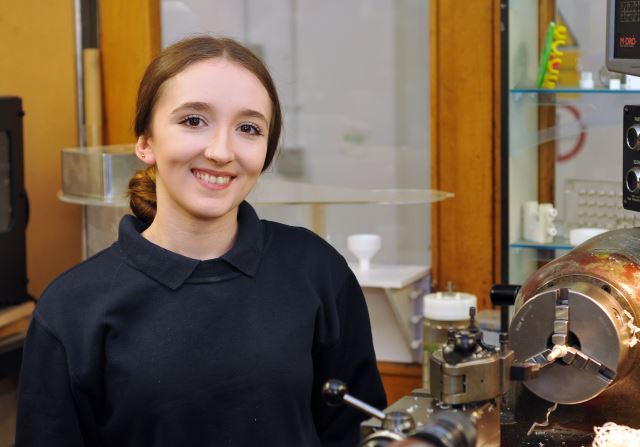
"I've only been here since August but I've learnt ten times more than I did at college."
I had flown a plane and seen what it was capable of but that made me want to know what was underneath the skin. I wanted to understand how such an amazing machine actually worked.
Becca had the opportunity to spend a week in the Biology department supporting the Workshop Manager at the University and her interest in engineering continued to grow. She decided to apply for an Engineering and Manufacturing Diploma at York College.
Whilst Becca gained the level 3 qualification at college she didn't gain the practical knowledge that she felt she needed to pursue a career in engineering. When she saw that the University was looking to recruit an Apprentice Mechanical Workshop Technician she jumped at the chance.
The Biology Research Workshop provides a dedicated departmental service and is tasked with coming up with bespoke solutions to problems for PhD students and staff. This can range from large projects like the SkyLine 2D auto chamber platform for unprecedented GHG analyser application in field experiments, which is a autonomous robot to help researches gather round the clock data through to smaller projects such as developing automatic doors for ants and creating tiny and precise parts for microscopes.
Becca's role includes developing her skills in welding, fabrication, milling, using computer controlled machines and operating the 3D printer and she feels she has learnt so many valuable skills in just a few months.
Our role is to help PhD students and staff because research equipment is so expensive. If they need a small part it may cost £600. We can often make this for just the cost of the materials, saving the department a lot of money.
Becca's manager Mark Bentley adds:
Taking on an apprentice is a successful way of addressing real skills gaps appearing in many technical roles. It is a small capital investment but can initially be a larger time and effort investment on current staff, but what you put in is what you get out. The chance to pass on your knowledge and skill set to the next generation is a wonderful and noble opportunity and one I would highly recommend.
Mark Bentley, Workshop Manager, Department of Biology
Finally what would Becca say to other women like her who are thinking about applying for roles that are typically male-dominated?
If you enjoy something then don't let the fact that there aren't a lot of other women doing it put you off. At the University you aren't treated any differently because you are female and longer term I think more and more employers want to address the gender imbalance putting us women in a strong position.
Considering taking on an apprentice? Find out more about how apprenticeships can work for you: contact sarah.farrell@york.ac.uk.
Case study 2