No and Low Alcohol - understanding marketing and consumption and improving accessibility
-
Case study
- Health and Wellbeing
Posted on 16 March 2026
Research in the Sociology department and School for Business and Society has improved our understandings of how people use No and Low (NoLo) alcohol drinks and the ways in which they are marketed, helping to inform policy and regulation. It has also led to the design and launch of materials and guidance to support venues to make NoLo products more visible and accessible for consumers.
The issue
The UK’s No and Low (NoLo) alcohol drinks market is expanding rapidly, yet we currently know very little about how NoLo products are marketed and used.
We need to establish a more developed evidence base to (a) help policymakers understand whether NoLos could improve public health (for example by replacing alcohol in some circumstances) and (b) make sure NoLos are being advertised and marketed in an appropriate way. This is particularly important because marketing for NoLos is subject to less regulation than alcohol marketing.
We also need to understand whether and how people might use NoLos to support abstinence or drink more moderately, and make sure NoLos are accessible, visible and normalised for people who do want to use them in this way.
The research
In initial research funded by the Institute of Alcohol Studies, we examined the ways in which NoLos are marketed and used by consumers in the UK. The project involved a media analysis of two major marketing campaigns and social media material for NoLos. This was accompanied by in-depth interviews with drinkers and non-drinkers who consume NoLos to enhance our understandings of how and why people use them.
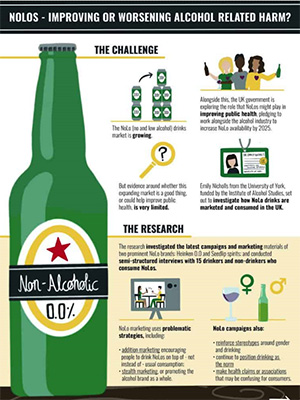
The research identified that some consumers are using NoLos as a ‘substitute’ for alcohol (for example, drinking NoLos at home and alcohol in public, or NoLos during the week and alcohol at weekends).
However, the research also revealed problematic marketing practices, including promoting NoLos as something to be drunk in addition to one’s usual alcohol consumption and ‘stealth’ marketing. NoLos are often produced by parent alcohol brands and designed to mimic that brand’s alcoholic options in terms of branding, presentation and taste, so stealth marketing occurs when a NoLo is advertised in a way that promotes the parent brand.
In follow-up work building on the promising findings around substitution, we conducted a systematic review of existing research, used a Q-methodology study to identify barriers NoLo drinkers face and launched an intervention in pubs in York to support them to stock and promote NoLos.
The outcome
A report was produced based on our initial work at the end of the project, which was shared with the Scottish and British government and informed a briefing for UK government ministers. The report has been cited by the World Health Organisation and presented directly and Emily has been invited to present the findings directly to the UK Government Office for Health Improvement and Disparities and Institute of Public Health in Ireland. This has helped to directly support policymakers considering the potential – or otherwise – of NoLos to improve public health.
We also met with the Advertising Standards Agency to discuss the future of the regulation of NoLo marketing. The report was later cited by three different organisations responding to a Committee of Advertising Practice consultation about changing the marketing regulations. In 2023, new guidance on the marketing of NoLos was published, stating that – amongst other changes – any NoLo advertising which promotes a parent alcohol brand must now be subjected to the same advertising regulations as alcohol marketing. As a result, this research has helped to contribute to the introduction of new and stricter guidelines around NoLo marketing.
In addition, our NoLo venue intervention demonstrated that NoLos do not reduce revenue, and led to the design of a guide for publicans, free Point-of-Sale material for venues (posters, stickers, beer mats) and even a NoLo map of York. We have worked with organisations to promote these materials, with engagement from York City Council, North Lincolnshire Council, Alcohol Change and multiple venues across and beyond York.
- The Marketing and Consumption of No and Low alcohol drinks in the UK
- Help or harm? Exploring the expanding ‘No and Low’ alcohol market in the UK
- Soberful – The Alcohol-free drinks market with Emily Nicholls
- “I don't want to introduce it into new places in my life”: The marketing and consumption of no and low alcohol drinks
- Example of the research being cited by the World Health Organization
- New guidance on the marketing of No and Low alcohol drinks
- Our No and Low materials webpage and further information
- NoLow Guide Policy Brief (PDF
 , 235kb)
 - Our NoLo map reported by the BBC


Dr Nadine Waehning
Research Title: Programme Leader in Marketing and Programme Leader of MSc Global Marketing