
.jpg)
The 40,000-person gap: securing the UK’s nuclear skills pipeline
‘Big science’ isn’t just something theoretical - it has a real world application and it needs to meet the needs of the here and now.
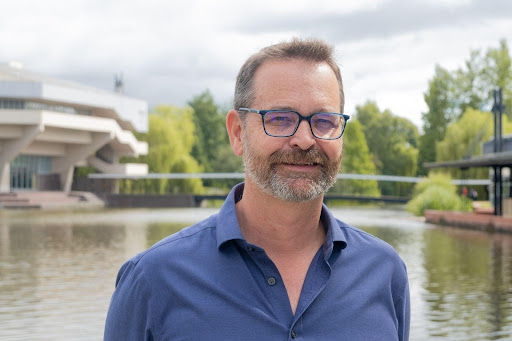
Professor David Jenkins, Head of the Nuclear Physics group, School of Physics Engineering and Technology
An unusual partnership
As one the largest and most active nuclear physics groups in the country, the University of York is leading a new consortium called PLANET (Physics-led Applications for Nuclear Technology). This is no ordinary partnership. York, the University of Edinburgh, and the University of Surrey bring expertise in nuclear physics whilst the University of Cambridge and University of Lancaster hold a wealth of research and training skills in nuclear engineering.
And why does this unusual structure matter? It’s a targeted pipeline to industry. By working together we can cover the full span from the very theoretical to the very practical aspects of nuclear science. And that means we’re able to train that next generation of students in a targeted way that will directly relate to what they will actually do in the real world. And those jobs are at the end of that pipeline needing to be filled.
The new pragmatism
People’s attitudes to working in nuclear research and its application to the defence industry have shifted a lot over the years. Things have got more real: with increasing threats to our energy security as well as our national security, there is a more pragmatic understanding about why this matters. We only need to look at Ukraine to see the necessity of defence capabilities and national security; and have an energy supply that is homegrown.
And it’s not just attitudes. Students are able to see the specific role they might play in national security, set by a government agenda that is addressing jobs and infrastructure as much as it is addressing defence and security.
Widening participation
It is unsurprising that the nuclear industry is very unrepresentative of our country. For example in some areas of this sector, women make up maybe 20% of the workforce at best.
Not only do we need to address that because it's the right thing to do for society, but with many nuclear sites requiring UK citizenship for security clearance, we can’t address a 40,000 people skills gap without recruiting from every corner of society. We need to be as broad in reach as we can be.
Solving industry problems
My career started in the ‘big science’ of international research, but now I find the application of that knowledge equally as interesting. I like problem-solving, whether it is a fundamental challenge or an industry problem that my previous self may have seen as perhaps a bit mundane.
But often, an industry problem which looks easy to solve is only easy because someone like me has spent 20 years doing the research. As we look toward 2030, I believe that the graduates of PLANET will be part of a new generation of nuclear talent who don’t see fundamental physics and national security as two different worlds but as one shared mission which is vital to our nuclear future. This is today’s ‘big science,’ and it’s a science that is securing our future.
About the author
Professor David Jenkins is Head of the Nuclear Physics group in the School of Physics Engineering and Technology at the University of York. It the largest in the UK, with flourishing research programmes in experimental nuclear physics, nuclear theory, nuclear astrophysics and hadron physics.
In 2023, he received the 2023 Institute of Physics Ernest Rutherford medal and prize for outstanding contributions to experimental nuclear physics, nuclear applications and widening participation in physics.
He currently leads Physics-led Applications for Nuclear Technology Programme (PLANET) – a Doctoral Focal Award delivered by UK Research and Innovation (UKRI) and match-funded by industry. This major £8m initiative is training at least 80 industry-ready nuclear scientists, and serves as a key part of a national drive to quadruple the number of nuclear specialists in the UK.