Study helps urban farmers create ‘light recipe’ to increase crop yield
Posted on Thursday 10 July 2025
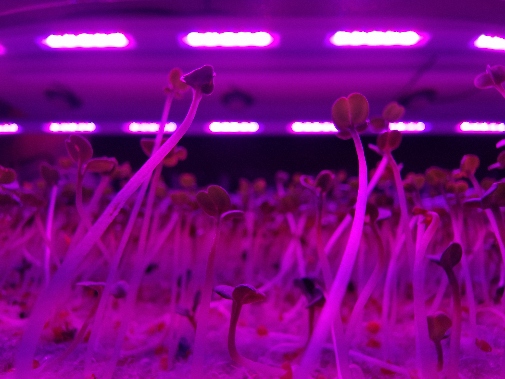
The study, conducted at Grow It York, an indoor urban community farm based in a shipping container at SPARK in the city, developed a mathematical model that could help inform urban farmers of how light varies in different areas of a confined space and how to use this information to design better lighting systems.
The team at the University of York and Vertically Urban (a UK-based horticultural lighting manufacturer), looked at how the plants in various parts of a contained farming facility might experience light. Plants near a wall, for example, could experience brighter light because light will bounce more in that area. They then investigated how these differences in light impacted crop growth of kale, radish and sunflower shoots.
Fresh fruit and veg
Dr Daphne Ezer, from the University of York’s Department of Biology, said: “More than six billion people will be living in urban centres by 2050, and there is a growing need to ensure that individuals living in these areas have access to fresh fruits and vegetables, especially as climate change threatens crop yields.
“One potential solution is having indoor urban farms that house dense shelves full of crops, also known as vertical farms. The lights in vertical farms can be highly controlled, enabling farmers to precisely design farming conditions to maximise yields.
“However, because of how many lights there are in a vertical farm, energy usage can be high, and many vertical farms do not have the experimental capacity to find the precise combination of lights that would improve their yields while reducing their carbon footprints.”
Highly controlled
The lights in vertical farms can be highly controlled, enabling farmers to precisely design farming conditions to maximise yields, but many vertical farms are small scale, fitted into compact urban spaces, and so taking ‘time-out’ to research different lighting practices to increase yield is not commercially viable.
Will Claydon, the lead researcher of the study, said: “These vertical farms might have a light recipe that is ‘good enough’, but it would be a risk to try new light treatments, because it could risk their commercial production.
“To tackle this problem we came up with a creative mathematical modelling strategy, and our key insight through this process is that even in a small vertical farm, there is a lot of variety in light colour and intensity in different parts of the farm.
“We were able to see which aspects of light quality are most important for each species of crop, and we hope this new understanding could help pave the way for other vertical farms to optimise the light treatments in their farms, with the benefit of not having to pause production.”
Grow It York
The researchers believe this new ‘light recipe’ model could mean that more vertical farms will be able to increase their yield and energy efficiency, enabling more fresh living greens to be produced in urban centres.
Grow It York, established in 2021, supplies hyper-local produce to the surrounding businesses and locals. The container farm grows salad crops such as pea shoots, watercress, microgreens and herbs, which can also be prepared and eaten fresh at the restaurants within Spark:York.
The research is published in Quantitative Plant Biology.