Ancient Rhino tooth helps push the boundaries of evolutionary research
Posted on Wednesday 9 July 2025
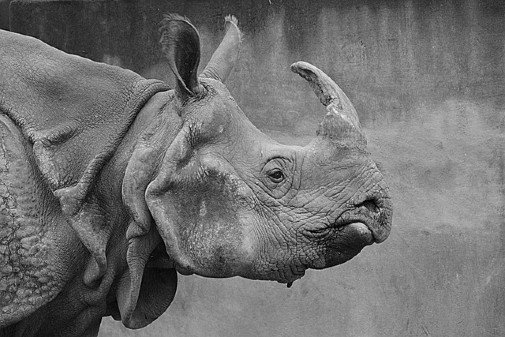
The recovered protein sequences allowed researchers to determine that this ancient rhino diverged from other rhinocerotids during the Middle Eocene-Oligocene epoch, around 41-25 million years ago.
The data also shed new light on the divergence between the two main subfamilies of rhinos, Elasmotheriinae and Rhinocerotinae, suggesting a more recent split in the Oligocene, around 34-22 million years ago, than shown previously through bone analysis.
The successful extraction and sequencing of ancient enamel proteins from a fossilized rhino tooth extends the timescale for recoverable, evolutionary-informative protein sequences by ten-fold compared to the oldest known ancient DNA.
Original
The team at York were involved in confirming that the proteins and amino acids were genuinely ancient. They analysed the rhino tooth, which was unearthed in Canada's High Arctic, using a technique known as chiral amino acid analysis to gain a clearer understanding of how the proteins within it had been preserved.
By measuring the extent of protein degradation and comparing it to previously analysed rhino material, they were able to confirm that the amino acids were original to the tooth and not the result of later contamination.
Dr Marc Dickinson, co-author and postdoctoral researcher at the University of York’s Department of Chemistry, said: “It is phenomenal that these tools are enabling us to explore further and further back in time. Building on our knowledge of ancient proteins, we can now start asking fascinating new questions about the evolution of ancient life on our planet.”
Endangered species
The rhino is of particular interest as it is now classified as an endangered species, and so understanding its deep-time evolutionary history, allows us to gain vital insights into how past environmental changes and extinctions shaped the diversity we see today.
To date, scientists have relied on the shape and structure of fossils or, more recently, ancient DNA (aDNA) to piece together the evolutionary history of long-extinct species. However, aDNA rarely survives beyond 1 million years, limiting its utility for understanding deep evolutionary past.
While ancient proteins have been found in fossils from the Middle-Late Miocene, - roughly the last 10 million years - obtaining sequences detailed enough for robust reconstructions of evolutionary relationships was previously limited to samples no older than four million years.
Vast timescales
The new study, published in the journal Nature, significantly expands that window, demonstrating the potential of proteins to persist over vast geological timescales under the right conditions.
Fazeelah Munir, who analysed the tooth as part of her doctoral research at the University of York’s Department of Chemistry, said: “Successful analysis of ancient proteins from such an old sample gives a fresh perspective to scientists around the globe who already have incredible fossils in their collections. This important fossil helps us to understand our ancient past.”
The fossil was in a region of Canada currently characterized by permafrost, and researchers say that dental enamel and the relatively cold environment the fossil was found in, played an important part in the long preservation of the proteins.
Game changer
Dental enamel provides a stable ‘scaffold’ that can protect ancient proteins from degradation over geological time. The hardness of enamel, which results from a complex structure of minerals, acts as a protective barrier, slowing down the breakdown of proteins that occurs after death.
Professor Enrico Cappellini, from Globe Institute, University of Copenhagen, said: "The Haughton Crater may be a truly special place for palaeontology: a biomolecular vault protecting proteins from decay over vast geological timescales.
“Its unique environmental history has created a site with exceptional preservation of ancient biomolecules, akin to how certain sites preserve soft tissues. This finding should encourage more paleontological fieldwork in regions around the world."
Ryan Sinclair Paterson, postdoctoral researcher at the Globe Institute, University of Copenhagen, and first author of the paper added: “This discovery is a game-changer for how we can study ancient life.”