Breakthrough in blood test for Alzheimer’s by University of York researchers
Posted on Thursday 9 October 2025
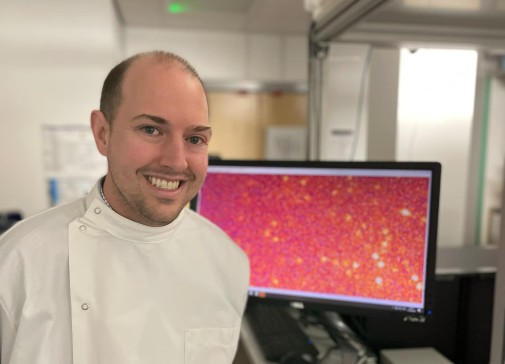
The results, detailed in the leading journal Optica, demonstrate that the team's light-based technology can successfully detect levels of the specific proteins that serve as indicators of Alzheimer's in the bloodstream.
Crucially, the new device can measure multiple “amyloid biomarkers” simultaneously, allowing for analysis of their ratios – a metric emerging as a highly accurate indicator of the disease.
The advance moves the project, which is being developed by University of York scientists, a crucial step closer to clinical trials.
Vastly amplified
The research team, an international collaboration between York, the University of Strathclyde and researchers in São Paulo, Brazil, has enhanced the device’s performance by redesigning the sensor at the nanoscopic level. Instead of a previous design involving parallel grooves, the new sensor uses a grid of “nanopillars”, which combined with gold nanoparticles, vastly amplifies the light-based signal used to detect the proteins.
Dr Steven Quinn from the University’s School of Physics, Engineering and Technology, who is leading the project with Professor Thomas Krauss and Dr Christina Wang, explained: “When you compare different technologies in photonics, you use a ‘figure of merit’, which is like a scorecard that takes into account key parameters like sensitivity and signal-to-noise ratio. Our new sensor’s scorecard outperforms competing technologies.
“We have pushed the boundaries of what is possible. This new design has allowed us to detect the amyloid biomarkers at the ultra-low, clinically relevant concentrations we need, which our previous sensor couldn't quite reach. The added bonus is that the technology remains scalable, mass-producible and we aim for it to be as simple to use as a Covid test.”
Game-changing potential
Current methods for diagnosing Alzheimer’s, such as brain scans (PET/MRI) or invasive lumbar punctures, are costly, time-consuming and not widely available. While new, highly accurate lab-based blood tests are emerging, they rely on large, expensive machinery, with a single test potentially costing thousands of pounds.
The York team's technology is being incorporated into a handheld device that could provide an indication of disease within seconds from a simple finger-prick of blood, at a projected cost of less than £100 per test. This could make early diagnosis far more accessible, enabling patients to access new treatments that are most effective in the early stages of the disease.
Dr Quinn added: “New Alzheimer's treatments work by specifically targeting the sticky amyloid proteins that build up in the brain. For these drugs to be effective, doctors first need to confirm that a patient has this protein build-up – a condition known as ‘amyloid positivity’. A simple, scalable blood test could be the way to facilitate widespread access to these emerging treatments. Our vision is a device that is user-friendly for clinicians and can be deployed in healthcare settings around the world.”
Next steps
The next major milestone for the project will be to validate the device using blood samples from patients with Alzheimer's and a healthy control group. This crucial phase will determine how effectively the test can differentiate between the two groups.
“The technology is not just limited to Alzheimer’s,” said Dr Quinn. “The same principles and protocols can be used to detect a protein called phosphorylated tau, another key Alzheimer’s biomarker, as well as alpha-synuclein in Parkinson’s disease. We believe this could become a platform technology to help differentiate between various forms of dementia, which is a major challenge for clinicians.
“While we still need to prove its effectiveness in patient samples, this technological advance is a vital piece of the puzzle and holds enormous promise as a cost-effective tool to open the door to widely available testing”