New research shows men and women of Roman Herculaneum had different diets
Posted on Wednesday 25 August 2021
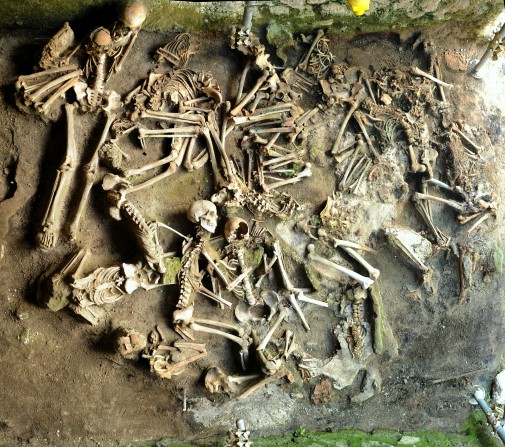
Researchers - led by the University of York’s BioArCh team - developed a new approach to analyse amino acids, the building blocks of proteins, from 17 adult skeletons found in the aftermath of the eruption of Vesuvius in 79 AD.
Lifestyles
By measuring the isotopes of carbon and nitrogen in the bone amino acids, the researchers were able to reconstruct the diets of people who lived contemporaneously in much more detail than was previously thought possible.
Senior author, Professor Oliver Craig, the Director of BioArCH from the Department of Archaeology, said: “The remains of those who perished at Herculaneum in AD79 offer a unique opportunity to examine the lifestyles across an ancient community who lived and died together. Historical sources often allude to differential access to foodstuffs across Roman society but rarely provide direct or quantitative information.
“We found significant differences in the proportions of marine and terrestrial foods consumed between males and females, implying that access to food was differentiated according to gender.”
Shelter
In total, 340 individuals have been excavated from the beach and from nine adjacent fornici (stone vaults) that run parallel to the seashore in Herculaneum, near Pompeii, where people sought shelter from the pyroclastic flow.
Researchers said they were able to quantify the gender gap more accurately within the group, with males on average obtaining approximately 50 per cent more of their dietary protein from seafood compared with females.
Males also obtained a slightly higher proportion of protein from cereals compared with their female contemporaries, whereas females obtained a greater proportion of protein from animal products and locally grown fruits and vegetables.
Fish
Lead author, PhD student Silvia Soncin, from the Department of Archaeology, said: “Our research builds on what we know that males had greater access to marine fish at Herculaneum and more broadly in Roman Italy.
“Males were more likely to be directly engaged in fishing and maritime activities, they generally occupied more privileged positions in society, and were freed from slavery at an earlier age providing greater access to expensive commodities, such as fresh fish.
Using their new approach, the researchers were able to more accurately quantify ancient diets so they could be compared with recent nutritional records. The team suggests that fish and seafood made a greater overall contribution to the diets at Herculaneum compared to the average modern Mediterranean diet; the latter increasingly dominated by animal products. Whereas a similar proportion of cereals were consumed between ancient and modern.