
Supporting the next generation of researchers in AI safety assurance
Posted on Thursday 8 October 2026
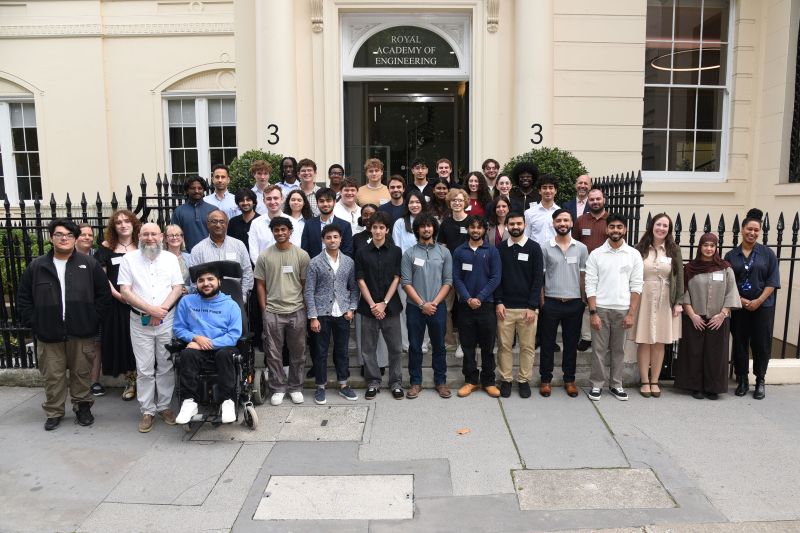
The eight-week programme brought together students from universities across the UK to work on an autonomous robotics challenge: developing a robotic system capable of identifying and sorting mixed waste in an initially unknown environment. The work explored applications in challenging environments such as nuclear decommissioning, where autonomous systems have the potential to reduce the need for people to undertake hazardous tasks.
As part of the programme, Dr Sepeedeh Shahbeigi and Dr Colin Paterson supervised Thamiliny Nanthanakumar and Muheto Niyonemera on the assurance aspects of the project. Our focus was on an important challenge in developing AI-enabled autonomous systems: how can we move beyond demonstrating that an AI component performs well and provide structured evidence that it is sufficiently safe and reliable for its intended role?
Working with the students, we explored how assurance can be integrated into the development of AI-enabled autonomous systems. This included considering potential hazards and safety requirements, evaluating the evidence generated through testing, and examining how this evidence could contribute to the wider safety assurance case for the robotic system.
The internship provided an opportunity to introduce emerging AI researchers to assurance as an integral part of developing autonomous systems, rather than something considered only after development is complete. It also gave us the opportunity to work with talented students as they explored how machine learning, robotics and safety assurance come together in practice.
Thamiliny’s experience
Thamiliny Nanthanakumar, a Computer Science student at Cardiff University, shared her experience of working on the project:
“During my internship, I worked on a nuclear decommissioning swarm robotics project, exploring how autonomous robots could safely identify and sort different categories of waste within an initially unknown environment.
“The robots were designed to autonomously explore and navigate their surroundings, identify waste using machine learning, and cluster similar waste objects. My main focus was developing and evaluating the machine-learning perception component that enables the robots to detect and recognise waste, as well as provide relevant information for navigation and clustering."
Thamiliny also explored the perception component's assurance using the AMLAS methodology:
“Alongside developing the component, I investigated how we could provide evidence that the machine-learning system operated safely and reliably by applying the Assurance of Machine Learning for use in Autonomous Systems (AMLAS) methodology.”
One of her key reflections from the internship was the importance of looking beyond machine-learning performance:
“One of the most valuable things I learned during the internship was that developing a machine-learning model with good performance is only one part of building a trustworthy autonomous system.
“Through the assurance work, I learned how potential hazards can be identified and translated into safety requirements, and how evidence from model testing, robustness evaluation and system-level testing can be used to demonstrate whether these requirements have been satisfied. This also helped me understand the importance of recognising and documenting limitations where the available evidence is not yet sufficient.”
Reflecting on what she achieved and what the experience meant for her future, Thamiliny said:
“By the end of the internship, I had developed and evaluated the perception model, tested its performance under different conditions, and contributed this evidence to the wider safety assurance case for the robotic system.
“Overall, the internship gave me valuable experience in bringing together machine learning, robotics and safety assurance, and has further encouraged my interest in working with intelligent and autonomous robotic systems in the future.”
Reflections from supervisor, Dr Sepeedeh Shahbeigi
For Dr Sepeedeh Shahbeigi, this was a second year supporting students through the Google DeepMind Research Ready Programme. Here, she reflects on returning to the programme and what she took away from this year’s experience:
“This was my second year supervising a student through the programme. Last year, the project focused on investigating robustness requirements for ML-based pedestrian detection. The intern developed an automated scenario-generation approach using CARLA, an automotive simulation platform, to systematically generate scenarios for evaluating the robustness of the perception system.
"Returning to the programme this year gave me the opportunity to explore assurance with students in a very different application. While last year we considered ML perception in an automotive setting, this year we looked at ML assurance as part of an autonomous robotic system for waste handling. The applications were different, but many of the fundamental assurance questions remained the same: What does the system require from its ML component to operate safely? How do we determine whether its performance is good enough for that context? And what evidence do we need to support that conclusion?
"One of the highlights for me was seeing the students begin to make these connections themselves. When working with machine learning, it is natural to focus initially on model performance. During the internship, we were able to broaden that perspective by connecting model development and evaluation to hazards, safety requirements, robustness testing and the evidence needed for the wider assurance case.
"One of my main takeaways from supporting the programme for a second year is the value of introducing assurance thinking early in a researcher’s or engineer’s career. Assurance encourages students to go beyond asking, ‘How can I make this model perform better?’ and also ask, ‘What does good enough mean for this system?’, ‘How do we know?’, and ‘What evidence supports that conclusion?’
"It has also been interesting to see how these principles transfer across applications. From pedestrian detection and automated scenario generation last year to autonomous robotics and waste handling this year, the technical problems have been quite different, but the need to systematically connect hazards, requirements, testing and evidence remains.”
Read more about the Google DeepMind project and the Royal Academy of Engineering