Reports made by staff about student conduct
Informal and formal options are included in all policies and procedures associated with protecting dignity at work and study and raising concerns.
Procedure for dealing with reports made by staff about student conduct relating to bullying, harassment, and hate incidents
Before raising a concern, staff may wish to explore options before deciding whether formal or informal action is appropriate.
Informal options
Both informal and formal options for resolution are outlined in the Non-Academic Misconduct Disciplinary Procedure.
When a report is made through Report and Support, initially the reporting staff member will be contacted by an appropriate adviser from the Conduct and Respect team to explore both informal and formal options for resolution.
The Conduct and Respect team will organise appropriate support, which may be provided by academic staff, professional support staff, or fire safety officers, as appropriate. Support for the reported person will also be provided.
Other sources of support are outlined on the University’s Report and Support web pages.
Formal options
Staff may feel that informal resolutions are not appropriate because of the nature or seriousness of the concern, or attempts at reaching an informal resolution may have been unsuccessful and they may wish to raise a concern formally.
Information on taking formal action is available within the University’s Non-Academic Misconduct Disciplinary Procedure. This procedure is governed by the University’s Regulation 7 which is the framework under which the University can investigate and respond to reports of student misconduct.
Support for taking formal action is provided by the University’s Conduct and Respect team. Other sources of support are outlined on the University’s Report and Support web pages.
Making a report
Report and Support is the appropriate route to raising a concern about student misconduct in all cases (see links below).
When a report is made through Report and Support, initially the reporting staff member will be contacted by an appropriate adviser to explore both informal and formal options for resolution. Advisers may be based within the Conduct and Respect team or College staff, as appropriate.
Unless there are overriding safeguarding concerns, this discussion will not be shared with others, and no action will be initiated without the consent of the reporting staff member. See Report and Support Confidentiality for further information.
If the reporting staff member decides to take the matter further, the Non-Academic Misconduct Disciplinary Procedure will be followed.
Anonymous reports can also be made through Report and Support. When anonymous reports are submitted, contact with the reporting person is not possible. If a reporting person selects the option to make an ‘anonymous’ report but then leaves information to identify themselves (ie full name or email address), this may then be treated as a report with contact details. Anonymous reporting will normally be used for monitoring trends, informing campaigns and resources, and proactive preventative work, but an anonymous report will not typically lead to a disciplinary investigation being launched. See section 5 of this policy for further information about anonymous reporting and what the information is used for. In some cases, a report may be initiated by someone other than the affected staff member themselves, for example, when someone has witnessed an incident, or when someone is very concerned about a situation they have been told about.
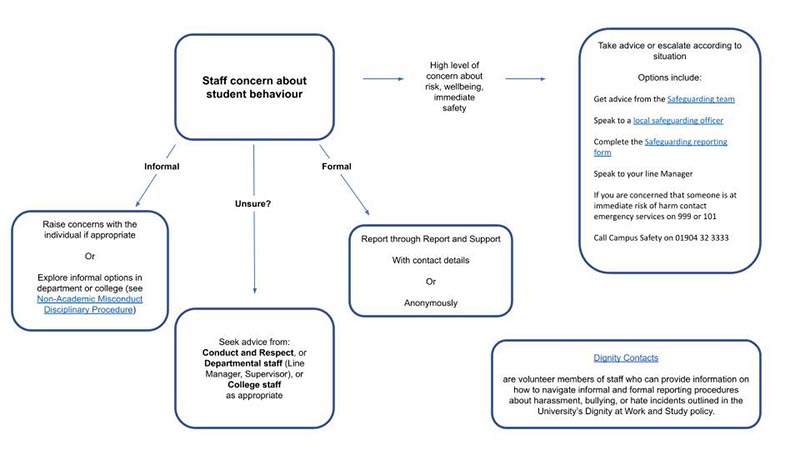
Procedure flowchart
We've put together this flowchart to illustrate the procedure described above: there's also a Google slide version available.