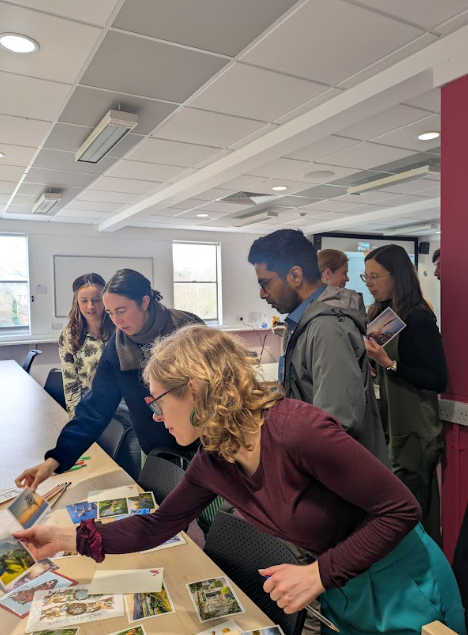
Arts-research collaborations from artists' perspectives
Posted on Thursday 16 April 2026
Authors: Judith Krauss (Resilient Socio-ecological systems co-theme lead) & Gina Allen & Tim Ralphs
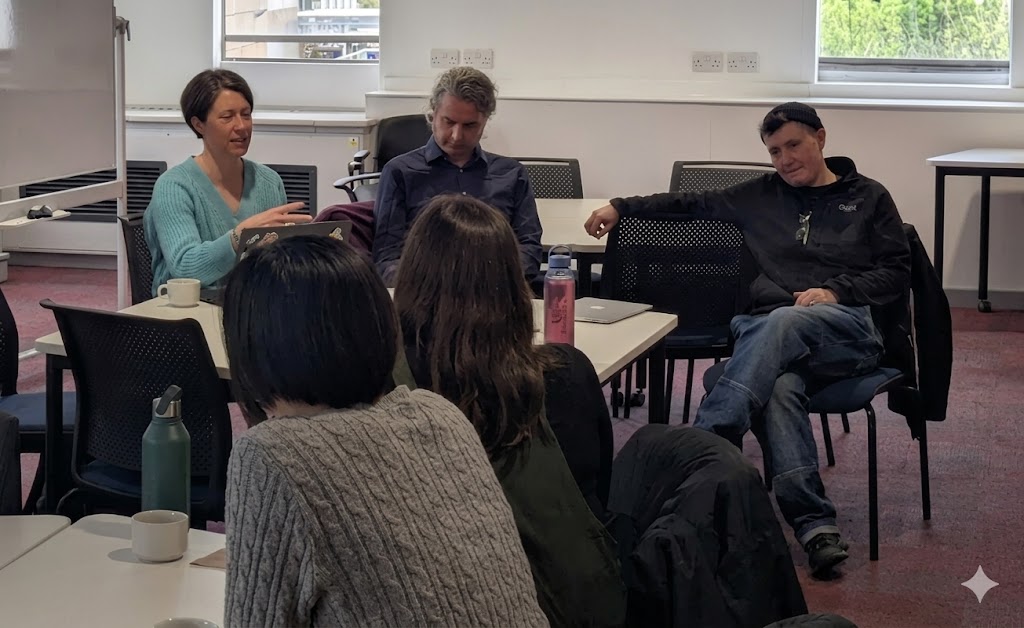
On 23 March 2026, YESI's recently launched Environmental Artivism network led by Felicia Liu and Catherine Love Smith, and the Resilient Socio-Ecological Systems theme invited three fabulous artists to campus to reflect on their arts-research collaborations in the sustainability and justice space, and share their top tips for researchers.
Storytelling and the power of narrative
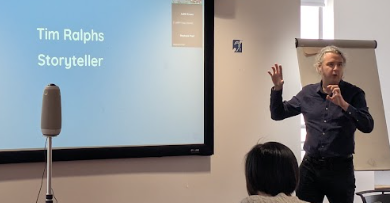
Tim Ralphs is a storyteller working with traditional material - folktales, myths and legends - adapting them for live, spontaneous performance. Tim might be asked to put together an 'evening of Viking stories' for a museum with a Scandinavia-themed exhibition, or to create something that rhymes for the children to enjoy while the parents queue for food at a village fete?
As a performer, he has made pieces to accompany academic research, such as at Hidden Perspectives 2013
when his “Jonathan and David” was premiered alongside lectures from The University of Sheffield’s Bible Studies Department as part of a wider festival.
Tim has a deep and ongoing fascination with how the same techniques that can be used to craft and perform fairytales or myth can be applied by academics to share their research with non-specialists, and he has delivered numerous projects to help researchers tell their stories. It has become clear from these storytelling training courses that this can help researchers to think about how to engage their audiences, and ditch jargon.
Researchers have fed back that this training has revolutionised how they teach, communicate with stakeholders, navigate tension, or share their findings (cf Tales from the Ivory Tower, Spotlight Leeds:Research Journeys, and Tales from the Global South). Moreover, the process of sharing their story reconnected them with why they were enthusiastic about their research. Fundamentally, Tim has found that working with artists is really good for researchers, to support and nourish them.
Audio production and the importance of trust
Kitty Turner is a freelance audio producer and musician who works with organizations in Higher Education, third sector and beyond to make podcasts and soundscapes, conveying complex ideas through sound. Some examples of Kitty's recent works are producing a podcast for a collaboration between Counterpoints, Art Reach and The Eden Project (themes of displacement, racial and climate justice), several podcasts and sound pieces for 'Many Happy Returns - Enabling Reusable Packaging Systems', video & audio production for Liquid Landscape Heritage and Urban Water Scarcities in Kathmandu, and podcast production for IGDC.
In these projects, Kitty has found that planning, and being involved early in the project, is important to shape successful outcomes. What is most conducive is having a lot of trust and creative control, and space to contribute one's own research to a project, for example finding out for a project around flying less that the Earth hums in C sharp, which then informed the music used for the exhibition audio.
Working closely with committed researchers, making genuine connections, finding what researchers are really interested in is finding a pot of gold. Conversely, a lack of communication – things can change, but please can we keep talking to each other – and a lack of clarity on responsibilities especially among co-sponsoring consortia (e.g. universities and arts organisations) can make life more difficult.
Equally, being involved early in the project can avoid unnecessary challenges, e.g. being consulted on what equipment would be best used for recording can avoid a lot of thankless sound restoration. For freelancers, avoiding unpaid labour is very important, as is abiding by deadlines as most artists will be working on multiple projects at the same time.
Visualising data through an environmental lens
Gina Allen started out with an MRes in Environmental Science, and has combined it with a passion for visual art leading to a focus on creating visual explorations of quantitative and qualitative data. Examples of her work include different styles of collaborations, always with the aim of creating the space for viewers to consider their own emotional and subjective responses to the theme. A project on air pollution involved creating portrait images using dirt collected from wheels and exhausts of cars bringing forward the human health impacts, exhibited alongside work by atmospheric chemistry and engineering researchers highlighted impacts of alongside research approaches to air pollution. Another project was a collaboration with a multidisciplinary, multi-year project on plastic use. The scale of the project offered huge opportunity for creative work, and close collaboration to focus in on areas to be communicated in the creative output was vital. A final example was the Can we Fly Less? project, which tried to bring forward the human implications and emotional responses to debates about flying and flying less. The collaboration proved a really good way of creating space to think together about how to encourage reflection through effective communication. Overall, her objective is using art to understand the human, the subjective and the emotional responses to research and data, and she is hoping to take forward and use arts-based practice as a means of research.
The artists’ top tips for successful research-arts collaborations
In terms of top tips, Tim asked collaborators to please remember that you are working with freelancers – this means that, unlike often salaried researchers, they will not be paid for initial conversations or grant development. This is important to bear in mind both in immediate interaction and in University systems, as being paid can take a lot of forms and a long time. A related point is being as specific as you can be on what you want from artists as early as possible – to save freelancers from wasting unpaid time, but also to advance the project.
As additional tips, Kitty stressed the importance of planning - a very good podcast very rarely results from two people just turning up and Kitty providing the microphones; rather, it's about connection, communication, trust and preparation, setting expectations for all involved, including for listeners. The most natural sounding conversations on podcasts are actually the most thought out and planned. Another point is to please bear in mind quotes don’t apply indefinitely. Costs of artists’ time and materials change – and as money conversations can be hard, it is really appreciated if researchers themselves check whether rates from earlier quotes have changed. Finally, clarity on communication, responsibility, including narrative and editorial responsibility, is vital.
Establishing clear communication and boundaries
Finally, Gina's top tips were having a clear sense of what you want to communicate, why, for whom and where. For example, where something will be displayed informs what will be made - something made for a gallery space might not readily translate online. Relatedly, please don’t expect it to communicate everything.
You’re inviting people to engage with your work, so for the creative aspect to afford viewers the space to respond emotionally from their own subjectivities, a springboard is needed - text gives the viewer the context and understanding to be able to contemplate or respond to the creative works. The materials or visuals used can communicate other dimensions not in the text, such as transience.
Beware that there can be pressure to limit supporting text – for example, gallery and online spaces don’t like a lot of text. Be prepared to find the balance so that your audience has enough information to engage, but doesn’t get lost in text.
Themes emerging from the Q&A
The artists and researchers in attendance discussed first the importance of addressing the question of intellectual property and copyright early on - as long as these questions are proactively discussed, solutions can usually be found.
On funding, we commiserated on how much rejection applying for grants involves – if we bought a potted plant for every rejection, we'd be living in a jungle! We discussed the importance of adapting proposals to funding calls and compromising in the process, and finding patchworks of funding, e.g. having some element paid for by a research project, some by a centre, and exploring for example artrabbit or other crowdfunding platforms.
In terms of starting conversations with artists, if you can tell them who the audience is, what you want to communicate, and why, that is already a very positive start. By contrast, if someone sends seven papers to read, and then ultimately decides 'I cannot pay you and this is not what I had in mind', this will be very counterproductive for all involved. An architect suggested a good practice from their field – having a questionnaire to work through together, bringing some visual or other aids to make the conversation more concrete, and being clear that there will be only e.g. three meetings, with the first one free.
Poetry from the planet
In sum, this was a very joyous and enlightening conversation – thank you so much again, and please watch this space for what the network and theme will get up to in future!
P.S: To get the creative juices going, we asked our wonderful attendees to develop nature-inspired haikus (5 syllables, 7 syllables, 5 syllables) – and what results, many thanks! (Full credit for the idea of haikus goes to Prof Pen Holland from Biology, co-convenor of the YESI Play for the Planet Network).
Participant Haikus
The common dolphin
Does not care for your deadlines
She knows they are lies
Mountain mist gathers
Dawn breaks on the horizon
Bright new day begins
At the allotment
Light glows through petals yellow
Whispers of the spring
As light grows stronger
The trees redress in reverie
And hearts rejoice
Brightly coloured beak
Blue rimmed scanning beady eye
Flashing feathers fly
All pictures courtesy of Felicia Liu.