Skip to content Accessibility statement

MA Literature in the Creative and Cultural Industries

Explore the place of literature in the creative industries through a unique combination of research and practice.

Year of entry: 2027 (September)
Show year of entry: 2026/27

Start date
September 2027
View semester dates
Length
1 year full-time,
2 years part-time

Apply for this course

Why study English at York?

Connect literary topics the study of the creative industries. You’ll explore fundamental links between the two disciplines in a core modules, then put theory into practice through a diverse range of option modules.

Gain practical skills in writing and letterpress printing. We’re home to Thin Ice Press, the Department’s very own print studio. You can develop your own portfolio of work to enhance your understand of creative practices. 

Make use of a range of libraries and archives on campus and beyond. You’ll have direct access to a rich variety of poetry and audiovisual collections, as well as the Humanities Research collections. The city of York also has amazing museums, libraries and archives that cover a wide range of periods.

Develop your passion for literature beyond your course. Our Writers at York series brings contemporary writers to the Department for readings and workshops, and a wide range of student societies cater to literary interests. PrintSoc, the University’s Print and Press Society, hosts talks and workshops in collaboration with Thin Ice Press.

A top ten research department according to the Times Higher Education’s ranking of the latest REF results (2021).
for English Language & Literature in the QS World University Rankings by Subject, 2026
As well as your department's facilities, you'll have access to the Grade II listed Heslington Hall, a hub with space for events and collaboration.

The Department of English and Related Literature offers world-class research and a vibrant academic community. I wanted to be part of it.

Nana, English and Related Literature MA student. Watch Nana's vlog.

Course content

You'll be encouraged to devise a distinctive path through the full range of our Masters options, and relevant modules in other departments, to reflect your individual passions, curiosities and research ambitions. Modules are assessed by a research essay or practical research project, and students' developing research skills are then brought to bear on a substantial dissertation relating to the field.

In addition to the course-specific module, Critical Approaches to the Creative Industries, core modules will cover valuable research, writing and presentation skills. Topics may include using library and online research resources, use of archives, academic writing and careers guidance. You'll select from a wide range of option modules including relevant modules from the MA Management in the Creative and Cultural Industries course.

You'll study 180 credits in total.

Modules

Core modules

Option modules

You will also study three option modules. Examples can be found below. Some option module combinations may not be possible. The options available to you will be confirmed after you begin your course.

Our modules may change to reflect the latest academic thinking and expertise of our staff, and in line with Department/School academic planning.

Dissertation

Your dissertation offers you the chance to examine a topic in depth and to develop your research skills. You'll work on a 12,000-14,000-word dissertation with regular supervision from a member of staff. The dissertation on this programme can also incorporate a practical project, which might take the form of a publishing project, community-based activity, or practice-based portfolio.

You'll submit your dissertation at the end of your course.

Learning outcomes

Every course at York is built on a distinctive set of learning outcomes. These will give you a clear understanding of what you will be able to accomplish at the end of the course and help you explain what you can offer employers. Our academics identify the knowledge, skills, and experiences you'll need upon graduation and then design the course to get you there.

Learning outcomes for this course
  • Analyse significant cultural and creative texts and concepts closely and critically, interpreting them with reference to the social, political, economic, aesthetic and/or industry contexts in which they were produced, reproduced, and received.
  • Synthesise information from a range of critical sources in a sophisticated and mature fashion, carefully evaluating and selecting material to make for controlled, informed, convincing and creative argumentation.
  • Evaluate and contribute to scholarly debates around literary modernism, and around the legacies of modernism in twentieth-century and contemporary literature and culture.
  • Initiate, conduct, and take responsibility for independent research, drawing on skills honed by graduate-level research training, research-led teaching, and the completion of a substantial dissertation project.
  • Communicate sophisticated written arguments in a clear, accurate and persuasive fashion, synthesising evidence from multiple sources so as to convey information creatively and convincingly.
  • Engage in verbal discussion of complex material, demonstrating versatility, rigour, and confidence in the reception, appreciation, and articulation of high-level ideas and perspectives.
  • Direct their own development, bringing new knowledge and skills to bear upon a range of contexts which may include (but is not limited to) doctoral study in English literature and related fields.

Fees and funding

Annual tuition fees

Study mode UK (home) International and EU
Full-time (1 year) £12,420 £27,840
Part-time (2 years) £6,210 £13,920

Fees are for year one. Fees for future years are subject to confirmation.

Fees information

UK (home) or international fees? The level of fee that you will be asked to pay depends on whether you're classed as a UK (home) or international student. Check your fee status.

Find out more information about tuition fees and how to pay them.

Additional costs

You'll need copies of the texts set for each module. Where possible, we will provide digital access. We'll let you know which texts and editions you'll need to buy (whether new or second-hand) before the start of each semester.

Funding information

Discover your funding options to help with tuition fees and living costs.

We'll confirm more funding opportunities for students joining us in 2027/28 throughout the year.

If you've successfully completed an undergraduate degree at York you could be eligible for a 10% Masters fee discount.

Funding opportunities

Chevening Scholarships

We are pleased to work with Chevening Scholars to offer funding for our Masters programmes. Chevening Scholarships provide one year of fully-funded postgraduate study in the UK for international (including EU) students. The scholarships are open to early and mid-career professionals who have the potential to become future leaders.

Teaching and assessment

You’ll work with world‐leading academics who’ll challenge you to think independently and excel in all that you do. Our approach to teaching will provide you with the knowledge, opportunities, and support you need to grow and succeed in a global workplace.

Teaching format

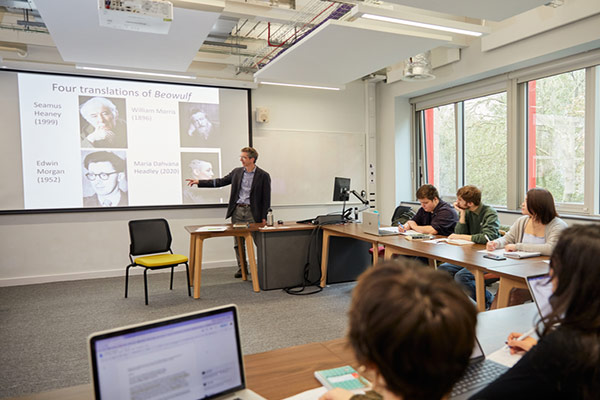
You'll normally attend two 2-hour seminars each week. If you are a part-time student you'll attend one 2-hour seminar a week.

Seminar groups consist of fewer than 16 students in most modules, though some core modules may involve a larger number of students. You'll complete essential reading for each seminar, and we encourage you to read more widely around the topic.

You'll attend a series of training lectures and workshops, designed to address presenting your work, writing at MA level, transferable skills, and career development.

Over the course of the year, you'll have the opportunity to attend research seminars and conferences hosted by the Department. You can also attend events organised through the Humanities Research Centre, a stimulating community unique to York.

Facilities

You can make use of our dedicated study spaces, including the F.R. Leavis Room and the Writing lab, to work, collaborate and socialise in.

York's library contains a rich variety of resources available to you. This includes, but is not limited to:

  • Poetry Society collection
  • Music and audiovisual collections
  • Humanities Research collections

The city of York also boasts rich, scholarly resources in a student-friendly and contemporary environment. You can immerse yourself in a range of public libraries and archives around the city and region.

Explore more facilities

Teaching location

You will be based in the Department of English and Related Literature on Campus West. Most of your contact hours will be in locations nearby on Campus West, including the Department's letterpress studio, Thin Ice Press.

About our campus

Our beautiful green campus offers a student-friendly setting in which to live and study, within easy reach of the action in the city centre. It's easy to get around campus - everything is within walking or pedalling distance, or you can always use the fast and frequent bus service.

Assessment and feedback

For some modules you will submit essays of 3,500-4,000 words. For others, you may have practical projects, which might include print or publishing projects or practice-based portfolios. The Postgraduate Life in Practice module will be assessed on the completion of a series of tasks connected to your core work for the MA. Your final assessment is a dissertation of 12,000-14,000 words.


Careers and skills

There’s a wide variety of possible career paths open to you after completing this MA, both across industry and academia. You'll develop skills that are useful in any industry.

Career opportunities

Career opportunities are likely to include a variety of roles within:

  • the arts sector
  • the creative industries
  • publishers
  • other literary organisations

Transferable skills

You'll develop a range of transferable skills including:

  • independent working
  • time management
  • efficient organisation
  • critical reasoning
  • effective argumentation
  • verbal communication

Entry requirements

Qualification Typical offer
Undergraduate degree 2:2 or equivalent.
Other international qualifications Equivalent qualifications from your country

English language

If English isn't your first language you may need to provide evidence of your English language ability. We accept the following qualifications:

Qualification Minimum requirement
IELTS (Academic and Indicator) 6.5, minimum 6.0 in each component
Cambridge CEFR B2 First: 176, with 169 in each component
Oxford ELLT 7, minimum of 6 in each component
Oxford Test of English Advanced 136, minimum 126 in each component
Duolingo 120, minimum 105 in all other components
LanguageCert SELT B2 with 33/50 in each component
LanguageCert Academic 70 with a minimum of 65 in each component
Kaplan Test of English Language 478-509, with 444-477 in all other components
Skills for English B2: Merit overall, with Pass with Merit in each component
PTE Academic 60 with 52 in Listening, 53 in Reading, 65 in Speaking, and 59 in Writing
TOEFL 4.5, with 5 in Listening and 4.5 in each other component
Trinity ISE III Merit in all requirements

For more information see our postgraduate English language requirements.

If you haven't met our English language requirements

You may be eligible for one of our pre-sessional English language courses. These courses will provide you with the level of English needed to meet the conditions of your offer.

The length of course you need to take depends on your current English language test scores and how much you need to improve to reach our English language requirements.

After you've accepted your offer to study at York, we'll confirm which pre-sessional course you should apply to via You@York.

Discover York

We offer a range of campus accommodation to suit you and your budget, from economy to premium.
Explore campus and city life and hear what our current students have to say about living here.
Lively, full of culture and beautiful, York is regularly voted one of the best places to live and visit in the UK.
Find out more about York. Chat to staff and students and take the tour, on campus or online.