
Faculty Champions Announcement
The Faculty Champions, enthusiastic and experienced academics, will help to drive the University’s commitment to meaningful involvement and collaboration with the public across all research activities over the next four years.
Through championing, encouraging and amplifying public involvement and participatory research practices, activities and successes in their Faculties, they will contribute to ensuring that research is relevant, accountable, and impactful for the public and communities.
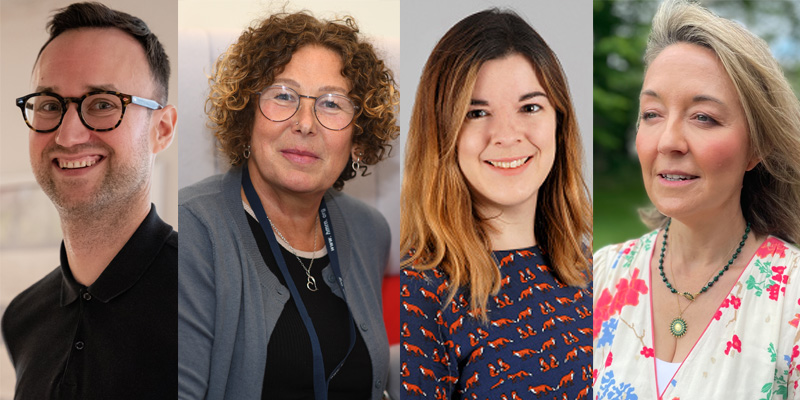
Meet the Champions
In the Faculty of Arts and Humanities: Dr Harald Fredheim, Lecturer in Museum Studies, Department of Archaeology.
My research is focused on participatory practices in the heritage sector and I’m interested in methods from focus groups and paper-prototyping through digital participation and crowdsourcing. I’m really keen to work with the other Champions to promote learning within and across the faculties, especially around methods, ethics and researcher wellbeing in facilitating participatory research, and am looking forward to learning about the work colleagues are doing already - and would like to do in the future!
For the Faculty of Sciences: Professor Debra Howell, Deputy Director of the Epidemiology and Cancer Statistics Group (ECSG), Department of Health Sciences and Dr Hannah Hobson, Senior Lecturer, Department of Psychology.
Debra: I’m a qualitative researcher and Patient & Public Involvement (PPI) lead, working within a large ongoing cohort study that currently contains around 55,000 patients with blood cancer. From a PPI perspective, I have worked alongside patients, caregivers and the public for almost two decades, and have learned plenty, as well as making a few mistakes along the way. I oversee the cohort’s Patient Partnership and run a local support group for patients and families. I’m keen to share my successes and failures, and provide advice, to promote meaningful PPI within research.
Hannah: My own research is on the links between language, communication and mental health. Over the last decade, it’s been inspiring to see more research priorities setting exercises with neurodivergent groups, increasing numbers of publications co-produced with neurodivergent authors, and more discussions between colleagues about how to do accessible and meaningful consultation. While challenging, these projects are rewarding and I believe highly motivating for researchers who want their research to make an impact outside academia. I’m looking forward to getting stuck in and am ready to learn a lot along the way.
In the Faculty of Social Sciences: Professor Lindsay Hamilton, Chair in Animal Organisation Studies, School for Business and Society.
My research is largely ethnographic in nature, and I have been particularly interested in the interactions between humans and other animals as well as experimenting with multi-species methods. Since 2013, I have seen this branch of the social sciences really take off to reveal how people work with, relate to and care for other species (or how they may also avoid or distance themselves in order to engage in different practices such as food production, pest control or tourism). I have been inspired to test collaborative and co-productive social science methods such as ‘cultural animation’ and arts-based approaches, which carry the potential to reveal polyvocal insights into social relations and meaning-making practices.
Public Involvement (PI) is often described as research being carried out ‘with’ or ‘by’ members of the public rather than ‘to’, ‘about’ or ‘for’ them. It is researchers working with the public to make decisions about research. Participatory Research (PR) aims to maximise the participation of people whose life or work is the subject of the research as equal partners with influence in decision-making and shaping the research.
Find out more about Involvement@York, or take a look at our Resource Library.