New tech could change the nature of live music shows, study shows
Posted on Thursday 25 June 2026
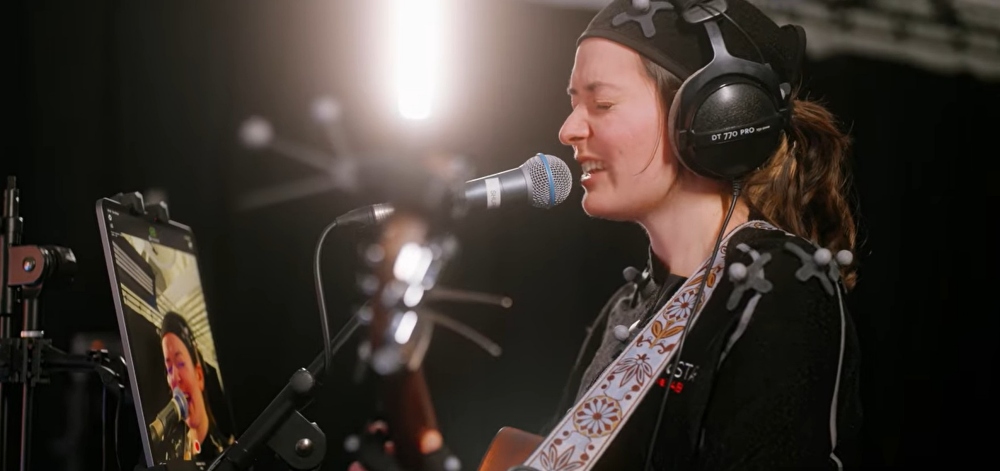
Independent Yorkshire-based singer-songwriter Marnie Glum and experts from the University of York’s CoSTAR Live Lab AudioLab, XR Stories and CoSTAR Live Lab trialled a new way of performing that challenges the definition of a ‘live band performance.’
The experiment saw the artist perform seamlessly with her band - even though they were physically separated across the City of York - with representations of the band being produced within a virtual recreation of London's famous BBC Maida Vale Studios.
The audience for the live concert, however, was based in West Yorkshire at the CoSTAR Live Lab studio.
By using hyper-fast connections, the musicians were able to play in perfect harmony without being in the same room, and to an audience in a different county. The trial proves that a band no longer needs to be in the same physical location to capture the energy of a live gig.
To bring the separated musicians together, the team used live motion-tracking to represent them as digital avatars in a shared virtual world.
Professor Gavin Kearney, Co-Director of CoSTAR Live Lab, said: “Using avatars solves a significant practical problem to virtual live performance. Motion data uses far less internet bandwidth than streaming high-definition video, which cuts down the lag that usually ruins online performances, allowing the band to play in perfect sync.
“It can also allow artists to be highly creative in how they convey themselves and their music to audiences, by creating fictional worlds or characters, which we have seen in the past with bands such as Gorillaz.”
Real time
Unlike the virtual concerts of ABBA Voyage, where the digital performances are pre-recorded and heavily polished in advance, everything in this experiment, including the instruments, was rendered entirely in real time.
Jacob Cooper, Technical Specialist in Immersive Audio, CoSTAR Live Lab, said: “The live element was crucial for us, because we know having experienced new technologies during the pandemic, that human connection was something that people missed about working remotely.
“In this trial the band members were in different locations, but could see each other represented in the virtual space via screens, and they could actually see, hear, and interact with the live audience.”
Wireless tech
Because the University of York's wired network spans the whole city, scientists were able to separate the musicians physically, but the next step is developing wireless technology that will allow musicians to play together in real time from entirely different continents.
Professor Kearney said: "Imagine a live concert of your favourite artists where every member of the audience can shape their own unique experience. You'll have the ability to engage with every aspect of a show wherever you are, whether you're right there in the arena or sitting in the comfort of your own living room."
Further information
Watch how the team put the performance together in this short film.
We’re inviting ambitious UK-based creatives to apply for up to £50k cash and 20 days of R&D time at CoSTAR Live Lab, Production Park via our latest round of Prototypes & Pilots funding.
Find out more and apply for CoSTAR Live Lab’s Intelligent Venues funding call here.