Ancient societies ‘far more democratic than assumed’, study suggests
Posted on Wednesday 18 March 2026
Researchers from the University of York, Field Museum, Chicago, and a consortium of universities brought together by the Coalition for Archaeological Synthesis, analysed archaeological and historical evidence from 31 societies across Asia, the Americas and Europe.
It is often assumed that democratic practices started in Greece and Rome, but the new research shows that many societies around the world developed ways to limit the power of rulers and give ordinary people a voice.
Dr Adam Green, from the University of York’s Department of Archaeology, said: “Our study challenges the traditional view that democracy emerged primarily in classical societies such as Athens and Rome.
“We found that governance should instead be understood by how concentrated power is, and how inclusive political participation is, and this gives us a much broader picture, and one that is further back in time than we might have thought to look for signs of democracy.”
Absolute power
While elections are often associated with democracy, the study suggests that they are not a reliable indicator on their own. Some leaders who assumed absolute power over a community have historically come to power through elections, the researchers say.
The team examined 40 case studies spanning thousands of years. In many cases, written records were limited or absent, so researchers relied heavily on archaeological evidence.
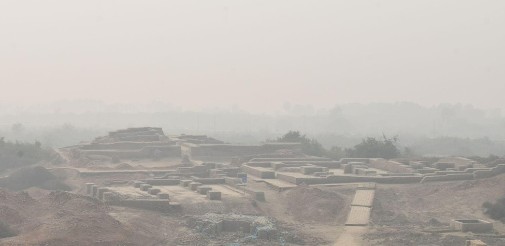
At sites such as Mohenjo-daro in South Asia, which flourished around 2600 BC as part of the Indus civilisation, archaeologists have identified advanced urban planning but little evidence of kings or elite dominance.
Instead, large communal buildings suggest that governance may have involved collective decision-making, challenging the long-held assumption that early cities were always ruled by powerful elites.
Mohenjo-daro
Dr Green said: “These early cities were expansive and prosperous, with civic amenities like private bathing platforms and well-planned streets which were maintained for centuries. And yet, there is no evidence for an all-powerful ruling class.
“What we see in cities like Mohenjo-daro in Pakistan for example, is large public structures, like the Pillared Hall, where hundreds of people could have assembled to make collective decisions on important issues. In the study, we find similar kinds of structures at Teotihuacan and Monte Albán in Mexico."
By contrast, cities built around centralised power - such as those where all roads lead to a ruler’s residence or monumental structures emphasising elite authority - were more likely to reflect autocratic systems.
Larger-than-life
Artwork and burial practices also offered insights. Monumental tombs and depictions of rulers as larger-than-life figures pointed to concentrated authority, while their absence suggested more distributed power.
Gary Feinman, the MacArthur Curator of Mesoamerican and Central American Anthropology at the Field Museum’s Negaunee Integrative Research Center, led the study, bringing together archaeologists with expertise on societies from across the globe.
He said: “When you find urban areas with broad, open spaces, or when you see public buildings that have wide spaces where people can get together and exchange information, those societies tend to be more democratic.”
Financing power
One of the study’s most significant findings is that population size or political scale did not determine whether a society became autocratic. Instead, the way leaders financed their rule played a crucial role.
Societies reliant on concentrated sources of wealth, such as control of trade routes, mining, or war spoils, were more likely to develop autocratic systems. Those funded through broader taxation or shared labour tended to distribute power more widely.
The study, published in the journal Science, also showed that more inclusive systems were generally associated with lower levels of economic inequality.
Modern threats
Researchers say understanding how past societies balanced power could offer valuable lessons for identifying and responding to modern threats to democratic systems.
Gary Feinman, said: “These findings challenge the idea that autocracy and great inequality are natural or inevitable outcomes of complexity or growth. History shows that people across the world have created inclusive political systems, even under difficult conditions.”