York’s geothermal drilling rig travelling at a speed of knots towards UK
Posted on Tuesday 1 September 2026
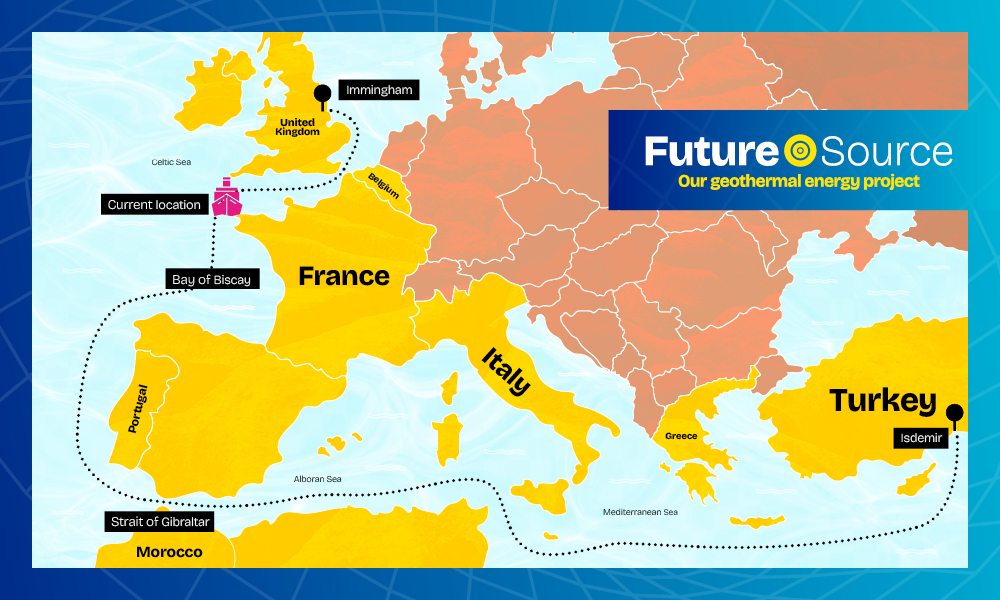
A cargo ship carrying the drilling rig, called BBC Bangkok, set sail from Isdemir in Turkey and cruised through the Mediterranean Sea at 11 knots. The vessel is charted a course through the Strait of Gibraltar, up the Atlantic coast and across the Bay of Biscay. It is scheduled to dock at the port of Immingham in North East Lincolnshire in early September 2026.
Workplace teams will offload the modern Drillmec swing-lift electric rig, known as Rig 65, into a holding area at the port before it’s moved to a specialist yard for final preparation work. Early next year, crews will deliver the 2,000 horsepower rig, which has a hoisting capacity of up to 500 tonnes, to University Campus East where it will be assembled before drilling begins.
The rig will remain onsite for a year while it works to sink a well four kilometres into the Earth, a depth equivalent to stacking 12 Eiffel Towers underground.
Pioneering
The landmark project, named FutureSource, will tap into natural geothermal streams beneath the city, aiming to cut the fossil fuel consumption of the University. It will serve as a pioneering active site for geoscience research, training and a proof of concept for clean energy innovation across both the region and the wider UK.
Specialist partner Marriott Drilling Group will lead the work, with drilling scheduled to start in 2027. A noise monitoring system will be put in place and there are comprehensive plans to minimise any noise disturbance. Minor ground vibration will be very localised and unlikely to be noticed outside the site boundary.
Living laboratory
Paul Bushnell, the University’s geothermal project director, said: “This is an incredible piece of engineering making its way to York. This project will transform how we power our campus. It will act as a living laboratory that will spur pioneering research, equip our students with future skills and aims to deliver real environmental benefits for our region.”
Jonti Hobday, Director of Marriott Drilling Group said: “Marriott Drilling is proud to be the delivery partner for this flagship UK deep geothermal project. As a UK company with 79 years of global experience, we are pleased to bring our international expertise home to support the project’s success and demonstrate geothermal energy’s role in the energy transition.”
Preparations for this flagship project of national significance are already underway on campus, after the University was granted planning permission in April 2026. Detailed FAQs about our geothermal energy project are available online.