Killer whale mums pay high price for raising sons
Posted on Wednesday 8 February 2023
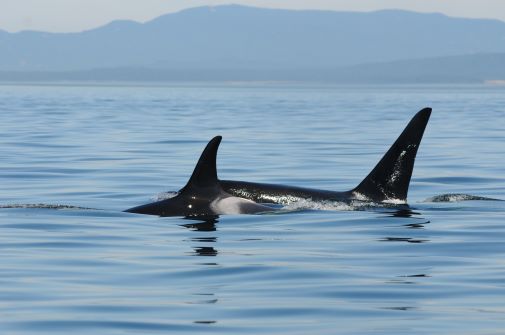
The University of York were part of a research team that carried out a study on killer whales and their breeding patterns comparing their support to male and female calves.
Killer whale mothers are known to provide more support to sons than daughters, especially after daughters reach adulthood, and the findings confirmed that this support comes at a considerable cost to the mothers.
Future
Researchers from the Universities of York, Exeter and Cambridge collaborated with the Centre for Whale Research (CWR) on the study, which found that each male calf reduced a mother’s likelihood of successful further breeding (a calf surviving to one year old) by about half.
Professor Dan Franks, from the Departments of Biology and Computer Science, said: "This strategy of indefinitely sacrificing future reproduction to keep their sons alive may have been beneficial in their evolutionary past, but it now potentially threatens the future viability of the southern resident killer whale population, which is critically endangered with just 73 individuals remaining."
The study, funded by the Natural Environment Research Council (UK) and National Marine Fisheries Service (US), on 40 females in the “southern resident” killer whale population, which live off the Pacific coast of North America.
Strategy
Both male and female resident killer whales stay in the group they were born into, and each group is led by an experienced female. The southern resident killer whales are fish-eating whales and feed predominantly on salmon. Mothers commonly bite salmon in two, eating half and giving half to their sons.
They also feed their young daughters, but once the daughters reach reproductive age this tends to stop – whereas they continue to feed their sons into adulthood.
The strategy discovered by this study – in which mothers indefinitely sacrifice their future reproduction to keep their sons alive – is highly unusual in nature and may even be unique.
Survival
Dr Michael Weiss, Centre for Research in Animal Behaviour at the University of Exeter, said: “Our previous research has shown that sons have a higher chance of survival if their mother is around. In this study, we wanted to find out if this help comes at a price.
“The answer is yes – killer whale mothers pay a high cost in terms of their future reproduction to keep their sons alive.”