University of York researcher named among Nation’s Lifesavers
Posted on Thursday 16 May 2019
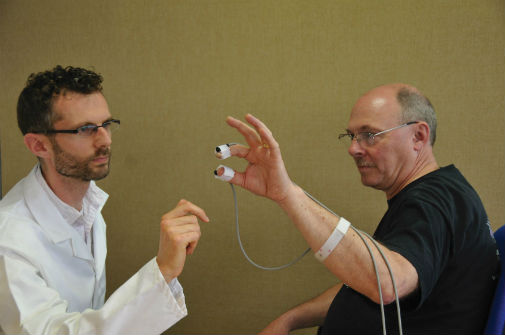
Professor Stephen Smith, from the Department of Electronic Engineering, is developing medical devices to accurately measure the progression of Parkinson’s, as well as the side effects of medication for its treatment.
Professor Smith and his research group have been placed on a list of the top 100 University researchers whose work is saving lives and making a life-changing difference to our health and wellbeing.
The list was compiled by Universities UK, the umbrella group for UK universities, as part of the MadeAtUni campaign to change public perceptions of universities and bring to life the difference they make to people and communities across the UK.
Tracking movement
Professor Smith and collaborators from Leeds General Infirmary and Heriot Watt University have developed the LID-Monitor and PD-Monitor, which have the potential to greatly improve the quality of data medical staff can access when prescribing medication or assessing the progression of Parkinson’s.
The LID-Monitor consists of six small devices, worn by the subject in their own home for a 24-hour period. The sensors track their movements continuously throughout the day, after which the data is uploaded for analysis and subsequently used in the management of their medication. The monitor reduces the need for a visit to hospital, which can be difficult for those living with Parkinson’s.
The PD-Monitor uses a simple finger tapping task, which is a standard test for people to take when clinicians are assessing the progress of the condition. The monitor gives medical staff highly accurate, consistent readings, and is being trailed in hospitals across the UK and medical centres worldwide. PD-Monitor is also being used in a nationwide clinical trial (led by Dr Camille Caroll, University of Plymouth) to assess the effectiveness of statins in slowing the progress of Parkinson's.
Quality of life
Professor Smith said: “The technology we have developed has huge implications for early diagnosis of Parkinson’s. The devices allow us to detect previously imperceptible differences in movement which are key indicators in diagnosing which neurological condition people may have.
“The devices can also ensure that, once diagnosed, individuals get the correct medication, helping to improve their quality of life and reducing hospital admissions and costs.”
Universities from across the country were invited to nominate an individual or group who has made a significant contribution to the nation’s health and wellbeing.
Professor Dame Janet Beer, President Universities UK, said: “When people think of lifesavers they tend to focus on the dedication and skill of our doctors, nurses, carers, and paramedics – many of whom are trained at universities. Every day, up and down the country, universities are also working on innovations to transform and save lives. Research taking place in universities is finding solutions to so many of the health and wellbeing issues we care about and the causes that matter.
Revolutionising care
“By proudly working in partnership with charities, the NHS and healthcare organisations, universities are responsible for some of our biggest health breakthroughs and in revolutionising the delivery of care.
“This campaign is a chance to bring to life the wonderful and often unexpected work going on every day in our universities and to celebrate some of the people working to make a life-changing difference to the nation.”
Research shows the public are proud of UK universities but have little understanding of the benefits they bring, with most not being aware that UK academics are behind many of the discoveries that save lives and keep us healthy. The MadeAtUni campaign gives the public an insight into some of this work and celebrates those who made it happen. More information on the campaign can be found on the dedicated website: www.madeatuni.org.uk .