Catch me if you can: Study reveals disguises are surprisingly effective
Posted on Monday 18 February 2019
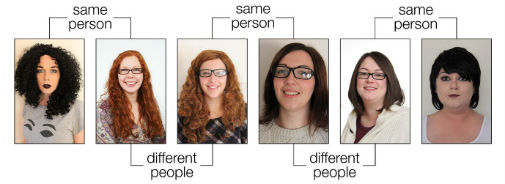
In the study, led by researchers at the universities of York and Huddersfield, participants were often fooled by disguises when asked to judge whether two photographs showed the same or different people.
Disguises reduced the ability of participants to match faces by around 30%, even when they were warned that some of the people had changed the way they look.
Participants were only able to see through disguises reliably when they knew the people in the images.
Security settings
Co-author of the study, Dr Rob Jenkins from the Department of Psychology at the University of York, said: “We shouldn’t be complacent about deliberate disguise in criminal and security settings. When someone puts their mind to concealing their identity, it can be very effective.
“Familiarity with the people who are disguising themselves improves accuracy. When you are unfamiliar with a face you are easily fooled by superficial changes in hairstyle or colouration.
“However, when you ‘know’ a face you tend to rely more on internal facial features - the eyes, nose and mouth - which are much harder to alter.”
The models recruited for the study were given plenty of time and resources with which to change their appearance. Many used make-up, changed their hair colour and style, and some grew or got rid of facial hair.
To ensure maximum effort, a financial incentive was introduced with a prize for the model whose disguise fooled the most participants.
Props like hats or dark glasses were not allowed as they are prohibited in real-life security settings.
Criminal suspects
The researchers also compared the effectiveness of two different methods of disguise.
Impersonation disguise - or trying to look like someone else - is sometimes used by people attempting to travel using a stolen passport or in cases of identity theft. Evasion disguise – trying not to look like yourself - might be used in witness protection programmes or by undercover police, as well as by criminal suspects on the run from the law.
The study found that evasion disguise is much more effective than impersonation disguise.
Dr Eilidh Noyes, from the University of Hudderfield, added: “With evasion disguise, you can change your appearance in any way you like. With impersonation, you can only change your appearance in ways that resemble your target, so your options are much more constrained.
“Deliberate disguise poses a real challenge to human face recognition. The next step is to test automatic face recognition on the same tasks.”