The nocturnal pollinators: scientists reveal the secret life of moths
Posted on Wednesday 12 September 2018
 (John Bebbington) 505.jpg)
Elephant Hawkmoth with Greater Butterfly Orchid pollen on its eyes. Image credit: John Bebbington
A joint study from the Universities of York, Newcastle and Hull suggests moths have an important but overlooked ecological role – dispensing pollen over large distances under the cover of darkness.
The team of scientists, working with collaborators from Butterfly Conservation and the Centre for Ecology & Hydrology, observed moths at a farm in East Yorkshire, using a new method of pollen detection called DNA metabarcoding to identify the different types of pollen they carried.
New insight
The study revealed that moths supplement the day-time work of bees and other pollinating insects, suggesting that plants with the capacity to be pollinated by both moths and bees may be at an advantage.
Lead author Dr Callum Macgregor, from the University of York’s Department of Biology, said: “Using cutting-edge techniques to distinguish between different pollen types allowed us to gain new insight into the species of plants which are important nectar resources for moths – and therefore might benefit from pollination after dark.
“Over half of the plant species we detected were not previously known to be visited by moths. It was particularly interesting that moths were carrying pollen from many of the same plant species that are visited by bees, hoverflies and butterflies.”
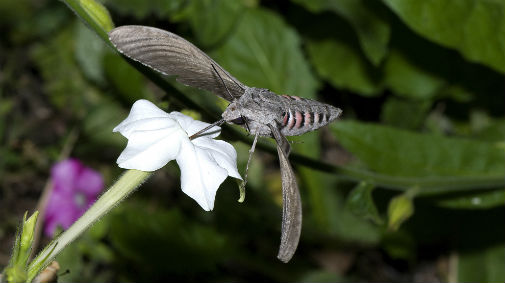
Hawkmoth feeds on a flower. Image credit: Keith Baldie, Butterfly Conservation
Agricultural crops
Pollen grains from crops such as peas, soybean and oil-seed rape were detected on multiple moths, despite a lack of previous evidence to suggest that moths are beneficial to farmers.
Dr Macgregor added: “Our study highlights the fact that we need to think seriously about the benefits of moths to plants and agricultural systems. While bees are excellent pollinators, they will only travel within the local environment of the nest.
“Moths appear to complement the work of bees and can carry pollen over greater distances as they don’t have the same ties to a particular part of the landscape. Potentially, this might help to prevent inbreeding among plants.”
Prolific pollinators
The new approach revealed 35% of all the moths captured were carrying pollen and moths from the Noctuidae family were found to be the most prolific pollinators.
The researchers also detected pollen from popular garden plants like privet and Verbena. Many gardeners choose nectar-rich flowers to help declining populations of bees and butterflies, and these results suggest that moths are also likely to benefit.
Project supervisor Dr Darren Evans, from Newcastle University’s School of Natural and Environmental Sciences, said: “Using new methods to analyse pollen enabled us to learn much more about our undervalued nocturnal ecosystems.
“The results demonstrate for the first time that moths could even pollinate some agricultural crops. This highlights a need for more research into the role of moths as ecosystem service providers.”