When chemistry gets personal
Posted on Monday 30 April 2018
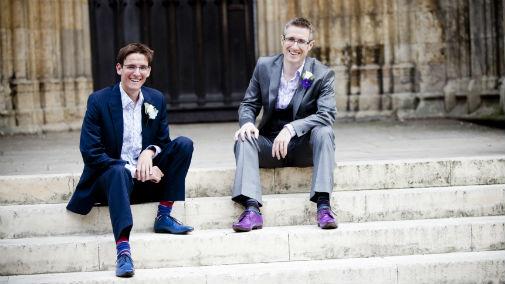
Sam (left) and David
In 2005, Professor Dave Smith switched the focus of his research to gene therapy treatments after meeting his husband Sam who has cystic fibrosis. Sam had to have a lung transplant in 2011.
Sadly, many patients die waiting for a transplant, and even after a successful operation, the new organ can be rejected by the patient’s immune system.
Stem cells
Now Professor Smith, from the Department of Chemistry, is researching ways to encourage the growth and differentiation of stem cells - a development which could lead to patient stem cells being used to grow organs on demand without the problems of transplant rejection.
Cystic fibrosis is a genetic disease and Professor Smith became interested in gene therapy treatments in which a healthy copy of the gene would be carried into a patient’s cells. This process requires a carrier system, which Professor Smith proposed would be self-assembled from simple molecules – a chemical solution to the problem.
After Sam’s successful transplant and inspired by the need to solve these problems, Professor Smith decided to develop smart, self-assembled materials to support and encourage the growth and differentiation of stem cells. In principle, a patient’s stem cells could then be used to grow their own organs on demand, with no problems of rejection.
This fundamental research, funded by the Engineering and Physical Sciences Research Council (EPSRC), is at an early stage in Professor Smith’s labs.
Solutions
In all of his research, Professor Smith has used his fundamental toolkit of chemical self-assembly to generate solutions to biological problems. In the process, he has developed a number of new concepts. One of them, self-assembled multivalency (SAMul), he has named after his husband Sam.
Professor Smith said: "As scientists, we rarely talk about the personal. After all, the underpinning philosophy of science is that whoever performs the studies, the results will be the same.
“However, the decision to let the ‘personal’ influence my direction of academic travel is one that I will never regret."